
Operations-focused team building consulting diagnoses why execution breaks down on the floor, then fixes it with a prioritized 60-day plan and hands-on implementation support, not workshops or trust exercises. The result owner-operators and operations leaders should expect: measurable gains in cycle time, error rates, and reclaimed labor hours within 90 days, and a team that runs the new process without a consultant standing over it.
TL;DR:
- Most operational issues are visible months before margin compression occurs, making early diagnosis crucial for effective intervention.
- A 60-day, phased engagement with clear deliverables can significantly improve cycle times, error rates, and labor efficiency within three months.
- Successful projects rely on measurable baseline metrics, such as cycle time and error rates, with documented progress within 90 days to justify continued investment.
- Consultants with proven implementation records, clear ROI methodology, and strong change management skills are the best fit for driving lasting operational improvements.
- Quick initial steps like capturing key metrics, auditing meetings, and assigning ownership to 60-day priorities can jump-start execution in the first month.
Table of Contents
- When Should You Hire an Operations-Focused Team Building Consultant?
- What a Team Building Consulting Engagement Actually Looks Like
- What ROI Should You Actually Demand?
- How to Choose the Right Consultant (and Spot the Wrong One)
- Common Frameworks Behind Operations-Focused Team Building
- Customizing the Approach by Company Size and Culture
- What Successful Engagements Look Like in Practice
- Why TKD Consulting Fits This Job
- Three Moves to Get Execution Moving in 30 Days
- Sources
When Should You Hire an Operations-Focused Team Building Consultant?
Most leaders wait too long. By the time margin compression shows up on a P&L, the underlying execution problem has usually been visible on the floor for months. Six signals should move a consulting conversation from "someday" to "this quarter":
- Margins are shrinking while revenue grows. Check gross margin trend against revenue trend over the last four quarters.
- Customer complaints rise even as headcount increases. Track error or rework rate as a percentage of total units or jobs.
- Meetings eat the calendar and decisions still stall. Measure the percentage of a manager's week spent in meetings versus doing the work.
- You're about to automate or invest capital. Confirm someone has mapped the process you're about to spend money on.
- **SOPs exist but nobody follows them. Compare documented process steps against what actually happens on a Tuesday afternoon.
- Leadership can't agree on where the bottleneck actually is. That disagreement itself is the diagnostic.
BCG's research on transformation programs found that 70% of organizational transformations fail to meet their objectives, and the common thread is planning without hands-on execution. A quick, low-cost check before you hire anyone: pull last quarter's rework tickets, time three team leads' meeting load for one week, and ask five frontline employees to describe the SOP for their own job. The gaps you find there are usually the gaps a consultant would find, just three weeks slower and at a day rate.
What a Team Building Consulting Engagement Actually Looks Like
A structured operations engagement runs in phases with specific outputs at each stage, not a single audit followed by a slide deck. Operations consulting engagements typically run 4 to 12 weeks, broken into discovery, diagnosis, design, pilot, and handover.
- Discovery (weeks 1 to 2). The consultant interviews leadership and frontline staff, pulls baseline data, and maps the process end to end.
- Diagnosis (weeks 3 to 4). Root causes get isolated and ranked by impact and cost to fix, not just by volume of complaints.
- Design and pilot (weeks 5 to 10). New workflows, scorecards, and meeting cadences get built and tested on a limited scope, often a single team or product line.
- Handover (weeks 11 to 12). Documentation, dashboards, and a trained internal owner take over, with a review cadence set for 30, 60, and 90 days.
Insist on five deliverables regardless of who runs the engagement: a current-state process map, a prioritized 60-day action plan, working scorecards tied to real metrics, a defined meeting cadence with clear decision rights, and pilot results with before-and-after numbers. A reliable handoff plan means named owners, simple dashboards, one trained operator, and a scheduled review, not a consultant who quietly becomes permanent overhead.
Pricing tends to fall into recognizable bands. Diagnostic-only engagements often run in the lower thousands. Full project-based engagements with implementation support commonly range widely depending on scope and company size. If the problem is chronic rather than a one-time fix, a retained fractional COO arrangement or interim operations leadership often costs less than a full-time executive hire while delivering the same ongoing judgment. TKD Consulting's 60-day execution framework follows this same phased structure, with governance built in rather than bolted on afterward.
What ROI Should You Actually Demand?
Ask any consultant to show you the math before you sign, not after the invoice arrives. The baseline metrics worth collecting before an engagement starts:
- Process cycle time (how long a task takes from start to finish)
- Error or rework rate per unit or per job
- Employee productive time versus time lost to rework, meetings, or waiting on approvals
- Working capital tied up in inventory, receivables, or work in progress
- Cost of error or rework per unit produced
Sourced benchmarks give you something to hold a consultant to. Mid-market operations engagements commonly report working capital reductions of 15 to 30%, cycle-time reductions of 25 to 40%, and 15 to 25% of employee capacity reclaimed. Those ranges aren't guarantees, but they're a reasonable floor for negotiating what "success" means in a contract.
The ROI math itself is simple. Take the annualized value of the productivity and cost gains, divide by the consulting fee, and you should land somewhere in the 5 to 10x return within 12 to 18 months range that industry benchmarks support. For a 90-day yardstick, require a documented baseline, a pilot with before-and-after numbers, and at least one metric moving in the right direction. If none of that exists by day 90, the engagement isn't working, no matter how good the diagnostic deck looked in week two.
How to Choose the Right Consultant (and Spot the Wrong One)
Five criteria separate consultants who deliver execution from consultants who deliver PowerPoint. Ask direct questions in the sales conversation, before scoping anything.
- Implementation record. Ask for a specific example where the consultant stayed through the pilot phase, not just the diagnostic.
- A measurable ROI methodology. Ask them to walk through a baseline-to-target calculation for a past client, even anonymized.
- A hands-on delivery plan. Ask what they personally do in weeks 5 through 10, not just weeks 1 through 2.
- Change-management capability. Ask how they get frontline buy-in when a new process replaces a familiar one.
- Technology fluency. Ask how they'd evaluate whether a process problem needs a workflow fix or an automation, since narrow, high-impact pilots often outperform full system overhauls for mid-market firms.
Watch for red flags during that same conversation. A consultant who can't name a baseline metric they'd track in week one is selling advisory work, not implementation. Vague deliverables ("we'll improve alignment") without a number attached mean there's nothing to hold them accountable to later. Dependency creation, where every dashboard and process only the consultant understands, is a business risk disguised as a service. And if they can't tell you their exit plan before the engagement starts, they don't have one.
A firm confident in its own methodology will take that deal; one that's selling a diagnostic and hoping for the best usually won't.*
Common Frameworks Behind Operations-Focused Team Building
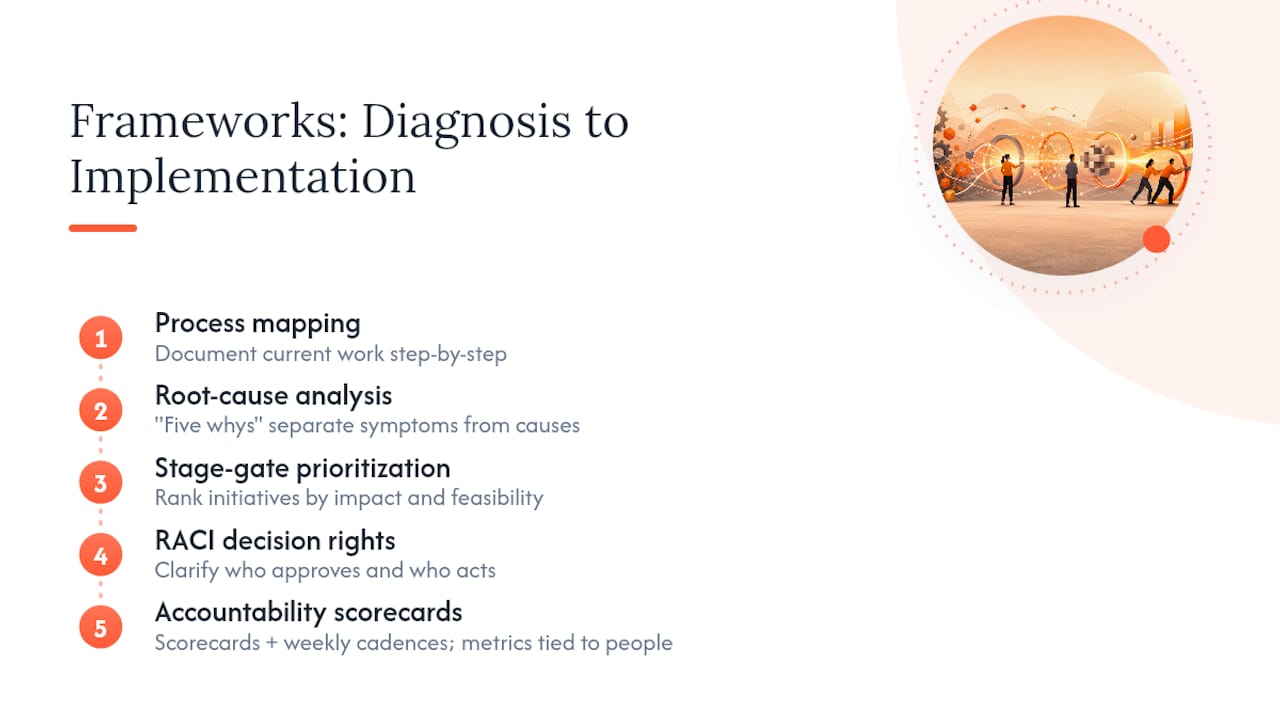
Most credible operations consultants pull from a small set of proven frameworks rather than inventing a new methodology for every client. Process mapping, borrowed from lean manufacturing, documents the current state of work step by step so root causes surface instead of staying buried in anecdotes. Stage-gate prioritization, a structure BCG and McKinsey both recommend for mid-market transformations, forces leadership to rank initiatives by impact and feasibility instead of tackling everything at once.
Accountability frameworks, built around scorecards and weekly cadences, replace vague ownership with named metrics tied to named people. This is where a lot of internal improvement efforts quietly die: everyone agrees something should change, but no single person owns the number. RACI matrices (who's Responsible, Accountable, Consulted, and Informed) solve a related problem, clarifying decision rights so approvals stop bouncing between three people who each think someone else has final say.
Root-cause analysis techniques, including the "five whys" method, get used during diagnosis to separate symptoms from causes. A rising error rate might look like a training problem on the surface and turn out to be a supplier issue or a broken handoff between shifts three steps earlier. None of these frameworks are exotic. What separates a firm that delivers results from one that doesn't is whether they actually implement the framework on the floor or just present it in a workshop and leave.
Customizing the Approach by Company Size and Culture
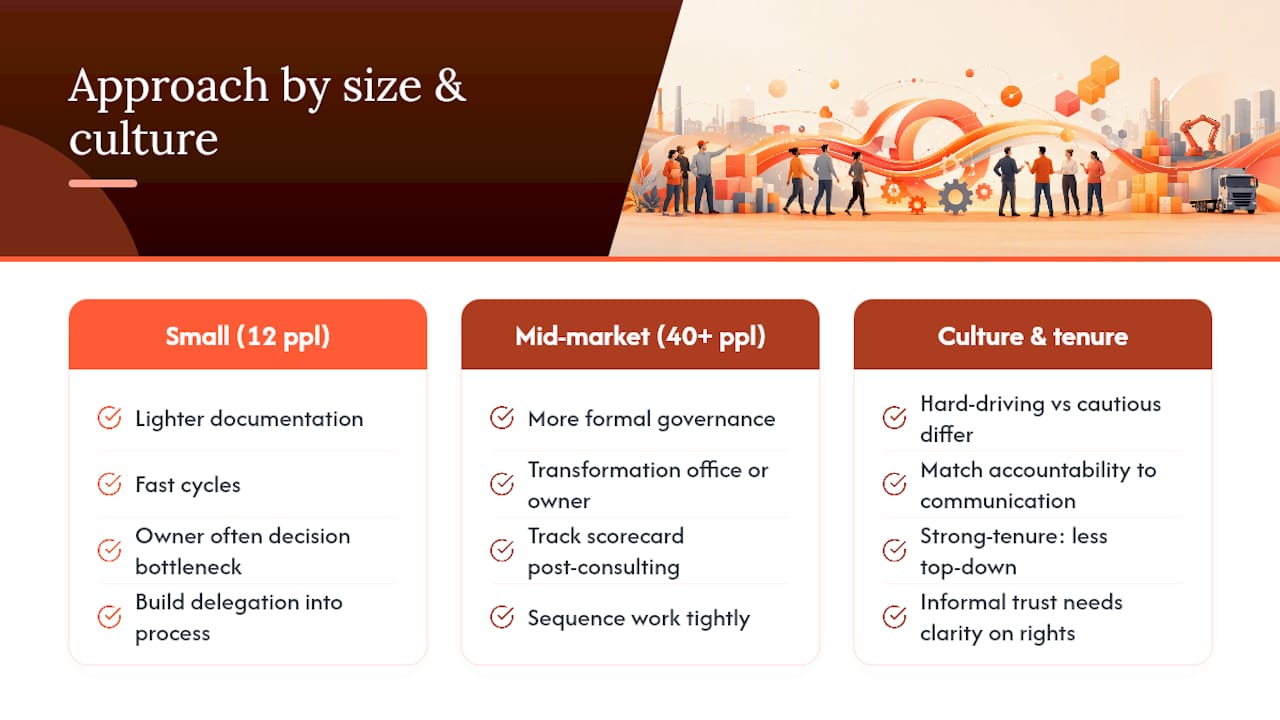
A 12-person industrial shop and a 40-person SaaS operations team need the same discipline applied very differently. Smaller, owner-operated businesses usually need lighter documentation and faster cycles. The owner is often still the bottleneck for decisions, so the plan has to build delegation into the process itself, not just fix the workflow around the owner.
Larger mid-market companies, especially those with multiple locations or shifts, need more formal governance: a transformation office or a designated internal owner who tracks the scorecard after the consultant leaves. Winners at this size tend to sequence work tightly, prioritizing a small number of initiatives and piloting before scaling company-wide.
Culture matters as much as size. A hard-driving sales floor and a cautious engineering team will not respond to the same accountability structure the same way. A leader's guide to strategy that sticks has to account for how a specific team actually communicates, not how a generic playbook assumes they should. Firms with strong tenure and informal trust networks often need less top-down enforcement and more clarity on decision rights. Newer or rapidly scaled teams usually need the opposite: more structure, written process, and a slower rollout so the new system has time to become habit before the next hire arrives.
What Successful Engagements Look Like in Practice
The diagnostic typically finds the same pattern: order accuracy is fine, but pick-to-ship cycle time has crept up as volume grew, because nobody redesigned the warehouse layout or shift handoff process to match the new order volume. A 60-day pilot on one shift, with a redesigned handoff and a simple scorecard tracking cycle time, often shows measurable improvement before the full rollout even starts.
A B2B services firm with SOPs that exist only in a shared drive is another common pattern. Employees improvise because the documented process doesn't match reality anymore. The fix isn't more documentation. It's rebuilding the SOP with the people who actually do the work, then building a short weekly cadence where deviations get caught and corrected instead of accumulating for a year.
A SaaS operations team drowning in approval chains shows up constantly. Every ticket needs sign-off from three people who are each waiting on someone else. Mapping decision rights and cutting the approval chain from four steps to two is often the single highest-leverage fix a consultant can make in the first 30 days, and it costs nothing to implement once the map exists.
Why TKD Consulting Fits This Job
The Operations Audit is a structured, time-boxed diagnostic built specifically for the pattern above: a company with a real strategy that isn't translating into what happens on the floor. The audit maps people, process, and performance systems against stated goals, then hands over a prioritized 60-day action plan, not a slide deck that sits in a shared drive.
Success gets measured the way this article has argued it should be: a documented baseline, checkpoints at 90 days, and a 12 to 18 month ROI goal built into the engagement from day one. Clients walk away with process maps, working scorecards, a defined meeting cadence, and a trained internal owner, the same handover discipline that keeps gains from evaporating once the engagement ends. For companies facing a longer gap between strategy and execution, the Strategy Execution Gap service extends that support into a retained or fractional arrangement.
If margin is compressing, SOPs aren't being followed, or leadership can't agree on the bottleneck, the next step is a paid discovery call. Come with one quarter of financials, a rough sense of your biggest process complaint, and fifteen minutes on the calendar. Start with the Operations Audit page to see what the diagnostic covers and book the first conversation.
Three Moves to Get Execution Moving in 30 Days
Most owners don't need a twelve-page plan to start. They need three specific moves in the first month.
First, capture one or two baseline metrics this week, even rough ones. Cycle time and error rate are usually the fastest to pull and the most revealing.
Second, run a 48-hour meeting audit across your leadership team. Log every meeting, who attended, and what decision actually got made. Most leaders are stunned by how many meetings produced no decision at all.
Third, pick one 60-day priority and put your own name on it as sponsor, not a delegate's. A distribution client once cut order-processing errors nearly in half in six weeks by doing exactly this: one metric, one owner, one weekly quarter-hour review. Nothing else changed. That's usually all it takes to prove the model works before scaling it further.
Client case studies and additional engagement results will be added here as new projects complete.
— David
Sources
- How to create a transformation that lasts — BCG
- Operations Consultant: What They Do and Cost — ConsultingDemand