
Project management consulting is an external, practitioner-led service that helps organizations deliver strategic initiatives on time and on budget by supplying senior delivery leadership, PMO capability, or short-term program rescue. Clients typically hire for one of four outcomes: getting a stalled project moving again, building a repeatable PMO from scratch, rescuing a troubled rollout, or training internal teams to run projects without outside help. Firms like TKD Consulting focus on the last two, pairing diagnosis with an execution plan the team can run alone.
TL;DR:
- Most project management consultants focus on building internal capabilities or rescuing troubled initiatives, with outcomes that last beyond the engagement.
- Certification such as PMP and relevant industry experience, especially in operational roles, are critical for delivering measurable results.
- Pricing usually involves day rates, fixed-scope sprints, T&M contracts, or monthly retainers, with costs rising in complex or regulated industries.
- When selecting a firm, ask for specific past results, sample deliverables, and clear success metrics upfront to avoid vague proposals and ineffective handoffs.
- TKD Consulting emphasizes execution with a 60-day action plan, scorecards, and capability transfer to ensure sustainable improvements in operations.
Table of Contents
- Core Services and Deliverables in Project Management Consulting
- Who Hires PM Consultants, and When?
- Roles, Skills, and Certifications That Actually Matter
- What Do Project Management Consultants Cost?
- How to Evaluate and Choose a Project Management Consultant
- TKD Consulting: The Operations Audit and How Execution-First Consulting Works
- Next Steps for Buyers and Consultants
- Execution-First Rules That Separate Successful Engagements
- Get a Practical Read on Where Your Operations Actually Stand
- Sources
Core Services and Deliverables in Project Management Consulting
Most project management consulting engagements fall into a handful of recognizable buckets, even though the branding varies from firm to firm. Large practices like Deloitte package this work as program management consulting, covering everything from PMaaS to full program rescue, while boutique firms tend to specialize in one or two of these lanes and go deep.
- Project or program delivery leadership — a consultant runs the initiative directly, reporting to an executive sponsor.
- PMO setup and optimization — building governance, intake processes, and reporting cadence, often delivered as fractional or on-demand PMaaS.
- Project rescue and recovery — stepping into a stalled or over-budget initiative to diagnose root cause and reset scope.
- Training and capability transfer — coaching internal staff on scorecards, meeting rhythms, and governance artifacts so the client doesn't need a consultant indefinitely.
The deliverables that matter most, in practice, are the ones that survive after the consultant leaves. A prioritized action plan is worth more than a strategy deck nobody opens.
Who Hires PM Consultants, and When?
The typical buyer isn't a Fortune 500 company with an internal PMO already humming. It's an owner-operator or mid-market leadership team that's outgrown informal project tracking but hasn't built formal delivery infrastructure yet.
- Owner-operated and mid-market companies where leadership is stretched across too many priorities.
- SaaS and B2B services firms scaling past their original operating model.
- Private equity-backed portfolio companies under pressure to hit integration or growth milestones fast.
Common triggers include a stalled initiative that's been "almost done" for two quarters, an M&A integration nobody has bandwidth to run, a software rollout that's gone sideways, or simply a capacity gap where the team has ideas but no one to execute them. A short diagnostic (days to a few weeks) fits urgent, narrow problems; a multi-month transformation fits organizational rebuilds where process, people, and systems all need to change together.
Roles, Skills, and Certifications That Actually Matter
Titles in this field range from individual project leads to PMO leads to fractional PMO directors who oversee a whole portfolio part time. Seniority tracks roughly with scope: a project lead runs one initiative, a PMO lead builds and governs the system multiple projects run through.
The skills that separate consultants who deliver from those who just facilitate meetings are consistent across engagements:
- Stakeholder alignment across departments with competing priorities
- Risk identification and mitigation planning, not just risk logging
- Realistic scheduling grounded in actual team capacity
- Data and reporting discipline that surfaces problems early
- Facilitation skills that keep meetings short and decisions fast
Certifications carry real weight in hiring conversations. PMI's Project Management Professional (PMP) credential remains the industry benchmark, and PMI's own career guidance for consultants points to a mix of formal education, credentials, and tool specialization as the standard path into the field. Agile certifications matter for software-heavy environments. That said, domain experience often outweighs a certification on a resume. A consultant who has personally run a distribution center under pressure reads a warehouse floor differently than one who has only studied it in a case competition.
Pro Tip: Ask a candidate consultant to describe a project they rescued and what specifically they changed in the first two weeks. Vague answers about "alignment workshops" are a warning sign; specific answers about scope cuts or reporting changes are not.
What Do Project Management Consultants Cost?
Pricing in this field breaks down into a few common structures, and understanding which one a proposal uses tells you a lot about what you're actually buying.
- Day rates for diagnostics and short assessments, common for a focused audit or rescue triage.
- Fixed-fee sprints for defined deliverables with a set scope and timeline.
- Time and materials (T&M) for open-ended or evolving work where scope isn't fully known yet.
- Monthly retainers for fractional PMO or fractional COO arrangements that run for months at a time.
Rates vary widely by seniority and industry complexity, and PMI's salary survey is a useful anchor for contextualizing what experienced project leadership commands in full-time compensation terms, which in turn shapes consulting day rates. Expect costs to climb with required onsite presence, regulated or technically complex industries, and engagements that demand C-suite-level judgment rather than coordination support. A well-built proposal should state upfront what success looks like in measurable terms and what happens when the engagement ends, not just what the consultant will do while it's active.
How to Evaluate and Choose a Project Management Consultant
Choosing well comes down to testing for outcomes, not credentials on a slide. Use this sequence when comparing candidates or firms:
- Ask for a specific past outcome. A consultant who can't name a metric they moved (schedule variance reduced, budget overrun stopped, milestone hit) is selling process, not results.
- Ask what happens after the engagement ends. The strongest firms build an implementation runway: scorecards, meeting cadences, and coaching that outlast the contract.
- Ask for a sample deliverable. A real action plan, not a generic template, shows how they actually think.
- Check how they define success upfront. Vague goals like "improve alignment" are a red flag; specific KPIs tied to a timeline are not.
Red flags to watch for: no enablement or handoff plan, metrics that stay fuzzy even after you push for specifics, and proposals built mostly around slide decks rather than working documents your team will actually use. If you're comparing multiple vendors, the same discipline applies to how they handle vendor performance evaluation generally, since a consultant is, functionally, a vendor.
Pro Tip: Turn this checklist into three lines in your RFP: "Describe a comparable engagement and its measured outcome," "Describe your handoff process," and "Provide a sample deliverable." Vendors who dodge any of the three usually dodge the work too.
TKD Consulting: The Operations Audit and How Execution-First Consulting Works
TKD Consulting was founded by David Karpatkin, an operations and sales leader with an MBA in Global Leadership from UT Dallas, who has personally run warehouse operations, home services, solar, and consumer products organizations. That background shapes the approach: recommendations come from someone who has carried a P&L, not just diagrammed one on a whiteboard.
The flagship engagement, the Operations Audit, is a structured, time-boxed diagnostic that maps people, process, and performance systems against a company's stated goals, then delivers a prioritized 60-day action plan.
- Scorecards and meeting cadences that make the plan trackable, not aspirational.
- A 60-day roadmap written for a floor manager to execute Monday morning.
- Coaching frameworks that transfer skill to the internal team, not just advice to leadership.
Practitioners consistently find that engagements built around training and capability transfer sustain their improvements longer than ones that end at the recommendation stage. That's the gap TKD's implementation runway is built to close. Beyond the Operations Audit, TKD offers project-based transformation work and fractional COO retainers for companies that need ongoing senior judgment without adding a full-time executive.
Next Steps for Buyers and Consultants
Whether you're hiring or building a career in this field, the path forward is concrete.
- If you're a leader: scope a diagnostic first, request a sample roadmap from any firm you're considering, and run a short paid discovery call before committing to a longer engagement.
- If you're a professional entering the field: build two or three documented delivery case studies with measurable outcomes, pursue a PMP or comparable credential, and design a capability-building offer rather than a pure staffing pitch.
- Either way: study why initiatives typically stall before they start, since understanding failure modes sharpens both hiring judgment and consulting practice.
Demand for this kind of delivery capability keeps climbing as PMI's job trend data shows organizations increasingly need people who can run initiatives, not just plan them on paper.
Execution-First Rules That Separate Successful Engagements
The rule that matters most: if a recommendation can't be handed to a floor manager on a Monday morning with clear next actions, it isn't finished yet. I've seen plans die not from bad ideas but from good ideas that stayed too abstract to act on.
One pattern shows up again and again in engagements that stick: a scorecard reviewed weekly changes behavior faster than a strategy memo reviewed once. When leadership starts asking about the numbers on that scorecard unprompted, the work is holding.
If your team is busy but not moving the needle you expect, that's usually the signal worth a conversation.
— David
Get a Practical Read on Where Your Operations Actually Stand
TKD Consulting isn't a slide-deck consultancy that hands you a strategy and disappears. It's the option for leaders who want a diagnostic that ends in a 60-day action plan their own team can run, with the scorecards and meeting cadences built in so the changes don't fade a month after the engagement ends.
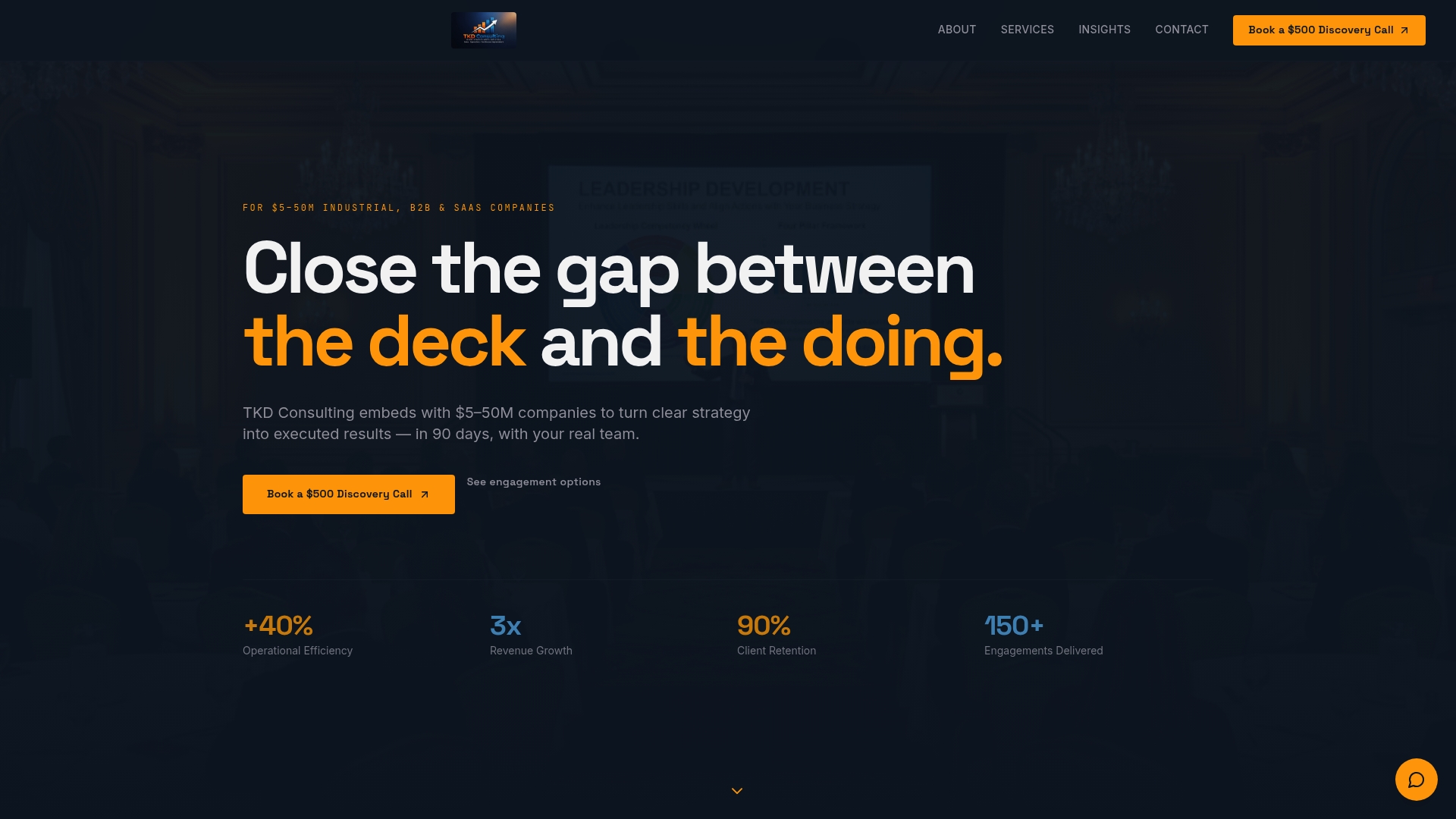
If your team recognizes itself in this article, whether that's a stalled initiative, a PMO that exists on paper but not in practice, or a leadership group spending more time firefighting than building, the Operations Audit is the place to start. For companies facing a longer transformation rather than a single fix, the Strategy Execution Gap engagement covers the multi-month work of rebuilding process and capability together. Either way, the first step is a conversation about what's actually stalling your team, not another round of planning.