
Digital transformation consulting exists to close one gap: the space between an executive's strategy deck and what actually changes on the operations floor. Done right, it delivers measurable business outcomes tied to a handful of prioritized use cases, not a technology overhaul for its own sake. The right first move for most leadership teams is narrow: pick one to three high-value use cases, tie them to hard metrics, and launch a time-boxed implementation wave rather than a multi-year roadmap. Firms like TKD Consulting build that first wave around a structured diagnostic and a 60-day action plan, so the recommendations land on a manager's desk instead of in a shared drive.
TL;DR:
- Focus on one to three high-value use cases connected to measurable metrics, and terminate pilots that do not show signals within 60 to 90 days.
- Ensure leadership commitment reaches middle management, and assign clear owner and weekly KPIs to prevent stagnation during implementation.
- Choose consultants with operational experience who deliver actionable, manager-ready plans and verify that recommendations include tools like scorecards, runbooks, and coaching frameworks.
- Evaluate whether your organization has the necessary budget authority, data access, and change appetite before starting a transformation to avoid ineffective spending.
- Prioritize diagnostic engagements, quick-win pilots, and clear milestone tracking over lengthy, over-engineered roadmaps to achieve measurable results within six months.
Table of Contents
- What Are the Core Pillars of a Successful Digital Transformation?
- How Do Digital Transformation Consultants Actually Work?
- Is Your Organization Actually Ready to Transform?
- Why Do Most Transformation Recommendations Never Get Implemented?
- Why Practical Operations Experience Changes the Quality of Recommendations
- How Should You Choose a Digital Transformation Consulting Firm?
- What Do Digital Transformation Consulting Services Typically Cost?
- What Timeline Should You Expect From a Transformation Engagement?
- What Do Successful Transformation Outcomes Actually Look Like?
- When Should You Hire a Consultant Instead of Building Internally?
- How TKD Consulting Turns Strategy Into Executed Results
- Sources
What Are the Core Pillars of a Successful Digital Transformation?
Every transformation that survives contact with the org chart gets six things right, according to BCG's framework for structuring digital initiatives around outcome-focused, incremental delivery. Skip any one of them and the program stalls somewhere between the kickoff meeting and the first quarterly review.
Strategy tied to outcomes. A transformation strategy that isn't anchored to a specific revenue, margin, or cycle-time target is a wish list. BCG's approach of moving initiatives through an innovate, incubate, industrialize sequence works because each stage forces a decision: does this use case earn its way to the next phase or get killed?
Leadership commitment that reaches middle management. Executive sponsorship gets a project funded. Middle-management buy-in gets it executed. The regional manager or shift supervisor who has to change how their team works every day is the actual bottleneck in most stalled transformations, far more often than the technology itself.
The right people in the right roles. A transformation office staffed entirely with strategists and no one who has run daily operations tends to produce plans that read well and fail on the floor.
Agile governance. Steering committees that meet quarterly can't course-correct fast enough. Weekly or biweekly decision forums with real authority to reallocate resources keep momentum alive.
Measured progress with the right KPIs. Vanity metrics like "features shipped" or "training sessions completed" don't tell you if the business changed. Track adoption rate, cycle time, and unit economics instead.
A modular, interoperable tech and data platform. DXC's transformation model pairs cloud migration and data capability building with organizational change management for a reason: platform decisions made in isolation from the operating model almost always require expensive rework later.
Here's what quarter-ready action looks like against each pillar:
- Pick one use case per pillar and assign a named owner, not a committee.
- Set one metric per use case that a floor manager can check weekly.
- Kill any pilot that hasn't shown a measurable signal after 60 to 90 days.
- Put a middle manager, not just a VP, in every steering conversation.
Most consultancies now frame this as delivering measurable outcomes via prioritized use cases rather than chasing technology adoption as an end goal, highlighting the critical importance of digital transformation in business growth. That's the right instinct. The mistake is treating it as obvious and then building a 40-slide roadmap anyway.
How Do Digital Transformation Consultants Actually Work?
Engagement models vary more than most executives expect, and picking the wrong one wastes both budget and a full fiscal quarter. Four models cover most of the market:
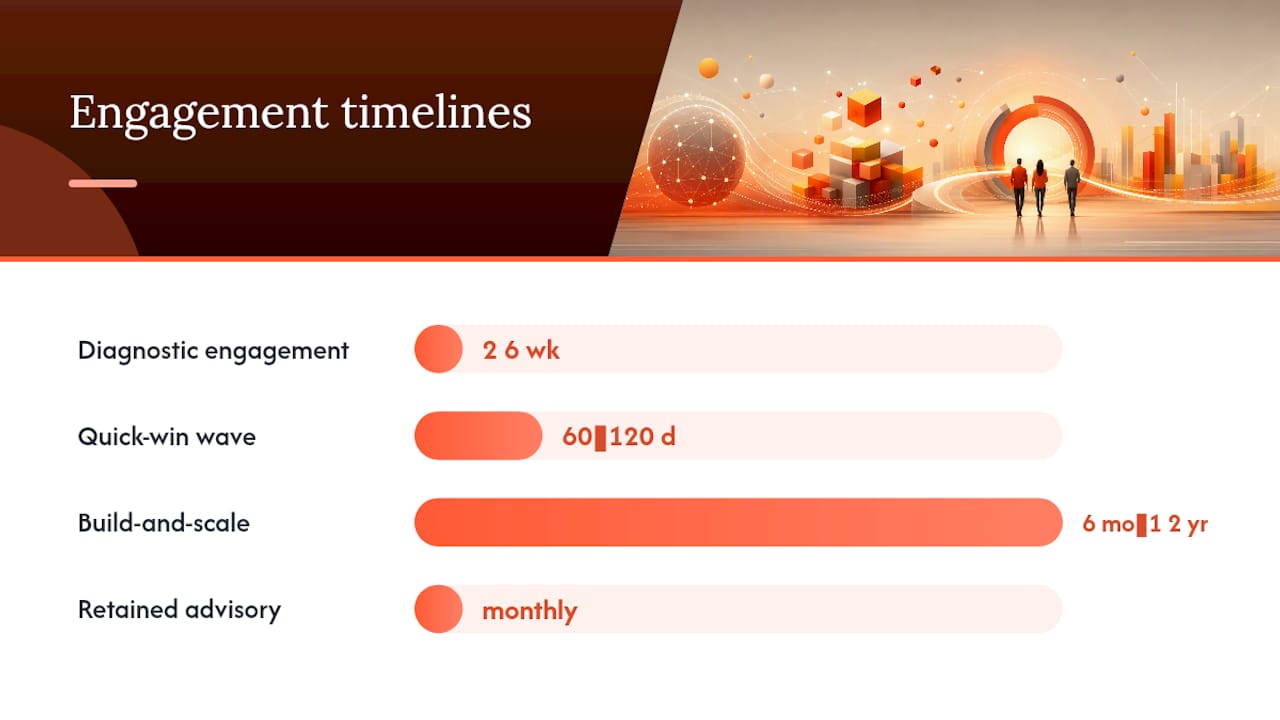
- Diagnostic engagements. A time-boxed assessment, typically two to six weeks, that maps current-state people, processes, and systems against stated goals. Output: a prioritized action plan, not a strategy memo.
- Quick-win implementation waves. A focused 60 to 120 day sprint that executes the top two or three items from a diagnostic, usually paired with a working MVP or pilot process.
- Build-and-scale engagements. Longer programs, six months to two years, that take a proven pilot and roll it across business units. Bain's model leans on integrated delivery teams and partner ecosystems here, since scaling almost always needs specialized capabilities no single internal team has.
- Retained or fractional advisory. Ongoing monthly support, often structured as a fractional executive relationship, for organizations that need senior judgment without a full-time hire.
Deliverables tend to look similar across firms even when the engagement labels differ. Expect a prioritized 60-day action plan, a working MVP or process pilot, scorecards tied to specific KPIs, documented runbooks for the new process, and a training program for the people who inherit it. Protiviti's consulting model explicitly couples strategy work with product optimization and revenue-system change, which is a useful check when you're evaluating a proposal: if it's strategy-only with no delivery component, ask where the runbooks and training live.
On timelines, diagnostics move fast. Quick-win waves show measurable value in the first 90 days if scoped correctly. Full build-and-scale programs take longer, but you should see a working proof point well before month six. If a consultant tells you nothing will be measurable for a year, that's a scoping problem, not a realistic timeline.
Is Your Organization Actually Ready to Transform?
Run this checklist before you sign a statement of work. Skipping it is the single most common reason transformation budgets get spent without producing results.
- Does the sponsoring executive have budget authority, or just an opinion?
- Are the people needed for the pilot actually available, or are they already at 100% capacity on other priorities?
- Can you pull the data you need today, or does someone have to build a new report first?
- Does the organization have the appetite to change a process that's been run the same way for years?
If two or more of these come back negative, fix them before the engagement starts. A consultant can help design the fix, but they can't manufacture executive bandwidth or clean data that doesn't exist.
Once you're underway, Strategy&'s framework for setting clear outcomes and performance metrics is a solid baseline: track KPIs in three categories. Adoption metrics (how many people or transactions are actually running through the new process), value metrics (margin, cycle time, revenue per unit), and risk metrics (error rates, compliance exceptions). A well-designed operational dashboard makes these visible to the people who need to act on them daily, not just to the steering committee.
Cadence matters as much as the metrics themselves. Weekly team-level check-ins catch problems before they compound. Biweekly or monthly steering reviews are where resourcing decisions and stop-loss calls happen. Anything less frequent than monthly at the steering level means you're finding out about failures a quarter after they started.
Why Do Most Transformation Recommendations Never Get Implemented?
The most common failure mode isn't a bad strategy. It's a good strategy that never gets a manager-ready handoff. A recommendation that lives in a consultant's final presentation and nowhere else evaporates within weeks of the engagement ending.
Three practices prevent this. First, run pilots with strict, written success criteria and a stop-loss rule decided before the pilot starts, not after it's underperforming and everyone's emotionally invested. Second, translate every recommendation into a scorecard, a meeting cadence, and a named role responsible for it, the same way you'd hand off any operational process. Third, build the coaching structure that helps a frontline manager actually run the new process, not just read about it.
Pro Tip: Before you approve any transformation initiative, ask the consultant to show you the exact document a floor manager would receive on day one of rollout. If that document doesn't exist yet, the plan isn't finished, no matter how polished the strategy deck looks.
The two pitfalls that kill more transformations than any technology failure: overengineering the solution before proving the simple version works, and designing the entire program around executive sponsors while ignoring the middle managers who have to run it daily. The fix for both is the same. Build small, prove value fast, and put a manager in the room from day one, not after the pilot's already underway. TKD Consulting's approach to the strategy execution gap treats this handoff as the actual deliverable, not an afterthought bolted onto a slide deck.
Why Practical Operations Experience Changes the Quality of Recommendations
David Karpatkin founded TKD Consulting after years running warehouse operations, home services, solar, and consumer products organizations, carrying P&L responsibility and running a distribution center under real operational pressure. That background shows up in the work: recommendations get written the way someone who has managed a shift would write them, not the way someone who has only diagrammed one would.
The flagship Operations Audit reflects that. It's a structured, time-boxed diagnostic that maps people, processes, and performance systems against stated goals, then produces a prioritized 60-day action plan built to be handed to a floor manager on Monday morning. The engagement includes the scorecards, meeting cadences, and coaching frameworks that keep the changes alive after the diagnostic ends, which is the exact runway that strategy-only engagements routinely skip. Mid-market organizations often get more value from a time-boxed diagnostic with a manager-ready action list than from an unfunded, multi-year roadmap that never survives its first budget cycle.
How Should You Choose a Digital Transformation Consulting Firm?
Start with proof of execution, not just proof of strategy. Ask any firm you're evaluating for an example of a recommendation they made that got implemented within 90 days, and ask what specifically changed on the operations floor. A firm that can only point to strategy decks and stakeholder workshops hasn't shown you they can close the execution gap.
Look for a few specific traits. Industry or operational fluency matters more than a generic transformation methodology; a consultant who has actually run a P&L or managed a facility asks sharper diagnostic questions than one who hasn't. Fit with your organization's size matters too. A firm built for enterprise programs with dozens of consultants will over-scope a $15 million company's engagement, while a boutique practice built for mid-market operations will right-size the diagnostic to what your team can actually absorb.
Check how the engagement ends. Does it conclude with a report, or with an implementation runway, scorecards, and a coaching structure? Bain's model leans on integrated delivery teams precisely because strategy without delivery capability doesn't scale. Finally, ask about the partner ecosystem. Scaling a pilot into an enterprise capability usually requires specialized skills no single firm has in-house, so a consultant who admits where they'll bring in a partner is being more honest than one who claims to do everything themselves.
What Do Digital Transformation Consulting Services Typically Cost?
Pricing structures vary by engagement type, and matching the model to your situation avoids paying for capacity you don't need. Four common structures dominate the market.
Day rates apply to short diagnostics, typically a flat rate per consulting day for a two-to-six-week assessment. This is the lowest-commitment entry point and the one most mid-market leaders should start with.
Project-based fees cover a defined scope with a fixed deliverable, common for quick-win implementation waves or a single-department rollout. You know the total cost upfront, which makes budgeting easier than an open-ended retainer.
Monthly retainers fund fractional COO-style or ongoing advisory relationships, where you need senior judgment on tap without hiring a full-time executive. This model fits organizations mid-transformation that need continued oversight without paying enterprise consulting rates.
Paid discovery calls are a smaller upfront cost some firms use before scoping a larger engagement, letting both sides confirm fit before committing to a full diagnostic.
The mistake to avoid is paying enterprise-scale project fees for a mid-market problem. A $20 million industrial company doesn't need the same engagement structure as a Fortune 500 division, and a good firm will scope the diagnostic and pricing to match your actual operating scale, not a one-size-fits-all rate card.
What Timeline Should You Expect From a Transformation Engagement?
Most engagements follow a predictable arc, and knowing it in advance helps you spot a proposal that's overpromising or underscoped. Diagnostics run two to six weeks and end with a prioritized action plan, not a lengthy strategy document.
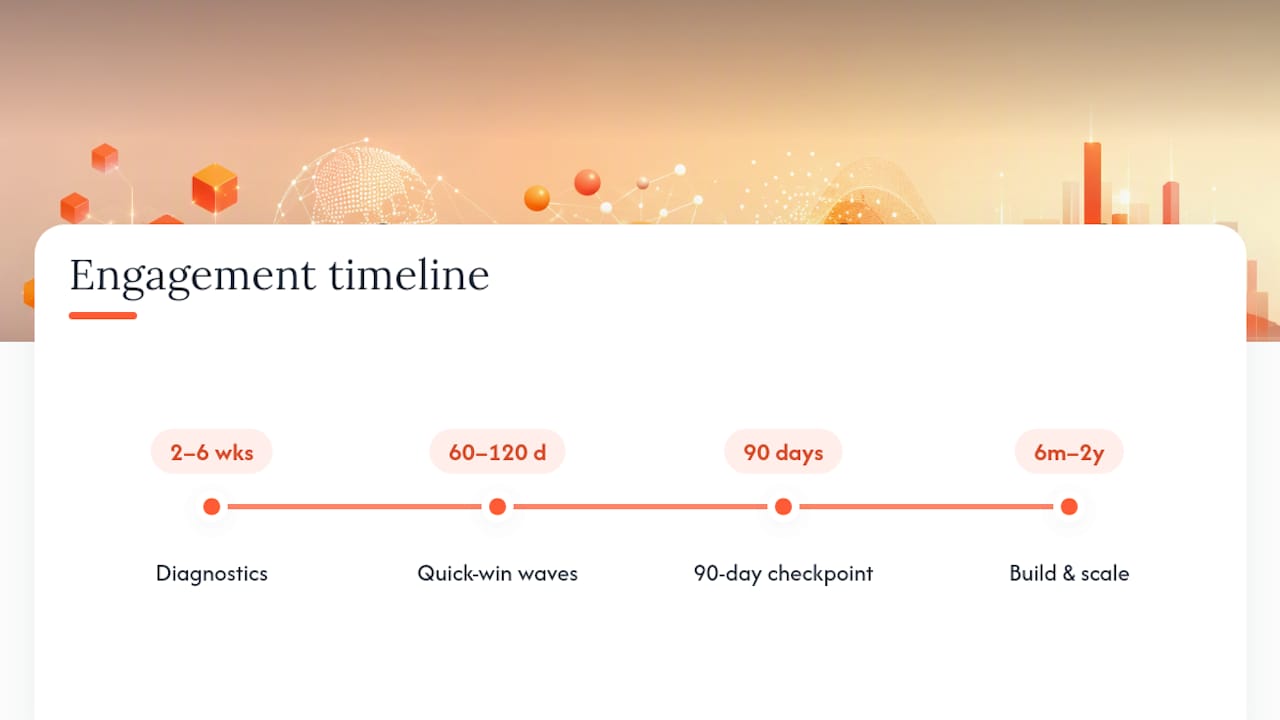
Quick-win implementation waves run 60 to 120 days and should produce a measurable result inside that window, whether that's a working pilot process, a reduced cycle time, or a documented efficiency gain. This is the phase where you find out whether the diagnostic's recommendations actually work outside a slide deck.
Build-and-scale programs extend six months to two years, depending on how many business units or locations are involved. You should still see a proven pilot and early metrics well before the halfway mark. If a consultant proposes a twelve-month engagement with no measurable milestone until month nine, that's a red flag worth pushing back on directly.
The milestone that matters most isn't the kickoff or the final report. It's the first 90-day checkpoint, where a real KPI either moved or it didn't. Everything downstream, including whether to fund a scaled rollout, should hinge on that data point rather than on how confident the original pitch sounded.
What Do Successful Transformation Outcomes Actually Look Like?
The clearest examples of digital transformation working share one trait: the outcome is a specific number, not a general improvement. A distribution operation that redesigns its pick-and-pack workflow alongside a new warehouse management system and cuts order-fulfillment time by a measurable margin has a transformation story. A sales organization that pairs a new CRM rollout with a revised territory and compensation structure and sees quota attainment rise has one too.
Sector-specific digital assets illustrate the same principle outside of pure operations. Consumer-facing portals in industries like healthcare, where Aetna's member portal ties process redesign directly to end-user workflow improvements, show that the technology is only half the outcome. The other half is the operational change that makes the tool actually get used.
What separates these from failed initiatives isn't the technology choice. It's that the initiative had one owner, one metric, and a defined stop-loss point before it launched. Programs that succeed almost always started smaller than leadership originally wanted, proved value on a limited scope, then scaled. The ones that fail typically tried to transform everything at once and lost the thread of what "success" even meant six months in.
When Should You Hire a Consultant Instead of Building Internally?
The decision rule is simpler than most leadership teams make it. If your organization lacks the internal bandwidth or the specific operational expertise to run a rigorous diagnostic, bring in outside help for that first wave. If the gap is capacity rather than capability, hire a consultant for the diagnostic and initial implementation, then build internal ownership from there.
The strongest pattern I've seen in how transformations actually succeed is consultant-led diagnosis followed by internal capability building. An outside team runs the assessment and the first 60 to 90 day wave, proves the model works, then hands the scorecards and cadences to an internal owner who keeps it running. That avoids the two failure modes on either end: permanent consultant dependency, and an internal team that never had the bandwidth to diagnose the problem correctly in the first place.
If you're scoping a diagnostic, insist on one thing above all else. It must end in a document a manager can execute Monday morning, not a set of recommendations that need another six weeks of internal translation before anyone can act on them.
— David
How TKD Consulting Turns Strategy Into Executed Results
TKD Consulting is built for the gap most transformation programs fall into: the space between a finished strategy and a team that actually knows what to do differently on Monday. Where a traditional consulting engagement hands you a final presentation, TKD's Operations Audit hands you a prioritized 60-day action plan, scorecards tied to real metrics, and coaching frameworks that keep a floor manager accountable long after the engagement wraps.
If your organization is already dealing with growing revenue and shrinking margin, or a strategy that looks great on paper and stalls on the floor, that's exactly the problem the Operations Audit is built to diagnose. For leaders who want to understand the disconnect before committing to a full engagement, the Strategy Execution Gap page breaks down exactly where most transformation plans stall and how TKD's model closes that distance. The next step is straightforward: book a discovery call, walk through your current operating picture, and find out whether a time-boxed diagnostic is the right fit before you commit budget to anything larger.
Sources
- Digital Transformation Strategy Consulting | BCG
- Digital Transformation Consulting Services | Protiviti US
- Digital Transformation Consulting Services | Bain & Company