
Automation consulting is an operations-first discipline that maps how work actually runs, prioritizes where orchestration will cut coordination overhead, and delivers a time-boxed pilot plus a governance plan so managers can run the workflow day-to-day. Hire one when approvals stall, tools have multiplied faster than your org chart, or your team is spending more hours coordinating handoffs than doing the work itself. The right next step is almost never a six-figure platform buy. It's a short diagnostic.
TL;DR:
- Automation consulting should focus on mapping workflows and designing orchestration rather than just automating individual tasks, with key processes like invoicing, lead routing, and dispatch benefiting most.
- Outside help is warranted when processes experience high exception rates, long approval delays, fragmented tools, or require redesign, not just staffing or training issues.
- A typical engagement includes discovery, prioritization, piloting, measurement, and scaling, usually within 60 to 90 days, at a cost ranging from $2,500 to tens of thousands depending on scope.
- Effective vetting requires specific questions about deliverables, success metrics, ownership, and timelines, with red flags including vague promises or a focus on platform only.
- Measuring pilot success relies on cycle time, manual touches, exception rate, throughput, and capacity gains, kept from decaying by clear ownership, regular reviews, and a simple change process.
Table of Contents
- What Automation Consulting Actually Means for Your Business
- Do You Actually Need to Hire a Consultant?
- What a Well-Run Engagement Looks Like
- How to Vet a Consultant Before You Sign Anything
- Measuring Results and Keeping Them From Decaying
- Getting Your Team Through the Change
- Working Around Your Existing IT Systems
- Why the Diagnostic Matters More Than the Tool
- Ready to Find Out Where Your Process Actually Breaks?
- Sources
What Automation Consulting Actually Means for Your Business
Forget the image of a technical integrator wiring robots into a factory floor. That's a different job, with a different buyer. Operations-focused automation consulting is about mapping the real path work takes through your company, from the moment a request enters to the moment it's resolved, and finding where handoffs break, where exceptions pile up, and where a manager is manually pushing a process forward that should run on its own.
The distinction that matters most is orchestration versus task automation. Task automation fixes one bottleneck: a form that auto-fills, an email that auto-sends. Orchestration designs the whole sequence, including where a human has to decide and where a system can act without asking. Splunk's research on automation versus orchestration makes the case that mid-market firms usually capture their biggest efficiency gains at the orchestration level, not from stacking isolated point fixes.
A few process types tend to reward this approach fastest:
- Invoice and AR processing — high volume, rule-based, and full of exceptions that eat someone's Tuesday afternoon every week.
- Lead routing — where speed to first contact often determines whether a deal survives.
- Dispatch and field coordination — where a five-minute delay in reassigning a job cascades into a missed appointment window.
Do You Actually Need to Hire a Consultant?
Not every operations headache justifies bringing in outside help. Some are training issues. Some are staffing issues. But a specific set of signals usually means internal fixes have hit their ceiling.
Watch for fragmented tools that don't talk to each other, a recurring exception rate that never seems to shrink no matter who owns the process, approvals that routinely sit for days waiting on one person, or a hiring plan that's really just an attempt to buy more humans to coordinate a broken handoff. Any one of these on its own might be manageable. Two or three together usually mean the process itself needs redesigning, not more headcount.
Run this quick scoring exercise before you call anyone:
- Volume — Does the process run often enough (weekly or more) that fixing it pays back quickly?
- Exception rate — What share of cases don't follow the standard path? Above 15 to 20 percent usually signals a process problem, not an execution problem.
- Measurability — Can you name the metric that would prove success (cycle time, touches, error rate)?
- Ownership — Is there one person accountable for this process end to end, or does it float between departments?
Score two or more of these as "no" or "unclear," and you have a legitimate case for outside eyes.
Pro Tip: Don't let a vendor talk you into a full platform rollout before you've run a fixed-scope diagnostic. A short, paid discovery phase costs a fraction of an implementation and tells you whether the implementation is even the right move.
What a Well-Run Engagement Looks Like
A credible engagement follows a sequence, and each phase produces something concrete you can hold in your hand, not a slide deck that gets filed away.
- Discovery/diagnostic — process maps, an exception inventory, and interviews with the people actually doing the work.
- Prioritization and design — a ranked list of automation candidates scored by business impact and feasibility, plus an orchestration design showing where humans decide and where systems act.
- Pilot build and test — a working version of the automation running on one process, with defined acceptance criteria.
- Measure and roadmap — results compared against baseline, documented in a decision memo.
- Scale or govern — either expand to adjacent processes or lock in ownership and monitoring for what you built.
Moxo's roadmap for process automation consultants describes this same arc: a real process map, an exception inventory, a configured pilot, and measured outcomes, typically within 60 to 90 days for a single process. That timeline holds up well against what most mid-market operations teams can realistically absorb without disrupting daily work.
Cost follows scope, and phased pricing is what keeps risk manageable. A focused process assessment typically runs $2,500 to $10,000, a single pilot lands in the range of several thousand to tens of thousands of dollars, and a multi-process implementation program can cost tens of thousands of dollars or more depending on complexity. Discovery itself should be a paid, evidence-producing phase that ends in a written recommendation, not a vendor demo dressed up as analysis.
How to Vet a Consultant Before You Sign Anything
Ask direct questions on the discovery call, and pay attention to how concretely they answer.
- What artifacts will discovery produce, and can I see a sample exception inventory from a past engagement?
- How will you define success for the pilot, in numbers, before we start building anything?
- Who owns this process after you leave, and what do you hand that person?
- What happens if the pilot doesn't hit its targets by day 60 or 90?
- Can I talk to a past client about what changed on their floor, not just what changed in a report?
Score proposals against a simple rubric:
- Pass: names specific deliverables (process map, exception inventory, pilot with measured before/after results, governance handoff).
- Pass: references a defined timeline, usually 60 to 90 days for a single process.
- Fail: leads with a software platform before understanding your process.
- Fail: won't commit to a fixed-scope diagnostic and pushes straight to a full build.
- Fail: deliverables described in vague language like "improved efficiency" with no metric attached.
The single biggest red flag is a consultant who treats discovery as a formality instead of real, artifact-producing work. If they can't show you what a process map or exception inventory looks like before you sign, they may not know how to build one.
Measuring Results and Keeping Them From Decaying
Five numbers tell you almost everything about whether a pilot worked: end-to-end cycle time, manual touches per transaction, exception or rework rate, throughput, and recovered capacity expressed in dollars or hours.
Before you build anything, capture a baseline. Sample at least several weeks of real transaction history so you catch the messy edge cases, not just the clean ones. Acceptance tests for the pilot need two layers: functional checks (does routing work, is data quality above threshold) and operational checks (did manual touches actually drop, do owners respond within an agreed window on a representative volume of cases).
The automation that decays within six months almost always lacks three things:
- A named owner responsible for the process, not a committee.
- A scorecard reviewed on a set cadence, weekly at first.
- A lightweight change process for handling new exception types before they pile up unmanaged.
Pro Tip: Put the first scorecard review on the calendar before the pilot even launches. Teams that wait to "see how it goes" before scheduling a review almost never schedule one.
Getting Your Team Through the Change
The consultant can design the workflow. Your people have to run it, and that means change management isn't a side task, it's half the engagement.
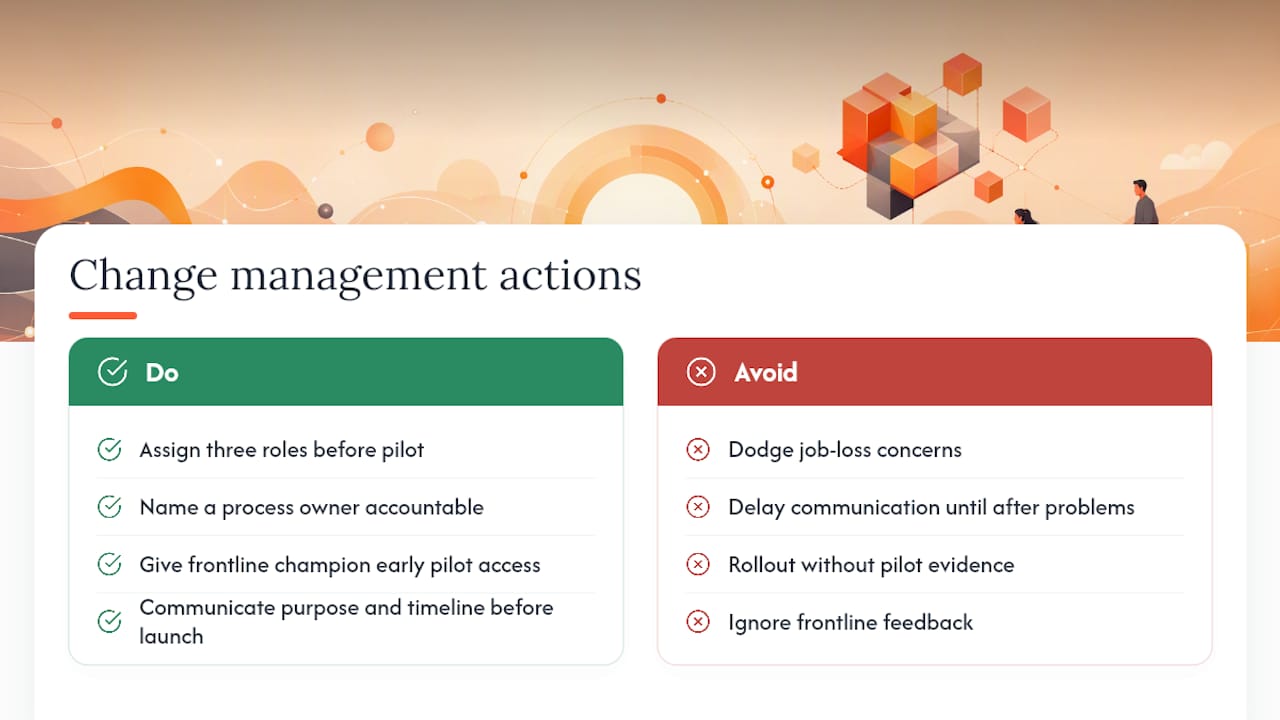
Assign three roles before the pilot starts. A process owner who's accountable for outcomes day-to-day, usually the operations leader who requested the work. A frontline champion, someone who actually does the job today and can tell you where the map is wrong before you find out the expensive way. And an executive sponsor, typically you or another senior leader, who removes obstacles and signals that this isn't optional.
Resistance usually comes from one of two places: fear that the automation eliminates a job, or skepticism that it will actually work better than the workaround people have built over years. Address the first directly and honestly, don't dodge it. Address the second by letting the frontline champion see early pilot results before the rollout goes company-wide. People trust a coworker's assessment more than a consultant's slide.
Communicate the pilot's purpose and timeline before it launches, not after something breaks. A short kickoff where the process owner explains what's changing, why, and what stays the same reduces the rumor mill dramatically. Change that's explained tends to stick. Change that's discovered tends to get quietly undone within a month.
Working Around Your Existing IT Systems
Almost no mid-market company gets to automate on a blank slate. You've got an ERP, a CRM, maybe a WMS, and a scatter of spreadsheets holding the process together in ways nobody officially approved.
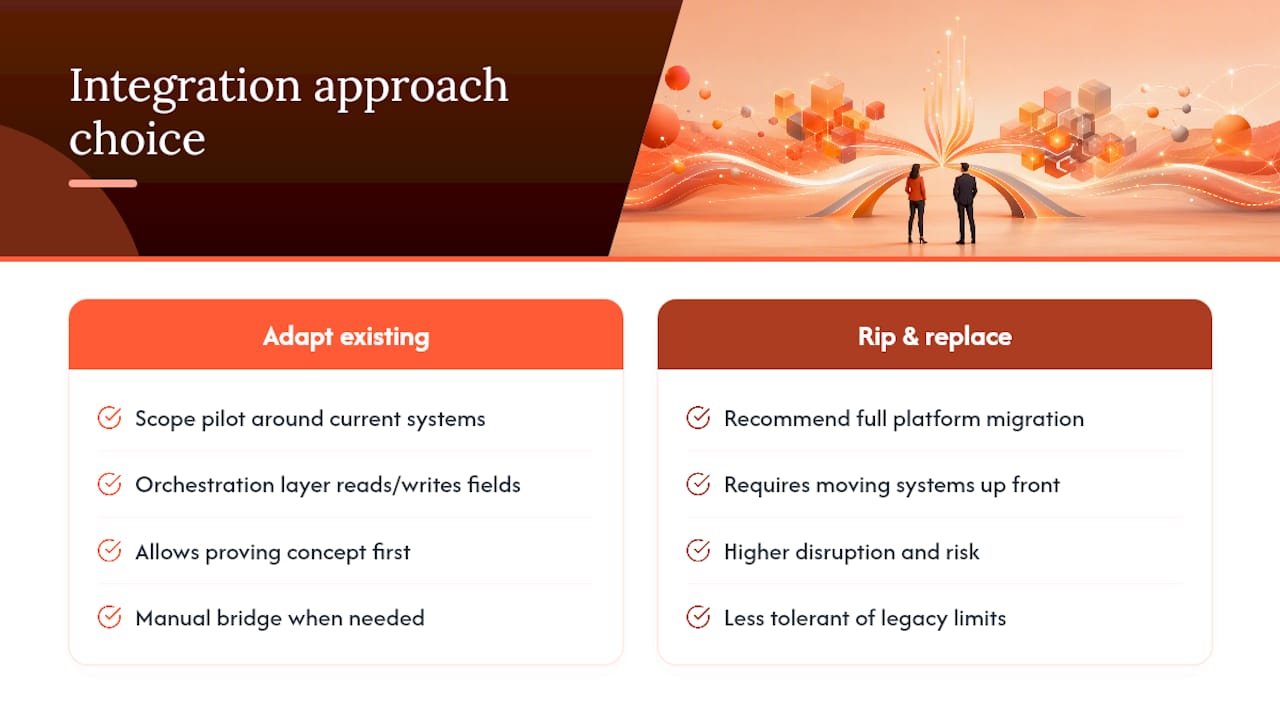
The integration problem usually isn't technical impossibility, it's data quality and system age. Legacy systems without modern APIs, inconsistent field naming between platforms, and permission structures built for a smaller company all slow things down. A capable consultant addresses this by scoping the pilot around the systems you already have rather than recommending a rip-and-replace, at least at first. That might mean building the orchestration layer to read from your existing ERP and write back through existing fields, instead of forcing a platform migration before you've even proven the automation concept works.
For document-heavy processes like contract approvals or agreement routing, integration usually centers on where documents change hands and who needs to see or sign what, a pattern well covered in practical guides to agreement workflow automation. For process orchestration generally, a good reference point on distinguishing platform capability from actual workflow design is available in Intelligent Automation's guide to AI automation services.
The consultants worth hiring will tell you plainly when a system limitation means the pilot needs a manual bridge step for now. That's a more honest answer than pretending every system talks to every other system cleanly.
Why the Diagnostic Matters More Than the Tool
Most operations leaders I talk to want to skip straight to the build. They've already decided what tool they want, and they're looking for someone to implement it. That instinct is understandable and usually wrong.
My MBA work in global leadership and years running distribution center operations and sales organizations taught me the same lesson every time: the process problem almost never lives where leadership thinks it lives. The floor manager who runs the process every day usually knows exactly where it breaks. Nobody's asked them in a structured way.
That's the entire premise behind TKD Consulting's Operations Audit. It's a time-boxed diagnostic that maps your people, processes, and performance systems against your stated goals, and it ends with a prioritized 60-day action plan built to be handed to a floor manager on Monday morning, not filed in a shared drive. Scorecards, meeting cadences, ownership assignments, all included, because a pilot that nobody sustains was never worth building.
— David
Ready to Find Out Where Your Process Actually Breaks?
TKD Consulting's Operations Audit gives you the diagnostic without the six-figure commitment. You get a mapped current-state process, an exception inventory, a prioritized 60-day action plan, and the scorecards and meeting cadences your team needs to actually run the changes, not just read about them.
Three reasons this beats jumping straight to a platform buy: it's time-boxed, so you know the cost and timeline before you commit to anything larger. It's evidence-based, so the recommendations come from what your own floor managers report, not a generic playbook. And it's handoff-ready, meaning your team keeps running the improvements after the engagement ends instead of watching them fade in month three.
If your operation needs more than a single pilot, a longer-term partnership closing the strategy execution gap might fit better than a one-off diagnostic. But for most leaders reading this, the right first move is the same one: book a discovery call and start with the Operations Audit.
Sources
- Automation vs orchestration | Splunk blog
- What a process automation consultant does in the first 90 days: A practical roadmap | Moxo
- Process Automation Consulting Guide | AI Automation Blog | Arsum
- Business Process Automation Consultant: Buyer's Guide | Aslan Intelligence