
Operational alignment is the deliberate coordination of processes, people, and technology so that daily work directly advances your organization's strategic goals. When it works, every team knows what they're doing, why it matters, and how their output connects to the company's direction. When it breaks down, you get the classic symptoms: revenue growing, but margin shrinking, teams busy, but not moving the needle, SOPs on paper that nobody follows. The core elements that hold alignment together are:
- Strategy connection: Goals and priorities are clearly communicated from the top and understood at every level.
- Process integration: Workflows across departments are designed to support each other, not compete.
- People alignment: Roles, responsibilities, and decision rights are explicit and matched to strategic priorities.
- Technology support: Systems and tools reinforce the operating model rather than create workarounds.
Three frameworks anchor serious thinking on this topic: the Strategic Alignment Model developed by John Henderson at MIT, the McKinsey 7S Framework, and the structured diagnostic approach practiced by TKD Consulting. Each offers a different lens, and together they cover the full picture from theory to execution.
Table of Contents
- How strategic planning connects to operational alignment
- What are the core dimensions of operational alignment?
- Who owns operational alignment in your organization?
- Benefits of getting alignment right, and what gets in the way
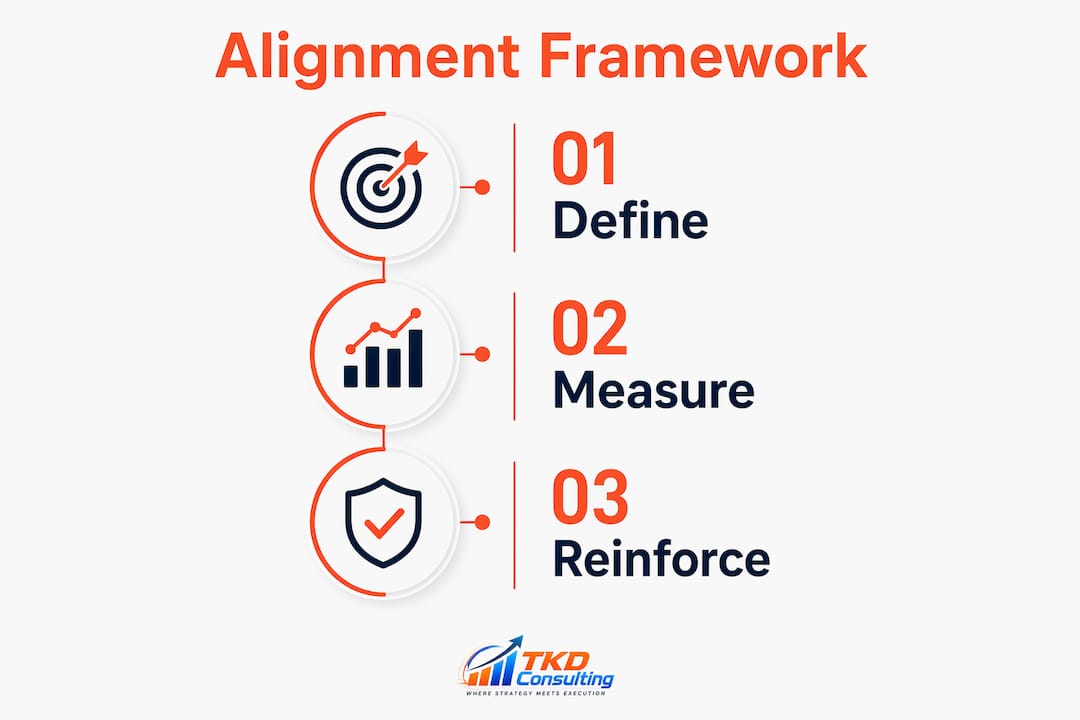
- A framework for sustaining alignment: define, measure, reinforce
- Practical steps for achieving operational alignment
- Which tools and technologies support operational alignment?
- Metrics and KPIs that tell you if alignment is working
- Real-world examples of operational alignment in practice
- How organizational culture shapes operational alignment
- TKD Consulting helps you close the gap between strategy and execution
- Key Takeaways
How strategic planning connects to operational alignment
Strategic planning sets direction. Operational alignment is what converts that direction into work people can actually do on Tuesday morning. Without the connection, strategy stays in the boardroom and execution stays reactive.
The planning lifecycle typically produces a set of priorities, resource commitments, and performance targets. The alignment problem is that those outputs rarely arrive at the operational level in a form teams can act on. Leaders assume their teams understand the strategy; teams assume leadership will clarify what to prioritize. Neither assumption holds.
"Alignment is not a one-time event but a continuous operating cadence involving regular updates, trade-offs, and project reviews that simplify communication rather than overload information."
The U.S. Office of Personnel Management's strategic planning framework treats alignment as the mechanism that links workforce capability to mission outcomes, a principle that applies equally to private-sector operations. The practical implication: your planning cycle isn't complete until the operational translation is done. That means converting annual goals into quarterly priorities, quarterly priorities into team-level objectives, and team-level objectives into the specific decisions and handoffs that happen every week.

What are the core dimensions of operational alignment?

Alignment isn't a single lever. It operates across four dimensions simultaneously, and weakness in any one of them limits what the others can accomplish.
Henderson's Strategic Alignment Model organizes this around two axes: strategic fit (the relationship between your external positioning and internal capabilities) and functional integration (how well your business operations and supporting systems work together). The model was developed in the context of IT strategy, but its logic applies to any functional domain.
The McKinsey 7S Framework adds texture by identifying seven interdependent elements: strategy, structure, systems, shared values, style, staff, and skills. The insight is that changing one element without adjusting the others creates misalignment, even when the change itself is sound.
| Dimension | What it covers | Common failure mode |
|---|---|---|
| Process | Cross-functional workflows and handoffs | Departments optimize internally, creating friction at boundaries |
| People | Roles, decision rights, and accountability | Unclear ownership leads to duplication or gaps |
| Technology | Systems that support the operating model | Tools that don't talk to each other, creating manual workarounds |
| Culture | Shared norms and behaviors that reinforce strategy | Stated values diverge from rewarded behaviors |
The culture row is the one most leaders underestimate. You can redesign a process in a week. Shifting the norms around how decisions get made takes months of consistent reinforcement.
Who owns operational alignment in your organization?
Alignment doesn't belong to HR, and it doesn't live on an org chart. It lives in the operating cadence, the rhythm of decisions and updates that either clarify or confuse direction. Every leadership tier has a distinct role.
Executives set the strategic frame and communicate it with enough specificity that middle management can translate it. Vague vision statements don't align teams; concrete priorities with explicit trade-offs do. When executives stay silent on tensions between competing goals, teams fill the gap with their own interpretations, and those interpretations diverge fast.
Middle managers are the translation layer. They convert strategic intent into team-level priorities and surface the operational friction that executives can't see from the top. The middle management gap is one of the most common reasons execution fails: when this layer is thin, overloaded, or undertrained, alignment breaks down even when the strategy is clear.
Team leads and frontline managers own the daily execution rhythm. Their job is to keep work connected to priorities, flag when something is drifting, and make sure their teams understand how their output feeds the larger picture.
Key responsibilities across all levels include:
- Clarifying roles and decision rights before a project starts, not after confusion surfaces
- Running structured communication cadences (weekly standups, monthly reviews) that reinforce direction
- Facilitating cross-functional conversations where dependencies exist
- Holding accountability without micromanaging execution
Cross-functional collaboration is where most alignment work actually happens. Sharing objectives, running regular syncs, and conducting joint retrospectives build the trust that sustains coordination over time.
Benefits of getting alignment right, and what gets in the way
The performance gap between aligned and misaligned organizations is measurable. High-performing companies with strong organizational alignment grow revenue 58% faster and are 72% more profitable, driven by clarity in strategy, culture, and talent alignment.
The benefits show up in specific, operational ways:
- Faster execution: Teams spend less time seeking clarification and more time moving work forward.
- Better resource use: Priorities are explicit, so people and budget flow toward what matters rather than what's loudest.
- Higher engagement: Employees who understand how their work connects to company goals are more motivated and less likely to leave.
- Fewer costly surprises: Problems surface earlier because communication channels are open and trusted.
The challenges are just as concrete. Most teams lose alignment due to excessive priorities, differing strategy interpretations, silence on tensions, information gaps, and mixed signals from leadership. Operational misalignment produces friction between teams, productivity loss, poor morale, and cascading miscommunications. None of those are soft problems.
Pro Tip: Focus your alignment work at the edges between teams, not just within them. Handoffs and dependencies between departments are where misalignment does the most damage. A short, structured cross-team session to map those dependencies is often more valuable than another internal team meeting.
A framework for sustaining alignment: define, measure, reinforce
Alignment degrades. Markets shift, priorities change, people turn over, and the clarity you built last quarter erodes. The organizations that stay aligned treat it as an operating rhythm, not a project with an end date.
A practical three-step cycle keeps alignment from slipping:
1. Define priorities explicitly. At the start of each quarter, leadership articulates the top three to five priorities with enough specificity that teams can make trade-off decisions without escalating every conflict. Vague priorities produce vague execution.
2. Measure alignment continuously. Short pulse surveys that assess clarity, direction, and confidence give you a real-time read on where teams are drifting. The key is acting on results within two weeks. A survey that produces no visible response teaches teams that their input doesn't matter.
3. Reinforce aligned behaviors. Recognition and course correction both belong in this step. When a team navigates a cross-functional dependency well, name it publicly. When a team is drifting from priorities, address it in the next operating review, not at year-end.
| Step | Tactic | Cadence |
|---|---|---|
| Define | Quarterly priority-setting with explicit trade-offs | Quarterly |
| Measure | Pulse surveys on clarity, direction, and confidence | Monthly |
| Reinforce | Recognition for collaboration; structured course correction | Biweekly |
TKD Consulting builds this cycle into every engagement through scorecards, meeting cadences, and accountability mechanisms that keep changes from evaporating after the initial work is done. The goal is to hand a floor manager something they can run on Monday morning, not a framework that lives in a shared drive.
Practical steps for achieving operational alignment
Getting from misaligned to aligned requires a sequence, not a single intervention. These steps work for organizations at any size.
Start with a diagnostic. Before you can align operations to strategy, you need an honest picture of where the gaps are. Map your current processes against your stated goals and identify where the disconnects live. TKD Consulting's Operations Audit is built exactly for this: a structured diagnostic that maps people, processes, and performance systems against strategic objectives, then delivers a prioritized 60-day action plan.
Clarify the strategy itself. Many alignment failures trace back to a strategy that was never specific enough to act on. If your leadership team can't agree on the top three priorities for the next 90 days, your teams certainly can't align to them. Get the strategy sharp before you try to cascade it.
Define accountability at every level. An operational alignment strategy defines who is accountable for which tasks and links team responsibilities to business objectives. Without explicit ownership, work falls into gaps between roles.
Build communication cadences that reinforce direction. Weekly team standups, monthly cross-functional reviews, and quarterly priority resets are the infrastructure of alignment. They don't need to be long; they need to be consistent and focused on the right questions.
Measure and adjust. Alignment is not a destination. Build in regular checkpoints, act on what you find, and treat course correction as a normal part of the operating rhythm, not a sign that something went wrong.
Which tools and technologies support operational alignment?
Technology doesn't create alignment, but the right tools remove friction and make alignment easier to sustain. The categories that matter most are:
Goal management platforms like Workboard, Perdoo, or Lattice translate strategic objectives into team-level OKRs (Objectives and Key Results) and make progress visible across the organization. When everyone can see how their work connects to company goals, the daily prioritization decisions get easier.
Project and work management tools like Asana, Monday.com, or Jira create shared visibility into who is doing what and when. Cross-functional dependencies become explicit rather than assumed, which is where a lot of alignment work actually happens.
Communication platforms like Slack or Microsoft Teams support the operating cadence when used with discipline. The risk is that they become noise generators. Structured channels for specific topics, combined with clear norms about response expectations, keep communication aligned rather than fragmented.
Performance dashboards and BI tools like Tableau, Power BI, or Looker give leadership and teams a shared view of performance data. When everyone is looking at the same numbers, conversations about priorities and trade-offs start from a common baseline.
Pro Tip: The tool is not the solution. Before selecting a platform, define the operating cadence it needs to support. A goal management tool with no one reviewing it weekly is just another dashboard nobody checks.
Metrics and KPIs that tell you if alignment is working
Measuring alignment requires looking at both leading indicators (signals that alignment is building or eroding) and lagging indicators (outcomes that reflect whether alignment was present).
Leading indicators:
- Pulse survey scores on clarity, direction, and confidence across teams
- Cross-functional meeting attendance and action item completion rates
- Time from strategic decision to operational implementation
- Escalation frequency (how often teams need leadership to resolve priority conflicts)
Lagging indicators:
- Revenue growth relative to plan
- Gross margin trends
- Employee engagement and retention rates
- Project on-time delivery rates
- Customer satisfaction scores tied to operational commitments
The most useful single metric is often escalation frequency. When teams are aligned, they resolve most priority conflicts at their level. When alignment breaks down, everything escalates. Tracking how many decisions require executive intervention tells you more about alignment health than most surveys will.
Building a measurement culture means making these metrics visible, reviewing them on a regular cadence, and treating the data as a conversation starter rather than a report card.
Real-world examples of operational alignment in practice
Manufacturing turnaround. A mid-size industrial manufacturer was growing revenue but watching margins compress. The diagnosis: sales was committing to custom orders that production couldn't fulfill at target cost. The two teams had different priorities and no shared visibility into capacity constraints. The fix was a weekly cross-functional review that included sales, operations, and finance, with a shared dashboard showing order backlog against production capacity. Within two quarters, margin recovered because the teams were making commitments based on the same information.
Service business scaling. A home services company with multiple locations was struggling to maintain quality as it grew. Each location operated with its own informal processes, and the company had no consistent way to measure performance. Implementing a standardized operational rhythm across locations, including weekly scorecards and a monthly leadership review, created the visibility needed to identify which locations were drifting and why. The result was faster problem identification and a more consistent customer experience.
SaaS go-to-market misalignment. A B2B SaaS company had a strong product but a leaky sales pipeline. Marketing was generating leads that sales wasn't converting, and neither team agreed on why. A structured review of the handoff process revealed that the two teams had different definitions of a qualified lead. Aligning on a shared definition, with explicit criteria and a joint review cadence, improved conversion rates without changing the product or the marketing spend.
These examples share a pattern: the alignment problem was visible in the outcomes, but the root cause lived in a process gap or a communication failure at the boundary between teams.
How organizational culture shapes operational alignment
Culture is the operating system underneath your processes. You can redesign workflows, clarify roles, and install new tools, but if the underlying norms reward individual performance over collaboration, or punish people for surfacing problems, alignment will erode regardless of what the org chart says.
The most common cultural barrier to alignment is the gap between stated values and rewarded behaviors. A company that says it values transparency but promotes leaders who hoard information will not sustain alignment. Teams learn quickly what actually gets rewarded, and they behave accordingly.
Psychological safety matters here more than most leaders expect. When teams feel safe raising concerns, surfacing conflicts, and admitting when priorities are unclear, alignment problems get identified and corrected early. When they don't, problems compound quietly until they become crises.
Lean principles offer a useful cultural model: make problems visible, address them at the source, and treat every process gap as a learning opportunity rather than a failure. Organizations that embed this norm find that alignment becomes self-correcting over time, because the culture actively surfaces and resolves the friction that misalignment creates.
TKD Consulting helps you close the gap between strategy and execution
Most organizations don't have a strategy problem. They have an execution problem, and it usually traces back to misaligned operations.
TKD Consulting works with $5–50M companies that are stuck between having a strategy and actually getting results. The flagship Operations Audit is a structured, time-boxed diagnostic that maps your people, processes, and performance systems against your stated goals, then delivers a prioritized 60-day action plan your team can execute immediately. Unlike a traditional consulting engagement that ends with a slide deck, TKD builds in the implementation runway: scorecards, meeting cadences, coaching frameworks, and accountability mechanisms that keep changes from evaporating. If your team is busy but not aligned, or your SOPs exist on paper but nobody follows them, the Operations Audit is the right starting point. Reach out to TKD Consulting to schedule a discovery call and get a clear picture of where your alignment gaps are and what it takes to close them.
Key Takeaways
Operational alignment is a continuous practice, not a one-time fix: organizations that treat it as an ongoing operating cadence consistently outperform those that address it only during annual planning.
| Point | Details |
|---|---|
| Alignment drives measurable results | High-performing aligned companies grow revenue 58% faster and are 72% more profitable than misaligned peers. |
| Culture is the hidden variable | Stated values that diverge from rewarded behaviors will undermine any process or structural change. |
| Alignment breaks at the edges | Handoffs and dependencies between teams are where misalignment does the most damage; start there. |
| Measure and act fast | Pulse surveys on clarity and direction only work if leadership acts on results within two weeks. |
| TKD Consulting | The Operations Audit maps people, processes, and systems against goals and delivers a 60-day execution plan. |