
An organizational maturity assessment is a structured evaluation of how consistently your people, processes, and metrics actually run compared to what leadership assumes. Done right, it produces three things: a score across specific dimensions, a clear identification of your weakest link, and a first concrete move to fix it. This article shows you how to run one, what to measure, and how to turn the results into a 60-day plan instead of a slide deck that sits in a shared drive.
TL;DR:
- Most teams overclaim maturity by one level, making it essential to verify progress through concrete evidence and specific decision impacts in the last 90 days.
- Selecting a maturity model aligned with your scope—such as operational, AI, or manufacturing—prevents inconsistencies and ensures meaningful benchmarking.
- Focused assessments on a single workflow with evidence-based scoring and a short, prioritized 60-day plan lead to more actionable results than broad or vague evaluations.
- Moving up one maturity stage generally requires between 9 and 18 months of active improvement, with leadership engagement and narrow scope accelerating progress.
- Engaging an external partner is advisable when dashboards are unused, processes cross multiple departments without clear ownership, or leadership cannot identify the highest-impact fix.
Table of Contents
- What Does Organizational Maturity Actually Mean?
- Which Maturity Model Should You Actually Use?
- How Do You Run an Organizational Maturity Assessment?
- What Dimensions Should You Score, and With What Questions?
- How Do You Turn Scores Into a Roadmap?
- How Long Does It Take to Move Up a Maturity Level?
- When Should You Bring in a Partner?
- What Actually Moves the Needle
- Get a Defensible Score and a 60-Day Plan, Not Just a Report
- Sources
- FAQ
What Does Organizational Maturity Actually Mean?
Maturity is not a personality trait or a vibe. It is a measurable statement about whether your operation runs on consistent processes, tracked metrics, and delegated ownership, or whether it runs on the memory and heroics of a few key people. APQC frames maturity as a staged progression, and the five-level structure that grew out of software process research decades ago still holds up because it tests something concrete: can this work happen the same way twice, without the founder in the room?
Here's what each level actually looks like on the floor, not in a slide:
- Level 1, Initial: Work gets done, but how it gets done depends on who is doing it. Tribal knowledge substitutes for documented process, and outcomes swing wildly week to week.
- Level 2, Managed: Processes exist for individual teams or projects, often written down after the fact, but they are not standardized across the organization. Two shifts running the same line can operate differently.
- Level 3, Defined: Processes are documented, standardized, and used organization-wide. This is usually the inflection point where a company stops firefighting and starts delegating, because the process itself carries the knowledge instead of a person.
- Level 4, Quantitatively Managed: Teams measure process performance with real metrics, not anecdotes, and use that data to catch problems before they become fires.
- Level 5, Optimizing: The organization continuously improves processes based on the data from Level 4, with a formal cadence for testing changes and retiring what doesn't work.
Most leadership teams overclaim by one full level. A VP will say "we're Level 4, we have dashboards," but if nobody has actually changed a process because of what the dashboard showed in the last quarter, that's Level 3 with a monitor bolted on. The check is simple: ask for one specific decision the metric drove in the last 90 days. Silence is your answer.
Which Maturity Model Should You Actually Use?
The framework matters less than picking one and sticking with it, but the right one saves months of wasted effort. Four stand out for mid-market operations leaders, each built for a different scope.
- APQC's maturity model is the most general-purpose option, built around five levels applied across any business function, from finance to supply chain. Start here if you're assessing broad operational health rather than one specialized domain.
- Microsoft's Well-Architected operational excellence model treats maturity as a continuous journey rather than a fixed destination, prescribing specific practices and trade-offs at each level. It's built for technology operations but its framing of agility over perfection applies to any ops function trying to avoid a "we arrived" mentality.
- The MITRE AI Maturity Model and Assessment Tool uses a six-pillar structure across 20 dimensions specifically for AI and data readiness, and it pairs the model with a scoring tool that visualizes results. If your assessment scope includes how ready your organization is to deploy AI or advanced analytics, this is purpose-built for that question, not a general ops model stretched to fit.
- NIST's MESA tool and Baldrige-aligned resources target manufacturing and process-heavy operations, benchmarking things like production management and quality systems against federal standards.
Pick the model that matches your primary scope, whether that's general operations, AI readiness, or a manufacturing floor, and adapt its dimensions to your business rather than blending two frameworks mid-assessment. Mixing models mid-audit is how you end up with scores that can't be compared to anything, including your own results next year.
How Do You Run an Organizational Maturity Assessment?
A defensible assessment has four moving parts: scope, evidence, scoring, and governance. Skip any one of them and you get a number nobody trusts, including the leadership team that commissioned it.
Pro Tip: Resist the urge to assess the whole company in one pass. A bounded scope with real evidence beats a company-wide survey that nobody can act on.
- Pick one flagship workflow or function. Order-to-cash, hire-to-productivity, or a single production line all work. Assessing "the whole company" produces a mush of averages that hides your actual problem. Narrow scope is what makes the assessment actionable instead of decorative.
- Collect evidence from four sources. Pull existing dashboards and system logs first, since they tell you what's actually happening rather than what people believe is happening. Then observe the work directly, on the floor or in the workflow, for at least a few real work cycles. Interview frontline staff, not just managers, because the gap between what leadership thinks happens and what actually happens usually lives at the frontline. Finally, audit the documentation itself. Does an SOP exist, and does anyone follow it?
- Score against descriptive anchors, not gut feel. For each dimension, write a one-sentence description of what Level 1 through Level 5 looks like, then require the team to pick the single description that matches an ordinary day, not a best day. Chiefoperatingofficer works this way, and the descriptive-anchor approach produces more defensible results than asking someone to self-rate on a 1 to 5 scale, because raw numbers invite grade inflation.
- Require one piece of concrete evidence per claimed level. If a leader claims Level 3 process discipline, ask for the actual SOP document and proof someone used it this month. No evidence, no level. This single rule does more to keep an assessment honest than any amount of workshop facilitation.
- Run a short scoring workshop to reach consensus. Gather the people who touched the evidence, present the scores dimension by dimension, and where two people disagree, write down both positions and the reasoning rather than forcing a false consensus. Disagreement is data. It tells you where perception and reality have drifted apart.
- Re-score on a short cycle to catch optimism drift. Teams tend to score higher the second time around, not because they improved but because the process reminded everyone it's being watched. A 90-day re-score using the same evidence standard keeps the number honest.
Instrumentation matters here too. If your dashboards don't reliably capture the metrics you're scoring against, fix the measurement before you fix the process; a guide to setting up growth analytics walks through the basics of building that visibility layer.
What Dimensions Should You Score, and With What Questions?
A workable assessment scores five to seven dimensions, each with a handful of concrete, observable questions. Vague dimensions like "culture" or "leadership" produce vague scores. These don't.
- Process discipline. Is there a written SOP for this workflow, and does the team follow it without deviation? Evidence: the SOP document plus a walkthrough where the observed steps match it.
- Metrics and visibility. Does a live dashboard show this workflow's performance, and has anyone looked at it this week? Evidence: a dashboard screenshot with a timestamp, plus a name of who checked it last.
- Quality and rework. What percentage of output gets reworked or returned, and is that number tracked anywhere? Evidence: a rework log or a defect tracker, not an estimate from memory.
- Ownership and people. Is there a named individual accountable for this workflow's outcome, distinct from whoever happens to be doing the work? Evidence: an org chart entry or a job description naming the owner.
- Improvement rhythm and governance. Is there a recurring meeting where this workflow's performance gets reviewed and changed based on data? Evidence: a meeting cadence on the calendar with minutes showing an actual decision made.
Translating answers into a score means resisting the temptation to average up. If four dimensions score Level 3 and one scores Level 1, the workflow's real maturity is closer to Level 1, because that's the constraint governing everything downstream. Document your dimensions the way you'd document any process, and a tool built for visual process mapping makes the audit trail easier to keep straight when multiple people are scoring different parts of the same workflow.
How Do You Turn Scores Into a Roadmap?
The score itself is worthless without a sequencing decision. Every mid-market team has five things it could fix. The job is picking the one that unlocks the other four.
- Identify the minimal winning move. Find the weakest dimension that, if fixed, makes progress on the others possible. A team with zero visibility into rework rates can't run a meaningful improvement rhythm, no matter how disciplined that rhythm looks on paper. Fix visibility first.
- Sequence with an effort by impact view. Rank each candidate fix on how much work it takes against how much it moves the whole workflow. High-impact, low-effort fixes go first, always. Everything else waits.
- Build a 60-day plan with a named owner and a measurable outcome per fix. A workable example: Week 1 to 2, the operations manager stands up a shared rework tracker (metric: daily entries logged, target 100 percent of shifts). Week 3 to 6, the same manager runs a weekly 30-minute review of that tracker with the floor leads (metric: number of process changes made from the review, target at least one per week). Week 7 to 8, document the two changes that stuck as the new SOP (metric: SOP signed off and posted at the workstation).
- Write every deliverable so a floor manager can execute it Monday morning. If the output of your assessment is a strategic recommendation instead of a specific task with a name and a date attached, it will not survive contact with a busy week. A management operating system built around clear cadences is what keeps these fixes from evaporating once the assessment excitement fades.
Pro Tip: If your 60-day plan has more than three initiatives running at once, cut it to two. Mid-market teams don't fail from lack of ideas, they fail from too many half-finished ones.
The 60-day execution framework matters because most assessments die in the gap between diagnosis and action, not from bad diagnosis.
How Long Does It Take to Move Up a Maturity Level?
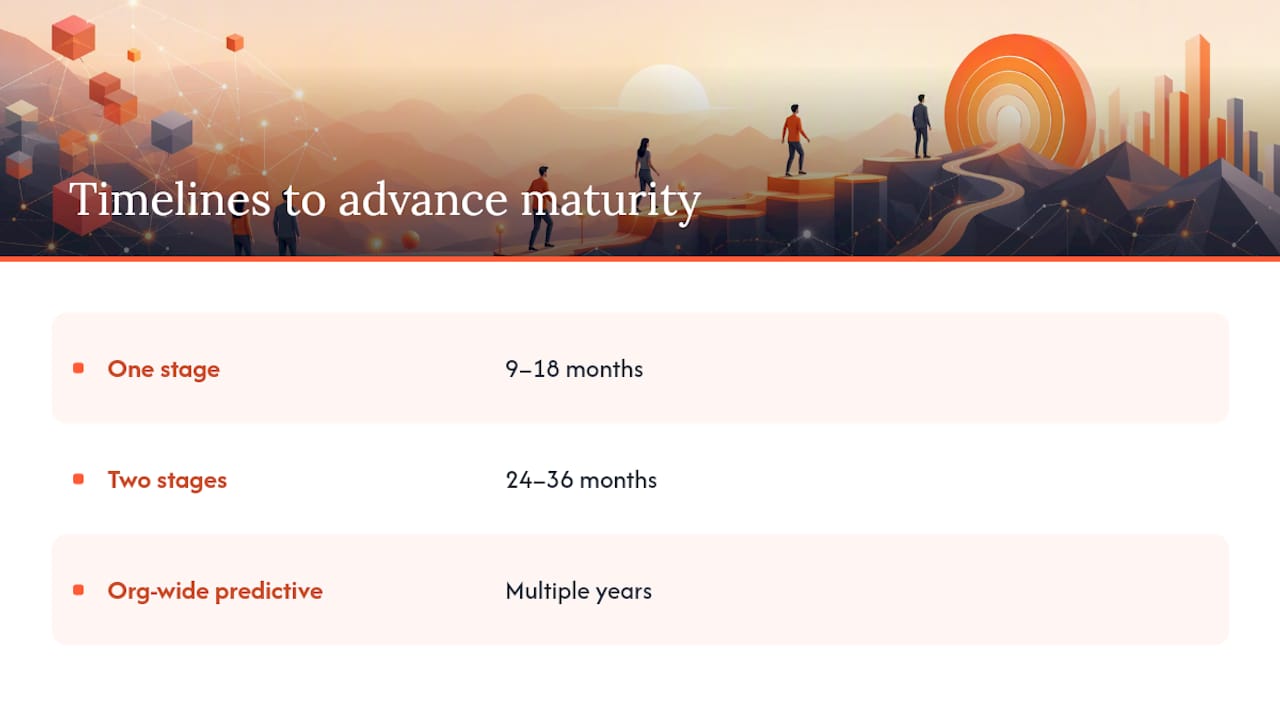
Moving one full stage typically takes 9 to 18 months for a mid-market company actively working the transition, and moving two stages usually runs 24 to 36 months. Full organization-wide predictive maturity, the top of the scale, often spans multiple years across every function.
Three things accelerate that timeline: visible leadership decisions that actually use the new dashboards, a named owner for each fix rather than a shared responsibility that nobody owns, and a scope narrow enough that the team can see progress inside a quarter. The biggest blocker is buying advanced tools before the foundational measurement exists. Skipping stages to buy Level 4 or 5 software while still operating at Level 2 tends to expose upstream process gaps rather than solve them, and teams frequently roll the purchase back within a year.

Cost scales with how much of this you run internally versus with outside help. Internal hours are cheap on paper but slow, since operations leaders are already stretched. A focused external diagnostic compresses months of internal trial and error into weeks.
When Should You Bring in a Partner?
Three signals mean you're past the point where an internal team can run this alone: the workflow crosses multiple systems or departments with no single owner in sight, dashboards exist but nobody has changed a decision because of them in months, or leadership agrees something's broken but can't agree on what to fix first.
A partner worth paying for delivers a scoped diagnostic with evidence, not opinions, a prioritized list of fixes ranked by effort and impact, and the scorecards, meeting cadences, and coaching that keep the fixes alive after they leave. That last piece is where most consulting engagements quietly fail. The recommendations are sound, but nobody built the mechanism to keep them running.

One consulting practice offers a time-boxed diagnostic against your stated goals, followed by a prioritized 60-day action plan and the implementation runway to execute it. Before hiring anyone, ask two questions: what evidence do you require before scoring a level, and what do you leave behind besides a report? If the answer to the second question is "just a deck," keep looking.
What Actually Moves the Needle
Most maturity conversations focus on frameworks. The frameworks matter less than two behaviors: naming a single owner per workflow, and reviewing the data on a fixed cadence instead of when a fire forces the issue. Teams that jump straight to Level 4 tooling without those two habits in place almost always roll it back within a year. Leadership that shows up to a weekly 30-minute review and actually changes something based on what's in front of them moves faster than any framework predicts. That's the whole game: fewer initiatives, clearer owners, a shorter loop between data and decision.
— David
Get a Defensible Score and a 60-Day Plan, Not Just a Report
Running the assessment yourself gets you a real score. What most internal teams lack is the outside judgment to know which weak dimension actually deserves attention first, and the discipline to build a plan the floor will follow instead of ignore after week two. TKD Consulting's Operations Audit is a time-boxed diagnostic that maps your people, processes, and performance systems against your stated goals, then hands you an evidence-backed score, your weakest dimension, and a prioritized 60-day action plan with the scorecards and meeting cadences built in, not left for you to invent later.
If your assessment already told you where the gap is but not how to close it fast, or if you'd rather skip straight to an outside diagnostic, book the Operations Audit and get a plan your floor managers can start executing this month. Leaders working on a broader strategy to operations gap can also look at Strategy Execution Gap engagements for a wider transformation scope.
Sources
- What is Your Organizational Maturity? | APQC
- Operational excellence maturity model | Microsoft
- MITRE AI Maturity Model and Assessment Tool
- NIST MESA manufacturing operation management maturity assessment tool
- Operations Maturity Assessment: Free Self-Scoring Tool
FAQ
What Are the Five Levels of Organizational Maturity?
The common structure runs Initial (inconsistent, person-dependent work), Managed (team-level processes exist but aren't standardized), Defined (standardized, organization-wide processes), Quantitatively Managed (performance is tracked with real metrics), and Optimizing (continuous improvement driven by that data).
How Do You Perform an Organizational Maturity Assessment?
Pick one bounded workflow, gather evidence from dashboards, direct observation, and frontline interviews, score each dimension against descriptive level anchors backed by concrete proof, then run a short workshop to reach consensus and build a prioritized 60-day plan from the weakest dimension.
What Are the Five Levels of Agile Maturity?
Agile maturity models generally mirror the same staged structure: teams start with ad hoc, inconsistent sprint practices, move to team-level agile adoption, then standardized practices across teams, then metric-driven sprint performance, and finally continuous process refinement based on retrospective data.
What Are the Five Levels of a Risk Maturity Model?
Risk maturity models typically track the same five-stage pattern applied to risk management specifically: ad hoc risk handling, department-level risk processes, standardized enterprise risk frameworks, quantified risk metrics tied to decisions, and continuous risk process optimization.
How Long Does an Organizational Maturity Assessment Take to Complete?
A scoped, single-workflow assessment with evidence collection and a scoring workshop typically takes a few weeks to run properly, while moving the organization up one full maturity level afterward takes 9 to 18 months with focused effort.