
Sales consulting delivers measurable revenue and repeatable selling by diagnosing where deals stall, redesigning the sales process, and embedding the coaching and reporting habits that keep the fix in place. It works for owner-operators and mid-market leaders watching a busy pipeline turn into inconsistent quota attainment. Below, you'll find a selection checklist, a real 60-day action-plan example, and the questions worth asking before you sign anything.
TL;DR:
- Sales consulting is most effective when addressing recurring issues like margin erosion, forecast inaccuracies, and wide win-rate variances despite a busy pipeline.
- Engagements should include a discovery phase, a clear 60-day plan, and ongoing measurement, with accountability assigned to specific individuals to ensure long-term success.
- A typical 60-day plan involves CRM audits, process revisions, KPI tracking, and manager coaching, aiming for visible improvements in forecasting and pipeline cadence within two months.
- Choosing a consultant requires verifying industry experience, proven results, and clear ownership of implementation, avoiding firms that only deliver strategy without ongoing involvement.
- Success depends on real execution, with concrete person-to-person accountability and structured cadences, not just strategic recommendations or slide decks left unused.
Table of Contents
- What sales consulting actually does
- Who should hire a sales consultant, and when
- Core services and what each one actually delivers
- How the engagement actually unfolds
- How to choose a sales consulting partner
- What a real 60-day action plan looks like
- What sales consulting is really trying to fix
- Why execution-first consulting works
- Get an Operations Audit built for how your team actually sells
- Sources
What sales consulting actually does
Sales consulting helps organizations optimize sales strategy, process, and performance to drive revenue growth and improve customer engagement. In practice, that means four things done in sequence: diagnosing where deals actually break down, redesigning the process around that finding, training the team on the new approach, and staying involved long enough to make sure it sticks.
The measurable targets are consistent across most engagements:
- Pipeline quality (are the right deals even in the funnel?)
- Deal velocity (how long does a qualified deal take to close?)
- Quota attainment across the team, not just top performers
- Forecast accuracy (does the number you commit match the number you close?)
Engagement shape depends on what you need. A fractional sales leadership arrangement puts senior judgment in the room part-time when you can't justify a full-time VP of Sales. A project diagnostic answers one specific question in a fixed window. Retained implementation stays through the coaching and cadence-building phase after the diagnosis is done. None of these is inherently better. They're matched to the size of the gap.
Who should hire a sales consultant, and when
You don't need a consultant because sales is hard. You need one when specific symptoms show up and keep recurring despite good intentions.
- Revenue keeps growing but margin doesn't, or growth has stalled despite a busy pipeline.
- Forecasts miss by a wide margin quarter after quarter, and nobody can explain why.
- Win rates vary wildly by rep with no clear reason tied to territory or deal size.
- The business is still founder-dependent for its biggest deals, three or five years in.
- Leadership spends more time firefighting individual deals than building the system that produces them.
Fit matters as much as symptoms. This kind of work suits owner-operated and mid-market companies, roughly the $5 million to $50 million range, where a full executive hire isn't justified but the gap between strategy and results is real. If the issue is narrow, a time-boxed diagnostic answers it. If the issue is structural, fractional leadership or a longer transformation engagement fits better.
Core services and what each one actually delivers
Most sales consulting practices offer some version of the same five services, but the value is in the deliverables, not the label.
- Diagnostic or operations audit: maps people, process, and performance systems against stated goals, ending in a prioritized action list, not just observations.
- Sales process and playbooks: defines qualification criteria, stage definitions, and clean handoffs between marketing, sales, and customer success.
- Enablement and coaching: manager coaching cadences, structured rep onboarding, and a plan for actual playbook adoption, not just a binder nobody opens.
- CRM and reporting: dashboards and scorecards that surface forecast hygiene problems before they blow up a quarter.
- Implementation and change management: the meeting cadence, ownership assignments, and accountability mechanism that keep the new process alive after week one.
Pro Tip: Ask any prospective consultant which of these five they personally stay involved in past the recommendation stage. If the answer is "none," you're buying a report, not a fix.
Vendor-reported outcomes from sales consulting engagements paired with execution support commonly include higher win rates, improved quota attainment, and tighter forecasting accuracy. The gap between average and strong outcomes almost always comes down to whether coaching and cadence survived past the first month.
How the engagement actually unfolds
A well-run sales consulting engagement moves through four distinct phases, and skipping any one of them is usually why the fix doesn't hold.
- Weeks 1 through 4: discovery. Interviews with leadership, sales managers, and frontline reps; a look at CRM data, call recordings if available, and existing SOPs.
- Weeks 4 through 8: the plan. A prioritized 60-day action plan, ranked by impact and effort, with clear ownership assigned to specific people, not departments.
- Month 3 and beyond: implementation. New process rolls out with manager coaching attached, scorecards go live, and a recurring cadence replaces ad hoc check-ins.
- Ongoing: measurement. Weekly or biweekly review of leading indicators (activity, pipeline coverage) and monthly review of lagging ones (win rate, quota attainment).
Foundational KPI guidance points to pipeline coverage, conversion rate by stage, and average deal size as the metrics worth tracking from day one, since they surface problems before quota misses do.
The inputs required are straightforward: access to CRM data, honest time from leadership and frontline managers, and a willingness to let scorecards show uncomfortable numbers early. Engagements that skip discovery or rush straight to a training day tend to produce recommendations that look good in a deck and evaporate within a quarter.
How to choose a sales consulting partner
Not every firm that calls itself a sales optimization consultant actually stays for the hard part. A short evaluation checklist before you sign:
- Do they have direct experience in your industry or a comparable sales motion (inside vs. field, transactional vs. long-cycle)?
- Can they show implementation evidence, not just a strategy document, from a past client?
- Do they cite measurable results, ideally with specific before-and-after numbers?
- Will they provide references you can actually call?
- Is the scope of the engagement written in plain, specific language?
On a discovery call, ask directly: who does the hands-on work, what exactly gets delivered and when, what's the realistic timeline, which KPIs define success, and who owns accountability once the consultant leaves the room.
Pro Tip: If a firm can't name the specific person who will sit in your sales meetings during implementation, assume nobody will.
Watch for red flags: a deliverable that's only a slide deck, no clear implementation runway after diagnosis, vague language around outcomes ("improved performance" instead of a defined metric), or unclear ownership of who executes what. A structured Sales Management Operating System gives managers visibility into when to coach and reduces the trial-and-error learning that sinks otherwise good recommendations.
What a real 60-day action plan looks like
TKD Consulting's Operations Audit is built around this exact structure: inspect people, process, performance systems, and tooling, then hand over a prioritized 60-day plan a floor manager can start executing on a Monday morning.
A realistic week-by-week breakdown looks like this:
- Weeks 1 to 2: CRM audit, pipeline review, and manager shadowing to find where deals actually stall.
- Weeks 3 to 4: Draft qualification criteria and stage definitions; assign ownership for each fix.
- Weeks 5 to 6: Roll out revised process with manager coaching attached, scorecards live.
- Weeks 7 to 8: First cadence review against early KPI movement.
| 60-day milestone | Who owns it | What to expect |
|---|---|---|
| Forecast clarity | Sales manager + ops lead | Fewer surprise misses by month two |
| Cadence adoption | Sales managers | Weekly pipeline reviews running without prompting |
| Early KPI movement | Whole team | Initial shifts in win rate or deal velocity |
By day 60, you should see a clearer forecast, a cadence that runs without the consultant in the room, and early KPI movement, not a finished transformation.
What sales consulting is really trying to fix
At its core, sales consulting exists to close four gaps at once: revenue that isn't growing fast enough, a process that exists in someone's head instead of on paper, talent that hasn't been coached in a structured way, and execution that falls apart the moment leadership looks away.
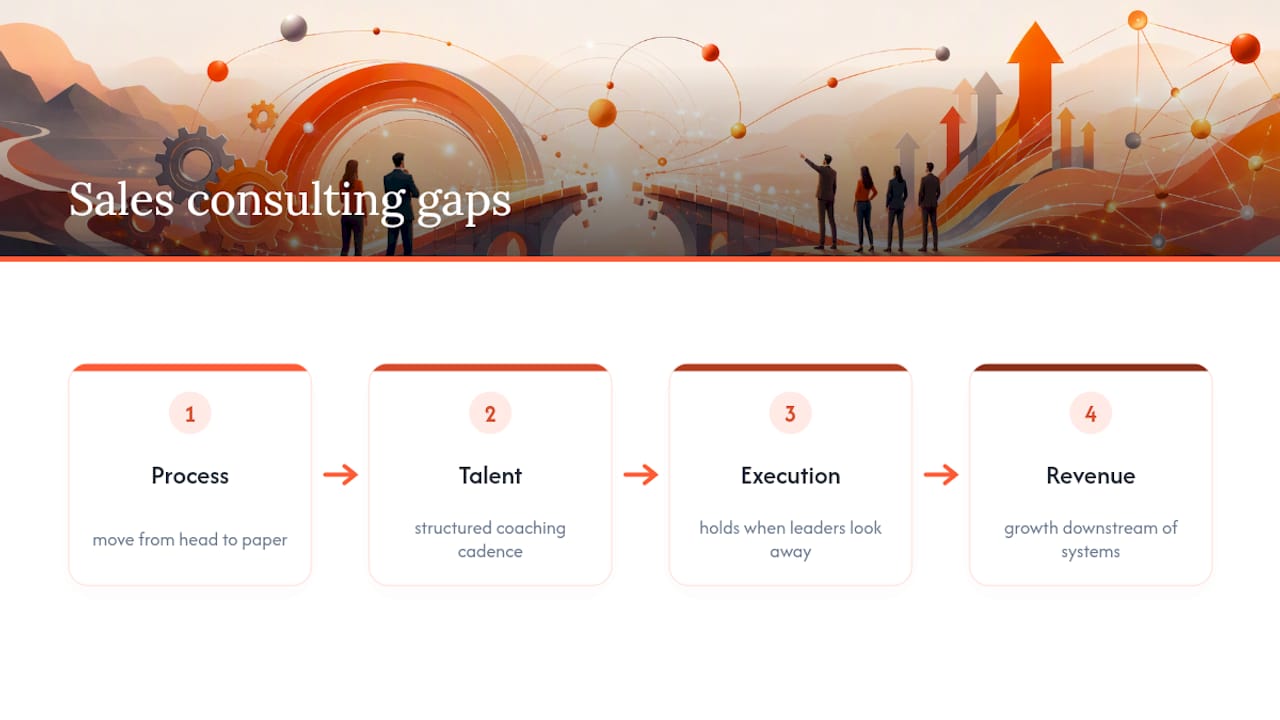
Most companies that seek out a sales strategy consultant already know their revenue number is wrong. What they underestimate is how much of the fix is about talent and execution rather than strategy. A brilliant go-to-market plan means nothing if the manager running weekly pipeline reviews has never been taught what a healthy stage-by-stage conversion rate looks like, or if reps quietly revert to their own habits within three weeks of a training session.
This is where the "consulting services for sales" label gets misleading. It sounds like advice-giving. The good version of this work is closer to operations engineering: build the qualification criteria, build the coaching cadence, build the scorecard, then stay long enough to see whether the team actually uses them. Revenue growth is the outcome everyone wants, but it's downstream of process discipline and consistent coaching, not a separate lever you pull on its own. A sales optimization consultant worth hiring treats those four aims (revenue, process, talent, execution) as one connected system, not four separate line items on a proposal.
Why execution-first consulting works
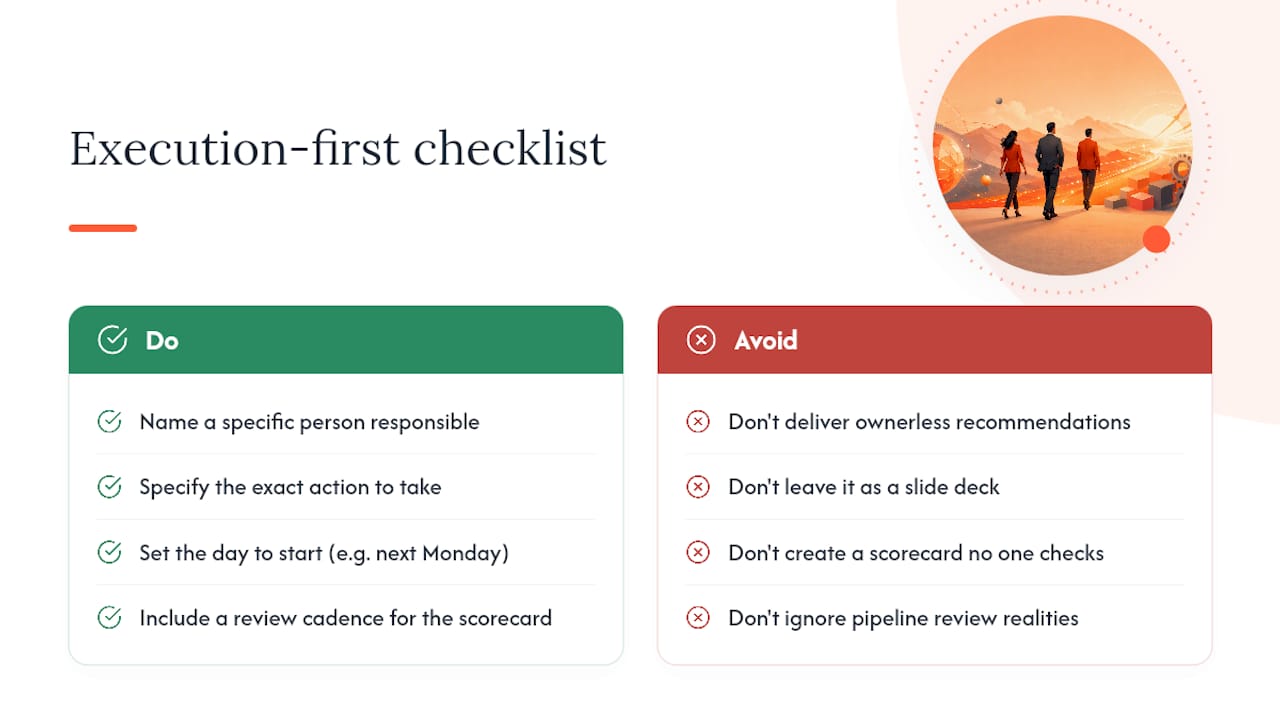
Most sales consulting fails for a boring reason: the recommendations were never designed to survive contact with a Tuesday morning pipeline review. I've watched plenty of strategy get built by people who never carried a quota or ran a P&L, and it shows in the deliverables.
Implementation fails when nobody owns the follow-through, or when a scorecard exists but nobody's cadence includes looking at it. The practical test for any proposal: does it name a specific person doing a specific thing next Monday? If not, it's still a slide deck.
— David
Get an Operations Audit built for how your team actually sells
TKD Consulting's Operations Audit is the alternative to a strategy deck that sits in a shared drive: a time-boxed diagnostic built for owner-operated and mid-market teams that need senior sales and operations judgment without hiring another full-time executive. It maps your people, process, and performance systems against your actual goals, then hands your team a prioritized 60-day action plan, complete with scorecards and a coaching cadence designed to outlast the engagement itself.
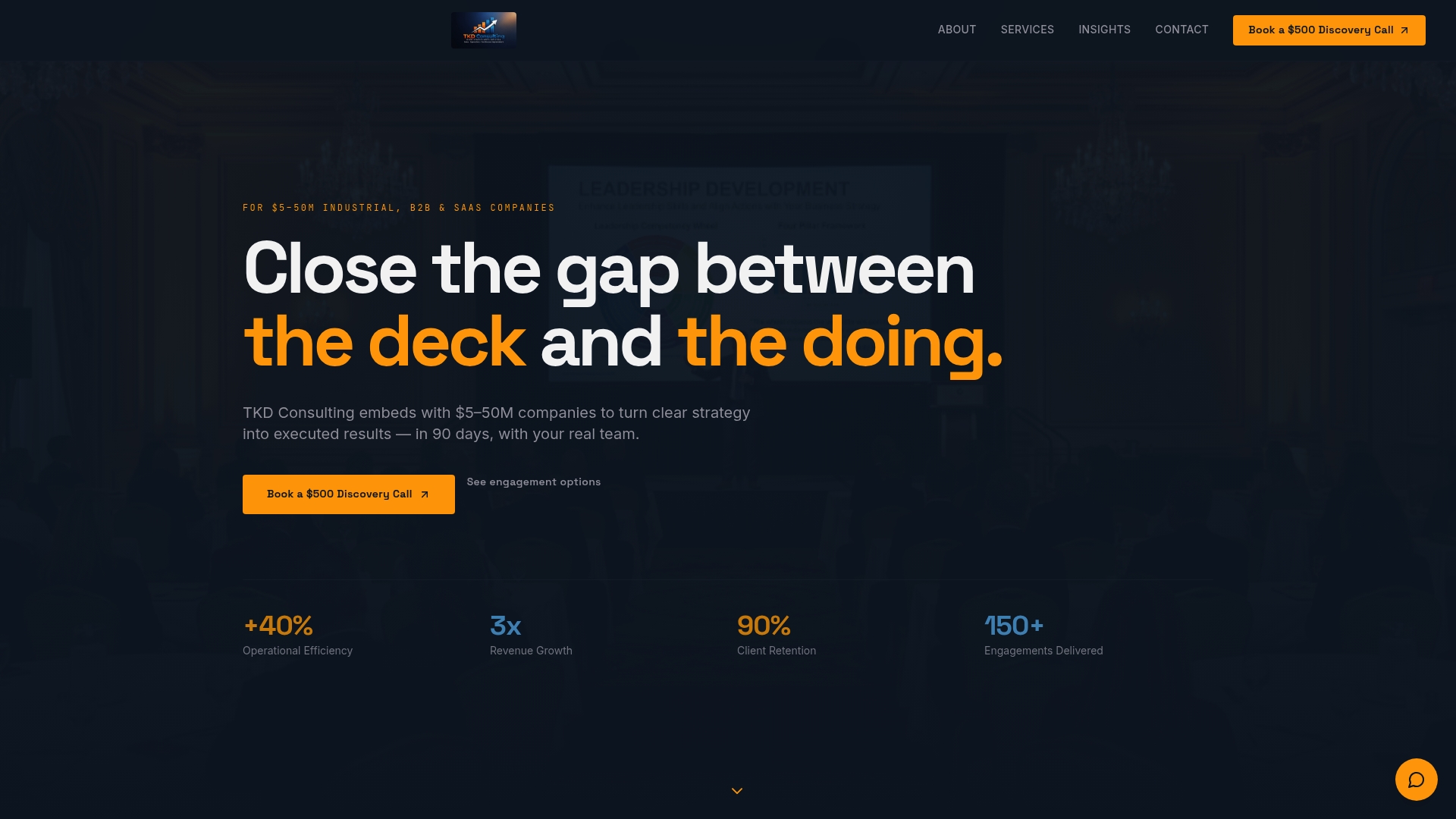
If your pipeline looks healthy on paper but revenue tells a different story, or if you're closing the strategy execution gap has become the real work, start with a conversation. Book an Operations Audit and get a plan your floor managers can start running Monday morning.