
What is a management operating system?
A management operating system is the set of tools, meetings, and behaviors that connects daily operations to strategic goals through a Plan-Do-Check-Act cycle. It is not a software platform or a methodology you read about once. It is the repeating structure that determines whether your team executes consistently or improvises constantly.
The core components of a well-built MOS include:
- Short-interval control meetings at the shift or daily level to catch problems early
- Visual performance tracking that makes KPI status visible without digging through reports
- Defined accountability routines so every leader knows what they own and when they report it
- Feedback loops that carry front-line data up to management and decisions back down
- Standardized review cadences at daily, weekly, and monthly intervals
Without this structure, strategy stays in the boardroom. With it, a floor supervisor on Tuesday morning knows exactly what target they missed on Monday and what to do about it before noon.
Core components that make an operating system work
The pillars of an effective business management framework fall into three categories: structure, tools, and people development. Each one fails without the other two.
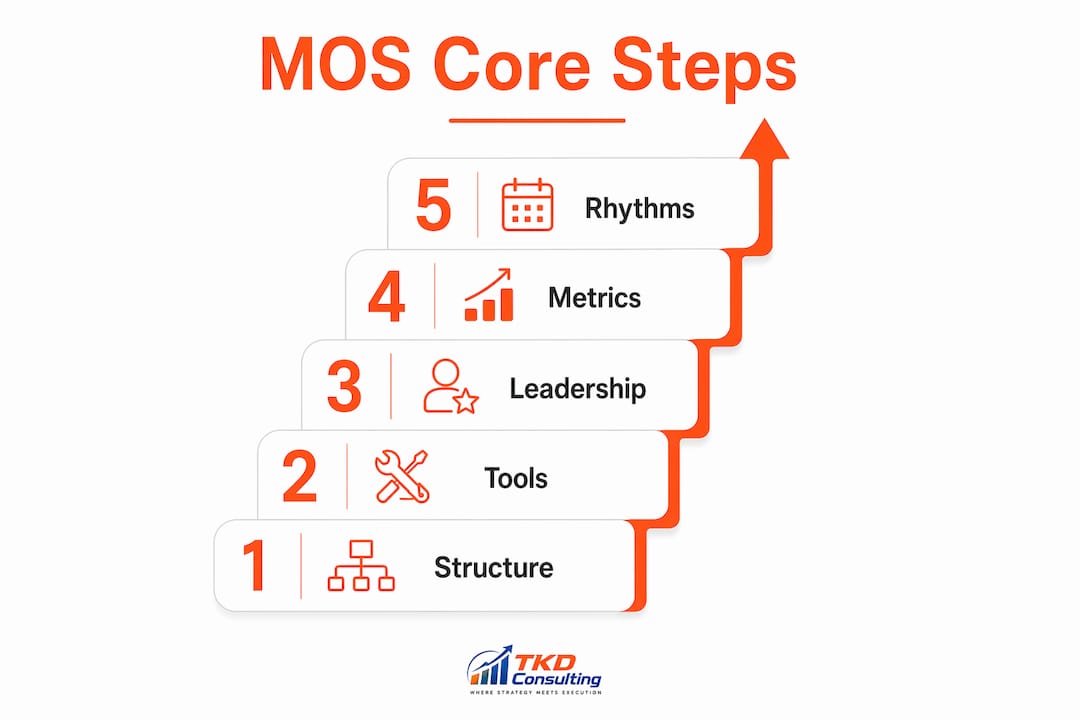
| Component | Function | Example |
|---|---|---|
| Meeting cadences | Create regular checkpoints for performance review | Daily huddles, weekly ops reviews |
| Visual management | Surface KPI status at a glance | Shift boards, digital dashboards |
| Defined KPIs | Measure what drives decisions, not just what is easy to count | Units per shift, defect rate, on-time delivery |
| Accountability roles | Assign ownership of each MOS element | Shift supervisor owns daily actuals |
| Leadership behaviors | Reinforce the system through consistent manager actions | Asking "what changed?" not "who failed?" |
| Continuous improvement loops | Turn data into corrective action | Root cause review in weekly ops meeting |
The Baldrige Excellence Framework makes a point that most practitioners miss: MOS components must align strategy, people, processes, and results together. Implementing any single pillar in isolation tends to feel like administrative overhead to the people doing the work, and adoption collapses within weeks.
Leadership behavior is the pillar that gets cut first and matters most. A supervisor who skips the daily huddle signals to the team that the system is optional. The cadence only holds when leaders treat it as non-optional for themselves.
Pro Tip: Build your operational rhythms before you build your dashboards. A team that meets consistently around simple data will outperform a team with a sophisticated dashboard and no meeting discipline.
How a management operating system improves performance and aligns teams
Front-line leaders who can detect and correct errors within a shift prevent small problems from becoming expensive ones. That is the core performance argument for a well-run operating system, and it is where most organizations leave money on the table by relying on monthly reporting cycles that surface problems weeks after they occurred.
The Baldrige approach describes this progression clearly: organizations move from establishing foundational processes, to developing consistency and data-informed decisions, to maturing into a fully aligned system that continuously learns and improves. Each stage requires the MOS to be functioning before the next stage is reachable.
A well-implemented MOS also moves organizations from firefighting to building by creating standardized, predictable methods for information processing and accountability. The practical effect is that leadership spends less time reacting to surprises and more time making decisions about growth. Communication improves because everyone is working from the same data at the same cadence, not from different versions of last week's spreadsheet.

Resource efficiency follows naturally. When supervisors monitor allocation at short intervals, waste becomes visible before it compounds. That is a different outcome than what monthly variance reports produce.
How to implement or upgrade your management operating system
Start with a current state assessment before designing anything. You need an accurate picture of where your processes actually stand, not where your SOPs say they stand. From there, implementation follows four phases: design, pilot, rollout, and continuous improvement.
Common pitfalls to address in each phase:
- Design: Tracking too many metrics. Map KPIs only to decisions you can actually act on. An MOS should answer "What is the one thing we need to change in the next four hours?" not produce a 40-row report nobody reads.
- Pilot: Choosing the wrong test group. Pilot with a team whose supervisor is bought in, not the team with the most problems.
- Rollout: Skipping training on behaviors, not just tools. The meeting format is easy to teach. The habit of asking the right questions in that meeting takes longer.
- Continuous improvement: Letting the system calcify. Schedule a quarterly review of the MOS itself, separate from the operational reviews it produces.
The planning-execution gap is the most common failure mode: the transition from strategic planning to front-line control breaks down because the system is too complex for supervisors to maintain. Designing MOS updates to take under five minutes per shift is a practical threshold worth holding. If it takes longer, data accuracy degrades and the feedback loop breaks.
Technology helps here. Platforms like CiteOps replace paper and spreadsheets with visual shift-level planning and real-time KPI tracking on tablets, modernizing the Plan-Do-Check-Act process without adding complexity for supervisors. The goal is a measurement culture where data entry is fast, visible, and tied directly to decisions.
Pro Tip: Design the MOS for your front-line supervisors first. If they can update it accurately in under five minutes, the data will be trustworthy. If it takes longer, the system will drift and eventually be ignored.
Leading MOS consulting providers in the United States
Two established providers specialize in management operating system consulting for U.S. organizations. Their approaches differ in meaningful ways depending on what your organization needs.
| Provider | Services Offered | Specializations | Certifications & Credentials | Industry Focus | Location | Rating |
|---|---|---|---|---|---|---|
| Balanced Scorecard Institute | Strategy execution consulting, KPI development, Balanced Scorecard training and certification, Nine Steps™ methodology | Strategy execution, KPI measurement, organizational performance improvement | Balanced Scorecard Professional Certification with The George Washington University | Public and private sector, nonprofits, government | Cary, NC (serves U.S. nationally) | a Google rating of 3.7 based on several reviews |
| SMS Operating Systems | MOS consulting, visual management implementation, accountability practice support | Operational control, performance improvement | Not publicly listed | Operations-focused organizations | New York, NY | — |
The Balanced Scorecard Institute is the stronger choice for organizations that need a credentialed, structured framework. Their Nine Steps™ methodology gives teams a repeatable path from strategy to execution, and the professional certification issued through The George Washington University carries real weight when you need to build internal capability that outlasts the engagement. The Balanced Scorecard framework is used across organizations of all sizes and sectors, which means their consultants have seen the failure modes that trip up most implementations.
SMS Operating Systems focuses on hands-on support for visual management and accountability practices. For operations teams that need practical, on-the-ground help building control systems rather than a certification program, that focus is the right fit.
What MOS implementation actually looks like in practice
The Entrepreneurial Operating System (EOS), detailed in Gino Wickman's Traction, is one of the most widely adopted business management frameworks among U.S. owner-operated companies. It uses scorecards to track leading indicators weekly, so teams stay proactive rather than reactive. The Scaling Up system, built on Verne Harnish's Rockefeller Habits, takes a top-down approach with a heavier emphasis on strategy and cash tools, and typically requires a coach to navigate its complexity.
What these systems share is a rhythm of accountability: defined meetings, defined metrics, and defined owners. The specific framework matters less than whether the cadence actually runs. Organizations that implement EOS but skip the weekly Level 10 meeting get the scorecards without the feedback loop, which is roughly like buying a scale and never stepping on it.
The practical lesson from these examples is that the system's philosophy should match your organization's current maturity. A 15-person company implementing Scaling Up before it has consistent weekly reviews is adding complexity it cannot yet absorb.
How to sustain and continuously improve your MOS over time
Sustaining an MOS long-term requires linking it to organizational purpose, not just operational targets. The Baldrige Excellence Framework is direct on this point: adoption depends on employees understanding why the system exists, not just how to fill it out. When the MOS feels like reporting for reporting's sake, people find ways around it.
Practical habits that keep an MOS alive:
- Review the MOS structure quarterly, not just the data it produces
- Rotate ownership of continuous improvement reviews so the system does not depend on one person
- Celebrate when the MOS catches a problem early, not just when targets are hit
- Adjust KPIs when the business changes rather than tracking metrics that no longer drive decisions
Training and certification programs reinforce MOS credibility and equip leaders with the skills to sustain the system after the initial implementation energy fades. Internal capability building is what separates organizations that improve continuously from those that run a good MOS for six months and then drift back to firefighting.
TKD Consulting brings the MOS from the whiteboard to the floor
If the providers above fit organizations that need a formal certification program or a visual management specialist, TKD Consulting is a different kind of engagement. Founded by David Karpatkin, whose background spans warehouse operations, home services, solar, and consumer products, TKD is built for owner-operated businesses and mid-market teams that need senior operational judgment without adding a full-time executive.
The flagship Operations Audit maps your people, processes, and performance systems against your stated goals, then delivers a prioritized 60-day action plan written for the floor manager who will execute it on Monday morning. Scorecards, meeting cadences, accountability frameworks, and coaching are part of the engagement, not an upsell. If your team is busy but not aligned, or your SOPs exist on paper but nobody follows them, that is exactly the problem TKD's operations consulting is built to solve.
Key Takeaways
A management operating system works only when structure, leadership behavior, and focused metrics operate together as a single system rather than separate initiatives.
| Point | Details |
|---|---|
| MOS connects strategy to execution | It links daily operations to strategic goals through a Plan-Do-Check-Act cycle. |
| Simplicity drives adoption | Designing updates to take under five minutes per shift keeps data accurate and the system alive. |
| KPIs must map to decisions | Track only metrics that answer "what do we change in the next four hours?" to avoid overload. |
| Sustained adoption requires purpose | Linking the MOS to organizational purpose prevents it from feeling like administrative overhead. |
| TKD Consulting for hands-on implementation | The Operations Audit delivers a 60-day action plan with scorecards and meeting cadences built in. |