
An operational readiness review is a structured go/no-go check that verifies whether people, procedures, and systems are genuinely ready to run something new or modified, before it goes live. Done right, it produces a documented decision plus a tracked list of open action items, not just a meeting. The AWS Well-Architected Framework and the DOE's ORR handbook both treat it the same way: evidence in, decision out.
TL;DR:
- An operational readiness review assesses not only technical systems but also organization, procedures, and staff competency, repeating at major changes and incidents.
- The review checklist should focus on critical categories such as architecture, testing, documentation, training, contingency plans, and regulatory compliance, starting with only the most essential items.
- Scheduling the review at least 8 to 12 weeks before launch with clear entry and exit criteria helps prevent rushed sign-offs and overlooked safety-critical issues.
- The review team must include cross-functional, independent, and executive stakeholders to ensure unbiased and comprehensive evaluation, especially under high-pressure situations.
- Post-review, continuous updates and tracking of open action items, incident feedback, and cycle times are essential to ensure findings translate into real operational improvements.
Table of Contents
- How Does an ORR Differ From a PSSR or Change Readiness Check?
- What Goes On the ORR Checklist?
- When Should You Schedule the Readiness Review?
- Who Needs a Seat at the Table?
- How Do You Actually Run the Review?
- Why Do ORRs Fail, and What Are the Warning Signs?
- How Do You Keep the ORR Working After Launch?
- What Does a Completed ORR Report Look Like?
- How Do You Improve the Process After Every Review?
- How Does an ORR Compare to a PDR or PIR?
- What Turns ORR Findings Into Real Fixes?
- How TKD Consulting Turns Readiness Findings Into a Working Plan
- Sources
How Does an ORR Differ From a PSSR or Change Readiness Check?
A pre-startup safety review, or PSSR, checks a specific piece of equipment or process against safety and regulatory requirements before it's turned on. A change readiness assessment looks at whether people and leadership are aligned enough to adopt something new. An operational readiness review sits above both. It asks whether the entire operation, procedures, staffing, documentation, contingency plans, and the technical system itself, can actually function once launched.
The distinction matters because teams often run a PSSR, check the compliance box, and assume they're done. They're not. AIChE's Center for Chemical Process Safety frames operational readiness as organizational and procedural, not just regulatory. A few things follow from that framing:
- An ORR covers training competency, not just training attendance.
- It checks whether documentation matches what's actually built, not what was originally designed.
- It's meant to repeat across the lifecycle, at major changes and after incidents, not just once before startup.
What Goes On the ORR Checklist?
Most operational readiness checklists break into seven categories, and AWS's own guidance groups the technical side into architecture, release quality, and event management. The other four come from process safety and facility-startup practice.
- Architecture and design: Does the system match approved specifications? Are single points of failure identified?
- Release quality: Has the system passed acceptance testing under realistic load or process conditions?
- Event management: Are alerting, escalation paths, and on-call rotations defined and tested?
- Documentation and turnover: Are operating procedures, as-built drawings, and permits complete and handed off?
- Training and staffing: Are operators certified on the actual current procedure, with adequate headcount for the schedule?
- Contingency and recovery: Are rollback, shutdown, and emergency response plans written and rehearsed?
- Compliance and permits: Are all required permits, licenses, and inspections current?
Pro Tip: Don't build a 200-item checklist on day one. Start with the 15 to 20 items that would actually stop a launch if they failed, then expand the list as you learn where gaps show up.
When Should You Schedule the Readiness Review?
Timing is where most ORRs quietly fail, because teams treat the review as a formality squeezed in the week before launch instead of a milestone with its own runway.
- Months out: Begin the Implementation Plan and Plan-of-Action per DOE-HDBK-3012-2003 guidance, well before any review date is set.
- Entry criteria: Confirm acceptance testing is complete, turnover documentation is finished, and a Certification Requirements and Assessment Document, or CRAD, exists.
- 8 to 12 weeks before operations: Hold the ORR itself, once inputs are stable enough to evaluate.
- Build in runway: NRC procedure P-2141 recommends roughly 90 days of buffer between the review and startup, so remediation has room to happen without rushing.
- Exit criteria: All Category A (safety-critical) findings closed, and a formal Readiness to Proceed memo signed by the authorizing executive.
Skip the runway and you get an ORR in name only, a checklist signed off under deadline pressure with open items nobody tracks past launch day.
Who Needs a Seat at the Table?
The review only works if the right mix of people shows up, and if someone senior enough owns the outcome. A team stacked entirely with the people who built the system will tend to grade their own work generously.
- The operations lead who will actually run the thing day to day.
- A safety or quality representative independent of the build team.
- The executive sponsor, who holds final Authorization Authority to approve or delay startup.
- Subject matter experts covering maintenance, training, and IT or engineering support.
- At least one external or cross-functional reviewer when internal politics or schedule pressure runs high.
That last point isn't optional in high-stakes launches. Internal-only teams under deadline pressure are prone to underreporting Category A findings simply because everyone in the room has a stake in the launch date holding.
How Do You Actually Run the Review?
Running an ORR well comes down to three phases: get the evidence together, present it under scrutiny, and chase every finding to closure.
- Prepare. Assemble the Implementation Plan, the CRAD, test results, and turnover packages before scheduling the meeting.
- Present. Walk the review team through a system overview, the test matrix and results, current documentation, training completion records, and contingency plans.
- Follow up. Assign an owner and due date to every open item, verify closure with independent QA rather than a self-report, and archive the final report as the record of decision.
A few habits separate reviews that stick from reviews that get forgotten by week two:
- Log findings the day they're raised, not from memory after the meeting.
- Classify every finding by severity (Category A safety-critical versus lower-priority) before debating whether it blocks startup.
- Require evidence of closure, a test result, a signed procedure, a completed training record, not a verbal "it's handled."
Why Do ORRs Fail, and What Are the Warning Signs?
The most common failure mode isn't a missed checklist item. It's a checklist item marked complete that wasn't actually verified in the field. Practitioner data on ORR checklists points to three repeat offenders: procedures that were written at a desk and never walked through on the floor, training records that confirm attendance but not competency, and punch list items misclassified as minor when they're actually safety-critical.
Watch for these red flags in the room itself:
- Nobody in the meeting can answer "who verified this in the field?"
- Findings get closed on a promise rather than evidence.
- The same three risk items get punted from review to review without escalation.
Pro Tip: If a finding has been "in progress" across two consecutive reviews, that's not a status. That's a decision someone is avoiding making.
How Do You Keep the ORR Working After Launch?
A readiness review that gets filed away after startup is wasted effort. AWS's own operational excellence guidance treats the ORR checklist as a living artifact, updated from real incident data rather than left static.
- Feed every post-incident review, or Correction of Errors process, back into the checklist so the next ORR asks about the failure mode that just happened.
- Push open action items into the team's actual backlog, not a separate compliance tracker nobody checks.
- Put outstanding ORR items on the executive inspection agenda, since sponsorship at that level is what keeps items from going stale.
- Track a small set of metrics: number of open Category A items, average time to closure, and incident recurrence rate tied to prior ORR findings.
A management operating system built around regular leadership reviews is often what makes this cadence stick instead of fading after the first quarter.
What Does a Completed ORR Report Look Like?
A usable ORR template isn't a generic form. It's organized to match the seven checklist categories, with each item scored, evidenced, and owned. A typical structure runs:
Cover section: system or process name, review date, sponsor, and overall recommendation (proceed, proceed with conditions, or hold).
Category scorecards: one section per category (architecture, release quality, event management, documentation, training, contingency, compliance), each item marked complete, incomplete, or not applicable, with a citation to the supporting evidence, a test report number, a signed procedure, a training log.
Findings register: every open item with severity classification, assigned owner, target closure date, and current status. This is the part that gets referenced weekly until the launch, so it needs to stand on its own outside the full report.
Readiness recommendation: a short narrative from the review lead summarizing risk posture and explicit conditions attached to any conditional approval.
A completed sample report for a warehouse management system cutover, for instance, might show 140 checklist items with 132 closed, 6 conditional (training refreshers scheduled within 30 days of go-live), and 2 held pending a network failover test. That's a report with teeth: specific, dated, and owned, rather than a page of checkmarks with no evidence trail behind them. If you don't have a template yet, start by adapting the category structure above rather than building from a blank page. It's faster and it forces you to think in the categories that actually predict failure.
How Do You Improve the Process After Every Review?
The single best predictor of whether your next ORR is better than your last one is whether you actually closed the loop on the previous one's findings. Most teams run the review, celebrate the go decision, and never look at the findings register again until something breaks.
A few habits change that. First, hold a short retrospective after every ORR, separate from the review itself, asking what evidence was hardest to gather and why. If training records took three days to compile because they live in four different systems, that's a process gap worth fixing before the next launch, not a one-time annoyance.
Second, track cycle time on findings closure across reviews, not just within one. If Category A items took an average of 45 days to close on your last three launches, that's a planning input for the next one's runway, not a surprise.
Third, rotate who leads the review. A single person running every ORR for a facility or product line tends to develop blind spots the same way any long-tenured reviewer does. Bringing in a fresh internal reviewer, or an external one when stakes are high, catches assumptions the regular team stopped questioning.
Fourth, treat the checklist itself as a backlog item. Every incident, every near miss, every "we didn't think to check that" moment after launch should generate a specific line item for the next version of the checklist. Teams that skip this step end up running the same review, with the same blind spots, indefinitely.
How Does an ORR Compare to a PDR or PIR?
These three reviews get confused constantly because they all sound like generic project checkpoints, but they check fundamentally different things at fundamentally different times.
A Pre-Deployment Review (PDR) happens earlier and asks a narrower question: is the build itself complete and does it meet design specifications? It's largely a technical sign-off, code, configuration, equipment installation, checked against a spec sheet.
An operational readiness review happens later and asks a broader question: can the organization actually run this thing, day in and day out, including the people, procedures, training, and contingency plans around it? A system can pass its PDR cleanly and still fail its ORR because nobody trained the night shift.
A Post-Implementation Review (PIR) happens after launch, often 30 to 90 days in, and asks whether the thing performed as expected in production. It's retrospective by design, comparing actual results against the assumptions the ORR was built on.
The practical relationship: PDR verifies the build, ORR verifies the organization's ability to run the build, and PIR verifies that the combination actually worked once it hit reality. Skipping the ORR and jumping from PDR straight to a live launch is the most common way otherwise well-built systems fail in their first month, not because the technology was wrong, but because nobody checked whether the humans around it were ready.
What Turns ORR Findings Into Real Fixes?
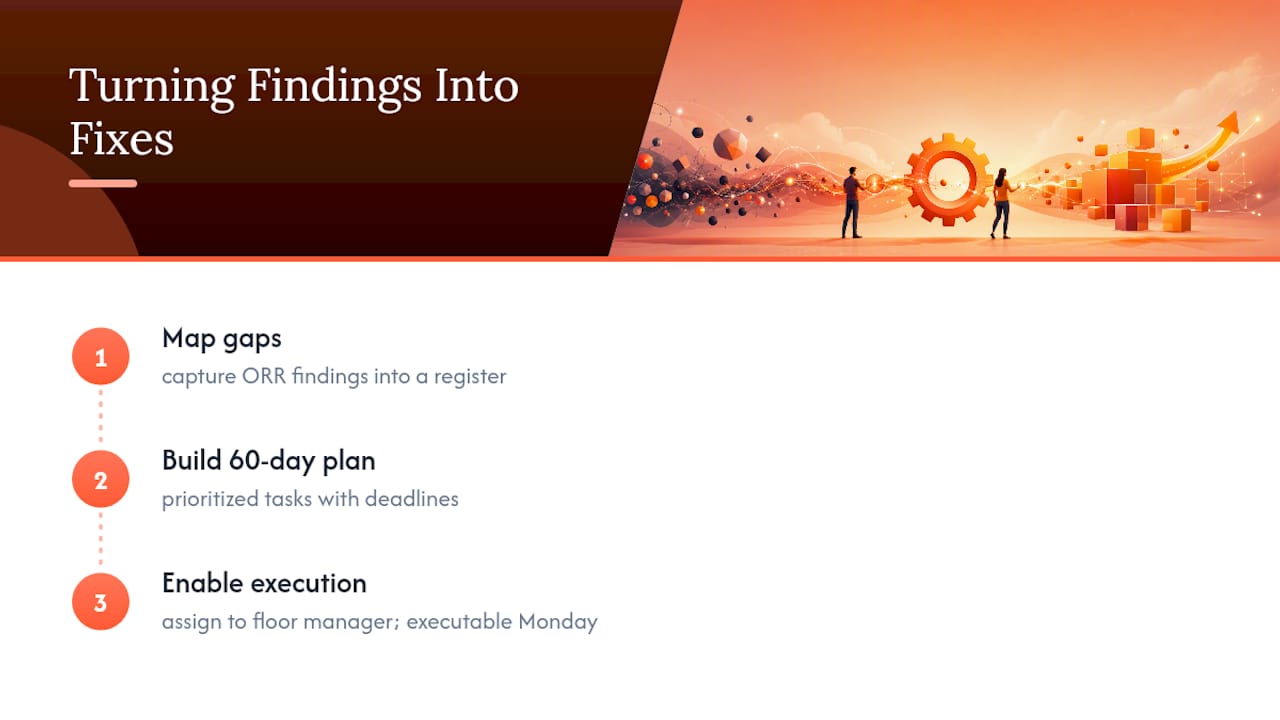
Most ORR reports don't fail because the checklist was wrong. They fail because the findings register sits untouched after the meeting ends, and nobody owns turning "training gap identified" into a scheduled fix with a deadline. That gap between diagnosis and execution is where a structured outside look tends to pay for itself.
An Operations Audit works the way a well-run ORR should: map the gaps, then build a prioritized 60-day plan a floor manager can actually execute Monday morning. David Karpatkin built that approach running warehouse and field operations under real deadline pressure, not from a consulting framework alone. External support earns its cost when internal teams already know something's wrong but keep running out of bandwidth to fix it.
— David
How TKD Consulting Turns Readiness Findings Into a Working Plan
Most operations teams that run an ORR don't struggle to find the gaps. They struggle to turn a findings register into work that actually gets done before the next deadline arrives. Consulting audits can help turn those findings into actionable plans.

Operations audits can be time-boxed diagnostics that map people, processes, and performance systems against readiness requirements, then deliver a prioritized action plan instead of a slide deck. Every ORR action item, whether it's a training gap, a documentation shortfall, or a contingency plan that only exists on paper, can be converted into owned, dated work with a scorecard and a meeting cadence to enforce it. Such audits can serve owner-operated and mid-market industrial, services, and SaaS teams needing senior operational judgment without adding a full-time executive. If your last readiness review left you with a long list of open items and no clear path to closing them, book an Operations Audit and get a plan your team can start executing this week.
Sources
- Operational Readiness Reviews (ORR) - AWS Well-Architected Framework
- DOE-HDBK-3012-2003 Guide to Good Practices for Operational Readiness Reviews (ORR) Team Leader's Guide
- Operational Readiness Review Identifier P–2141 (NRC procedure)
- Introduction to Operational Readiness | AIChE CCPS