
Management consulting is the business of hiring outside experts to diagnose why an organization isn't performing the way leadership wants and to recommend fixes leadership can actually execute. It's a career path built on structured problem solving, and a service organizations buy when they need judgment they don't have in-house. This article walks through the specializations, the skills that get people hired, the pay and career ladder, and how to tell a diagnostic worth paying for from a slide deck that gathers dust.
TL;DR:
- Most management consulting engagements focus on diagnosing root causes with clear, actionable plans and real implementation support, not just delivering reports.
- Specializations include strategy, operations, digital, and HR consulting, with skills in analysis, communication, and project management being most valued.
- Shorter, scope-limited projects with specific, measurable outcomes are increasingly preferred over long-term, open-ended retainers.
- The true value lies in consultants' ability to follow through on recommendations and build accountability frameworks that sustain change beyond the engagement.
Table of Contents
- What Management Consultants Actually Do
- The Different Flavors of Management Consulting
- Skills and Credentials That Actually Matter
- Career Path, Job Titles, and What Consultants Actually Get Paid
- How to Break Into Management Consulting
- When It Actually Makes Sense to Hire a Consultant
- The Practitioner's View: What Slide-Deck Consulting Gets Wrong
- How a Typical Consulting Engagement Actually Unfolds
- Where Consulting Engagements Go Wrong, and the Ethics Behind Them
- Where Management Consulting Is Headed
- Why Most Consulting Advice Undersells the Hard Part
- Get a Diagnostic Built for Execution, Not a Shelf
- Sources
What Management Consultants Actually Do
A management consultant gets hired to look at a specific business problem from the outside and come back with a plan that fixes it. That's the whole job, though the shape of the work varies a lot depending on what's broken.
Most engagements fall into a handful of buckets. A strategy consultant might help a company decide which market to enter next or whether to divest a struggling division. An operations consultant maps out how work actually flows through a warehouse or a service team and finds where it breaks down. A technology consultant leads a digital transformation, migrating a company off spreadsheets and onto a proper ERP system. And organizational change specialists work on the human side, restructuring teams or rebuilding a broken performance culture.
The output of a good engagement usually includes:
- A diagnostic report that names the actual root cause, not just the symptom leadership noticed
- A prioritized action plan, ranked by impact and effort, not a 40-item wish list
- Scorecards or dashboards to track whether the fix is working
- Either a handoff document for the internal team or hands-on implementation support, depending on the scope
That last point is where a lot of engagements quietly fail. A consultant can hand over a beautifully formatted PDF and walk away, and six months later nothing has changed because nobody owned the follow-through.
Pro Tip: Before hiring a consultant, ask directly whether the engagement ends at a recommendation or includes implementation support. The answer tells you whether you're buying a report or an outcome.
The Different Flavors of Management Consulting
Not every consultant does the same kind of work, and knowing the split helps both job seekers and buyers figure out who they actually need.
The broadest divide is generalist versus specialist. Strategy or "general management" consulting tends to sit closest to the C-suite, tackling questions like market entry, pricing, or M&A integration. Specialized consulting drills into one function: operations, IT and digital, human resources, or finance.
A second useful split is industry focus versus functional focus. Some consultants know one industry inside and out (healthcare, manufacturing, SaaS) and apply that depth across many types of problems. Others master one function (supply chain, sales operations, org design) and apply it across many industries.
Typical goals by specialization:
- Strategy consulting: growth planning, competitive positioning, portfolio decisions
- Operations consulting: process mapping, throughput improvement, cost reduction
- IT/digital consulting: system migrations, automation, data infrastructure
- HR/people consulting: org design, compensation structure, leadership development
Skills and Credentials That Actually Matter
Consulting firms and clients look for a fairly consistent skill set regardless of specialization. Quantitative analysis and structured problem solving sit at the top, followed closely by communication. A consultant who can't translate a complex finding into a two-minute explanation for a CEO isn't useful, no matter how sharp the analysis.
Project management ability and facilitation skills round out the core list, since much of the job involves running workshops, managing timelines, and keeping stakeholders aligned.
On credentials, there's no single required path into the field. According to the Princeton Review, there's no mandatory degree for consulting, though most practitioners hold a bachelor's in business or a related field, and MBAs become common at senior levels. Beyond formal education:
- CMC (Certified Management Consultant), offered through the Institute of Management Consultants USA, signals adherence to professional standards
- PMP certification demonstrates project delivery competence and improves hireability for consulting roles
- Data analysis and financial modeling skills are increasingly treated as baseline, not bonus
Practical experience often outweighs credentials at the senior level. Someone who has actually owned a P&L or run a distribution center under pressure brings a kind of pattern recognition no certification teaches.
Career Path, Job Titles, and What Consultants Actually Get Paid
The typical consulting career ladder runs from analyst to consultant to manager, then up to principal or partner. Analysts do the data work and build models. Consultants own workstreams and start client-facing work. Managers run the engagement and the client relationship. Partners sell the work and carry the firm's reputation into the room.
Not everyone climbs that specific ladder, and plenty of experienced operators skip it entirely:
- Independent consultants build their own client base and set their own scope
- In-house strategy or operations roles use consulting skills without the travel
- Fractional COO arrangements let a company get senior operational leadership part-time instead of hiring full-time
On pay, the Bureau of Labor Statistics reports a 2024 median salary of about $101,191 for management analysts, the government's closest occupational match to management consultants, with 9% projected job growth through 2034. That growth rate outpaces the average for all occupations, driven largely by companies wanting outside help with efficiency and technology adoption.
How to Break Into Management Consulting
Getting into consulting without a big-firm pedigree is harder than the internet makes it sound, but expert NAICS code consulting can help guide your classification and entry strategy effectively. Most people get in through one of three doors: a formal internship pipeline, lateral entry after building deep industry experience, or a referral from someone already inside a firm.
- Build real problem-solving reps. Practice case interview frameworks (market sizing, profitability trees, market entry) until they feel automatic, not memorized.
- Get certified where it counts. A PMP or a functional certification (Six Sigma, CMC) gives recruiters something concrete to point to.
- Network deliberately. Cold outreach to consultants for 20-minute conversations works better than mass-applying to job boards.
- Rewrite your resume around outcomes. "Reduced cycle time by X" beats "responsible for operations" every time.
Pro Tip: If you're switching from an industry role into consulting, lead your resume with the specific business problems you solved, not your job title. Firms hire problem solvers, not titles.
Expect early-career work to be heavier on data crunching and slide production than glamorous strategy sessions. That's normal, not a red flag.
When It Actually Makes Sense to Hire a Consultant
Bringing in outside help makes the most sense in a handful of recognizable situations: rapid growth that's outpacing the current org structure, a clear gap between what leadership decided and what's actually happening on the floor, a digital transformation nobody internally has led before, a turnaround, or an M&A integration.
The common thread in all of these is that internal teams are often too close to the problem, or too invested in the current process, to see it clearly. An outside perspective surfaces issues that organizational politics or plain habit have kept hidden.
A engagement worth paying for should produce:
- A prioritized action plan scoped to roughly 60 days, not a 12-month roadmap nobody will follow
- Direct implementation support, not just a recommendation and a wave goodbye
- Scorecards and meeting cadences that keep the changes alive after the consultant leaves
- A scope narrow enough to measure. "Improve operations" isn't a scope; "cut order fulfillment time by 20%" is
Setting the scope tightly up front is what separates engagements that stick from ones that quietly unwind six months later.
The Practitioner's View: What Slide-Deck Consulting Gets Wrong
Most people picture management consulting as a team of analysts building a 90-slide deck and presenting it to an exhausted leadership team. That picture isn't wrong, it's just incomplete, and the missing piece is usually the reason recommendations don't stick.
TKD Consulting was built around that gap. David Karpatkin, who holds an MBA in Global Leadership from UT Dallas, spent years running warehouse operations, leading sales teams to quota, and building commercial infrastructure from scratch before ever writing a diagnostic report. That background shapes how the firm's flagship engagement, the Operations Audit, gets built: a time-boxed assessment of people, processes, and performance systems that ends in a 60-day action plan, not a slide deck.
The distinguishing piece is what comes after the diagnosis:
- An implementation runway: scorecards, meeting cadences, and coaching frameworks handed to a floor manager, not left in a shared drive
- Recommendations written to survive contact with a Monday morning shift, not a boardroom
- Accountability mechanisms built in from day one, instead of bolted on after the changes fail to take
Execution-focused consulting exists because most failed engagements don't fail on strategy. They fail on follow-through.
How a Typical Consulting Engagement Actually Unfolds
Most engagements move through a fairly predictable arc, even when the specific methodology varies by firm or specialization.
It starts with scoping: defining the problem, agreeing on what success looks like, and setting a timeline. Skipping this step, or leaving the scope vague, is the single most common reason engagements run long and disappoint everyone involved.
Next comes diagnosis. This is where the consultant gathers data, interviews stakeholders, and observes actual operations rather than relying only on what leadership believes is happening. The gap between the two is often the whole finding.
Then comes the recommendation phase: synthesizing findings into a prioritized set of actions, usually ranked by impact versus effort, and presenting them in a form the client can actually act on.
The final phase, and the one traditional consulting skips most often, is implementation. This is where recommendations get translated into new workflows, training, scorecards, and accountability structures. ISO 20700, the international guideline for management consultancy services published in 2017, treats this phase as part of the professional standard, not an optional extra.
Some firms formalize these stages into named methodologies; others run a looser version of the same arc. What matters more than the label is whether the last phase actually happens, since that's where most of the real value either shows up or evaporates.
Where Consulting Engagements Go Wrong, and the Ethics Behind Them
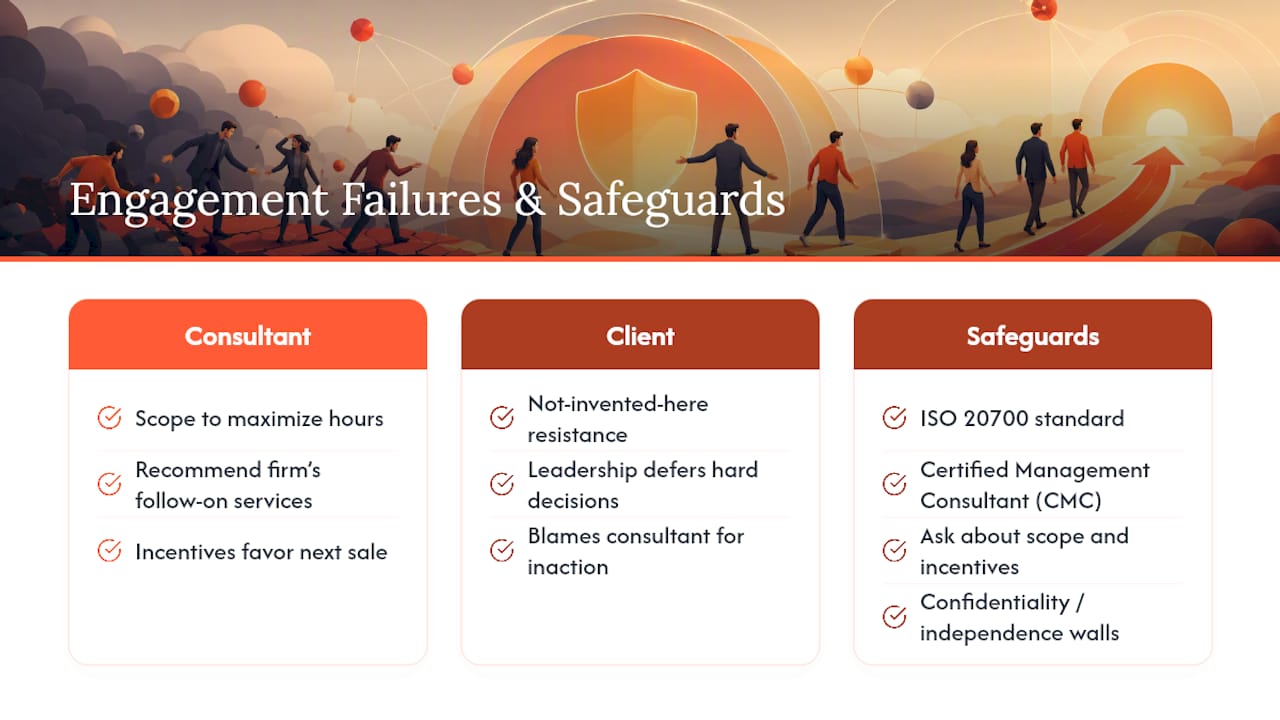
The most common failure in consulting isn't bad analysis. It's a good analysis that never gets implemented because the consultant's incentives point toward the next sale rather than the current client's follow-through.
That tension shows up in a few recognizable patterns. Some firms scope engagements broadly to maximize billable hours rather than to solve the actual problem quickly. Others recommend solutions that happen to require the firm's own follow-on services, a conflict of interest that's rarely disclosed outright. And because consultants often work with sensitive financial and personnel data, confidentiality and independence matter enormously; a consultant advising two competitors in the same market needs airtight walls between engagements.
Client-side challenges compound the problem. Internal teams sometimes resist recommendations they didn't help create, a dynamic often called the "not invented here" effect. Leadership can also treat a consultant's report as a substitute for making a hard decision themselves, then blame the consultant when nothing changes.
The industry's answer to some of this is standardization. ISO 20700 and the Certified Management Consultant credential exist specifically to give clients a way to vet a consultant's professionalism and independence before signing a contract. Neither guarantees quality, but both are reasonable filters. The more reliable filter, honestly, is asking pointed questions about scope, incentives, and what happens after the final presentation.
Where Management Consulting Is Headed
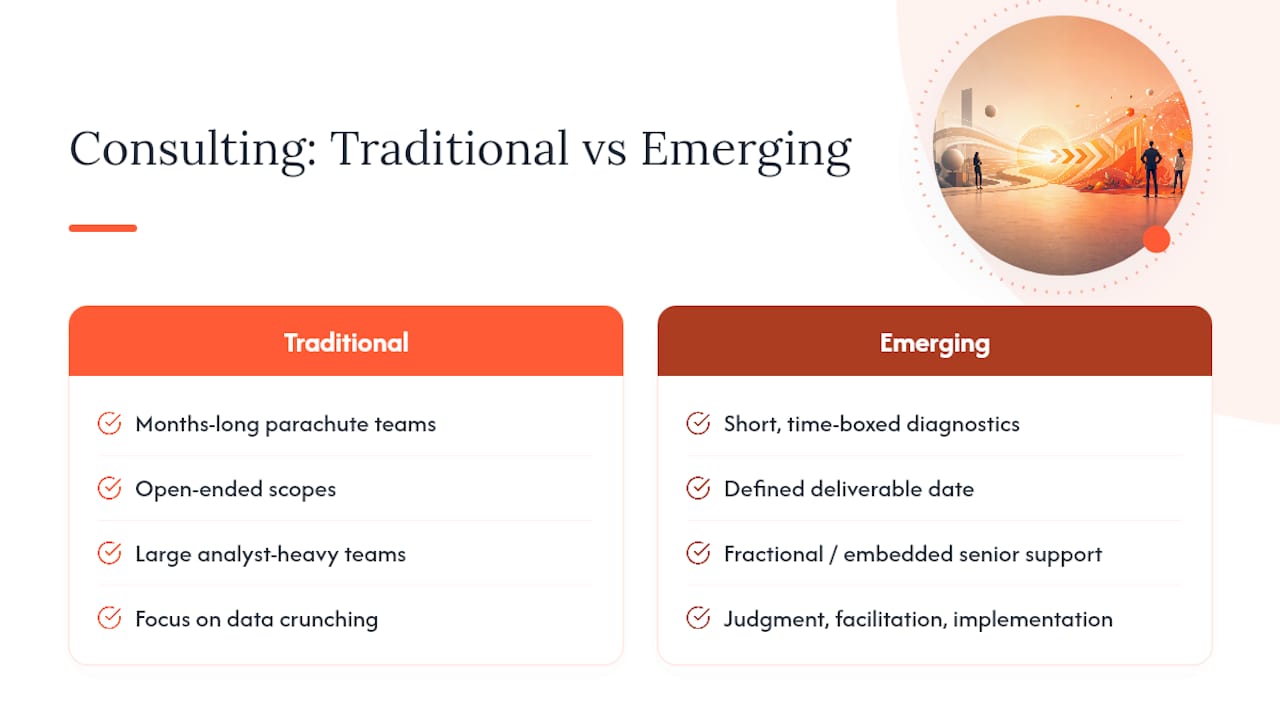
A few shifts are reshaping how consulting gets bought and delivered, and none of them point toward the old model of a big team parachuting in for six months.
Clients increasingly want shorter, sharper engagements. Instead of open-ended strategy retainers, more organizations are buying time-boxed diagnostics with a defined deliverable date, largely because leadership has gotten burned by open-ended scopes before.
Technology is compressing the analysis phase. Data analysis work that used to take a team of analysts weeks now happens faster with better tooling, which shifts the real value of a consultant toward judgment, facilitation, and implementation rather than data crunching.
Embedded and fractional models are also gaining ground. Rather than hiring a full consulting team or a full-time executive, mid-market companies are increasingly buying fractional COO-style support: senior judgment on a retainer basis, without the overhead of a permanent hire.
None of this eliminates the core value proposition. Organizations still need an outside, objective perspective to see problems their own teams are too close to notice. What's changing is the packaging: shorter timelines, tighter scopes, and a growing expectation that the consultant sticks around long enough to see the change actually take hold.
Why Most Consulting Advice Undersells the Hard Part
The conventional advice about management consulting spends most of its energy on how to get hired, and almost none on what separates a useful engagement from a wasted one. That's backwards for anyone actually trying to fix a business, not just enter the profession.
The research is pretty consistent on one point: the value of consulting comes from an outside perspective paired with the discipline to see a recommendation through. Career guides love to talk about frameworks and case interviews, and those matter for getting hired. But frameworks are commodity knowledge now. What isn't commoditized is judgment earned from actually running operations under pressure, and the willingness to stay past the recommendation phase.
If there's one thing worth prioritizing, whether you're building a career in this field or hiring for one, it's implementation capacity. A sharp diagnosis without an execution plan is just an expensive opinion. The organizations getting real value from consulting aren't the ones with the fanciest strategy decks. They're the ones whose consultant stuck around long enough to build the scorecards and cadences that keep the change alive after the invoice is paid.
— David
Get a Diagnostic Built for Execution, Not a Shelf
If this article made one thing clear, it's that the gap between a smart recommendation and an actual result is where most consulting engagements quietly fail. TKD Consulting exists specifically to close that gap: instead of a strategy deck that sits in a shared drive, you get a diagnostic built to hand to a floor manager on Monday morning.
The Operations Audit is the entry point: a structured, time-boxed assessment of your people, processes, and performance systems that ends in a prioritized 60-day action plan, plus the scorecards and coaching frameworks to keep it running after the engagement ends. If your team already has a strategy but can't seem to get it off paper, the Strategy Execution Gap page walks through exactly how that disconnect gets fixed. Owner-operators and operations leaders at $5 million to $50 million companies use this when growth has outpaced the org chart, or when the SOPs exist but nobody follows them. Book a discovery call and find out whether an Operations Audit is the right starting point for where your team is stuck.
Sources
- Management consulting - Wikipedia
- Management analysts | U.S. Bureau of Labor Statistics
- What Does a Business Consultant Do? | SNHU