
A strategy execution framework is a systematic set of phases, mechanisms, and governance structures that translate strategic intent into measurable daily outcomes. If you have a strategy but your team is still firefighting, start here: mandate a one-page initiative brief before any new initiative launches this week.
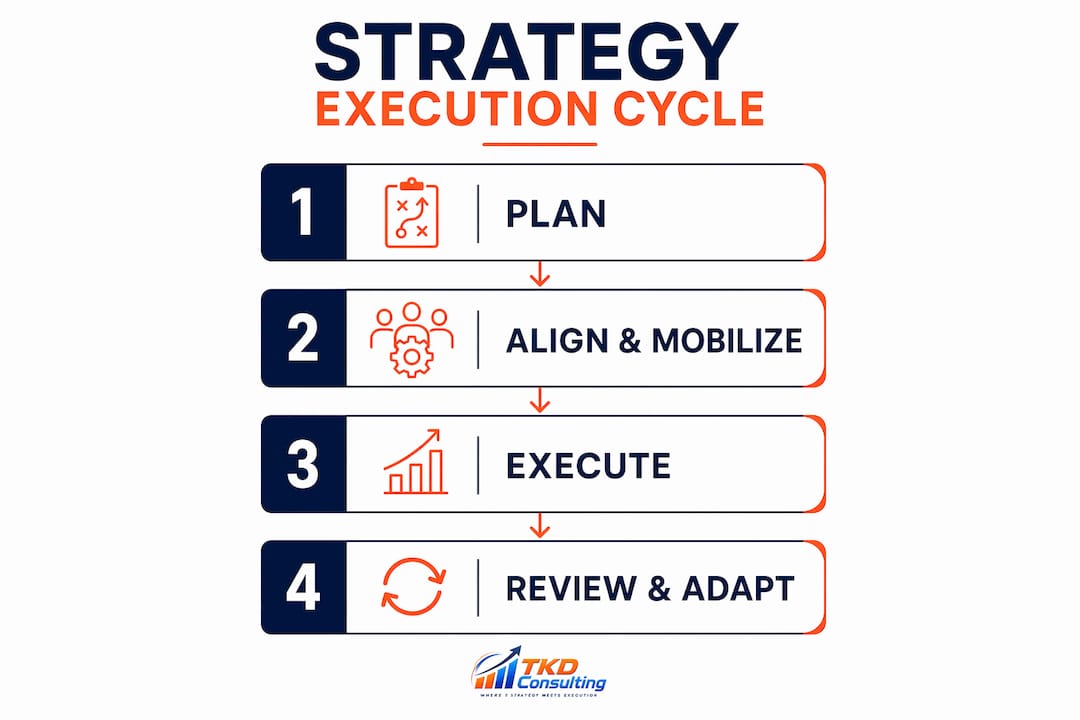
The framework has four essential elements, each feeding the next in a continuous cycle:
- Plan: Define strategic pillars, set OKR anchors, and map capabilities against priorities.
- Align & Mobilize: Cascade goals, assign sponsors, and stand up governance (including an Office of Strategy Management).
- Execute: Run weekly cadences, maintain dashboards, and confirm resources at each gate.
- Review & Adapt: Hold quarterly pivot reviews, adjust priorities, and close the loop before the next planning cycle.
The single highest-leverage first action is the one-page launch handshake. No initiative starts without a confirmed owner, resource sign-off, decision rights, and a 30-day outcome target written on one page. That one rule alone stops more failed projects than any strategy offsite.
Table of Contents
- What is a strategy execution framework, and why does it matter now?
- Why strategy execution usually fails
- A practical four-phase strategy execution framework
- Operational mechanisms that connect strategy to daily work
- How to implement the framework: a step-by-step playbook
- What to measure and how to build dashboards that drive decisions
- Common rollout pitfalls and the red flags that signal trouble early
- A 60-day operations audit playbook (TKD Consulting example)
- Key Takeaways
- Why the handshake beats the transformation project
- TKD Consulting turns strategy into results you can measure
- Useful sources and further reading
What is a strategy execution framework, and why does it matter now?
A strategy execution framework is the operating system between your strategy deck and your team's Monday morning. It defines the phases, tools, and governance that convert strategic choices into measurable outcomes, quarter over quarter. The key word is systematic: without it, execution depends on heroics and memory rather than repeatable process.
The cyclical model (Plan → Align & Mobilize → Execute → Review & Adapt) outperforms the traditional annual planning approach because strategy rarely survives contact with reality unchanged. Markets shift, capacity constraints surface, and priorities compete. A cyclical model builds in the adaptation loop that a linear, once-a-year process cannot.
Leaders should expect five core components in any credible framework:
- OKRs (Objectives and Key Results): Focus and outcome accountability at the team level.
- Balanced Scorecard (Kaplan & Norton): Balanced measurement across financial, customer, process, and learning dimensions.
- Capability map: A visual inventory of organizational capabilities versus what the strategy actually requires.
- Operating model canvas: A one-page view of how the organization delivers value, highlighting where the model must change.
- Office of Strategy Management (OSM): A small governance team that maintains execution rhythm and escalates blockers.
Together, these components connect strategic intent to the floor-level work that actually moves the numbers.
Why strategy execution usually fails
Most execution failures are not strategy problems. The strategy is often sound. The breakdown happens in the space between decision and delivery, and it almost always traces back to the same handful of root causes.
Wharton's research shows that organizations fail when leaders apply single-variable fixes, such as adjusting incentives or restructuring the org chart, instead of aligning culture, reporting lines, and resource allocation simultaneously. Fixing one lever while leaving the others unchanged rarely holds.
The recurring failure drivers, and the framework mechanisms that address each:
- No clear ownership: Every initiative has a sponsor in name but no accountable owner with decision rights. Fix: assign a single named owner per initiative in the one-page brief.
- Weak governance: No OSM, no cadence, no escalation path. Fix: stand up even a part-time OSM function with a defined meeting rhythm.
- Tracking activity instead of outcomes: Teams report tasks completed, not results changed. Fix: shift to outcome-based KRs where the measure is a business result, not a deliverable.
- Missing capability alignment: The strategy requires skills or capacity the organization does not have. Fix: run a capability map before committing to initiatives.
- No execution cadence: Strategy gets reviewed quarterly at best, so drift goes undetected for months. Fix: weekly tactical meetings with a standing agenda tied to dashboard thresholds.
- Resource misallocation: Initiatives are approved without confirming budget or headcount. Fix: resource confirmation is a required field on the launch handshake.
- Cultural reversion to daily fires: Teams default to urgent operational work the moment pressure rises. Fix: the OSM's job is to protect strategic work time and flag when drift is happening.
Pro Tip: The fastest diagnostic is to pull your last five initiative launches and check whether a one-page brief exists for each. If fewer than three do, your governance gap is the primary execution risk, not your strategy.
A practical four-phase strategy execution framework
The four phases below form a repeatable cycle, not a one-time project. Each phase has a clear purpose, expected outputs, and the tools that plug in most naturally.
Phase 1: Plan (weeks 1–4)
Purpose: Translate strategic intent into a prioritized, resourced set of initiatives with measurable outcomes.
Key activities:
- Define three to five strategic pillars with a one-sentence outcome statement each.
- Build a capability map: what capabilities does each pillar require, and what gaps exist today?
- Set OGSM or OKR anchors at the organizational level (Objectives and Key Results for focus; OGSM for organizations that need a tighter narrative link between goals and measures).
- Confirm resource availability before any initiative is approved.
Tools: OKRs, OGSM, Hoshin Kanri (for organizations that need policy deployment cascades across manufacturing or field operations), capability map.
Phase 2: Align & Mobilize (weeks 3–8)

Purpose: Create the execution bridges that prevent teams from reverting to default operational priorities. HBR's research identifies mobilization as the most commonly skipped and most consequential phase.
Key activities:
- Assign an executive sponsor and a named initiative owner for each pillar.
- Stand up the OSM or designate an existing role to perform OSM functions.
- Cascade OKRs from organizational level to team level, with each team's Key Results visibly connected to a strategic pillar.
- Run a pre-launch handshake for every initiative: owner confirmed, resources confirmed, dependencies mapped, first-30-day outcomes written down.
Tools: Balanced Scorecard (for cross-functional alignment across four perspectives), cascaded OKRs, one-page initiative brief.
Phase 3: Execute (ongoing, weekly/monthly rhythm)
Purpose: Convert aligned plans into measurable progress through disciplined cadence and visible accountability.
Key activities:
- Weekly tactical meetings: 30–45 minutes, standing agenda, dashboard-driven, focused on blockers and threshold breaches.
- Monthly resource reviews: confirm capacity is still allocated as planned.
- Dashboard updates: lead and lag indicators refreshed on the agreed cycle (see Section 7).
- Escalation protocol: any threshold breach triggers a defined governance response within 48 hours.
Tools: 4DX (Four Disciplines of Execution) works well here for teams that need a simple scoreboard and WIG (Wildly Important Goal) focus. Balanced Scorecard dashboards for cross-functional visibility.
Phase 4: Review & Adapt (quarterly)

Purpose: Close the loop. Assess what moved, what did not, and why, then adjust priorities before the next execution cycle begins.
Key activities:
- Quarterly strategy review: compare outcomes against OKR targets, not just task completion.
- Pivot decision gates: for any initiative more than 20% off target, the sponsor decides to continue, adjust, or stop.
- Capability reassessment: has the gap map changed? Are new investments required?
- Feed findings back into the next Plan phase.
Typical timeline: Most organizations run a 90-day execution cycle with a full Review & Adapt session at the end. The handoff from Review & Adapt back to Plan should take no more than two weeks to avoid momentum loss.
Operational mechanisms that connect strategy to daily work
Knowing the phases is one thing. The mechanisms below are what actually make the cycle run.
OKRs vs. Balanced Scorecard: use them together
OKRs and the Balanced Scorecard solve different problems. OKRs drive focus and outcome accountability at the team level: one Objective, two to four Key Results, a 90-day horizon. The Balanced Scorecard (developed by Kaplan & Norton) provides a broader measurement architecture across four perspectives: financial, customer, internal process, and learning & growth. Used together, OKRs give teams a sharp target while the Balanced Scorecard ensures the organization is not optimizing one dimension at the expense of another.
A team hitting its revenue OKR while customer satisfaction collapses is not executing well. The Balanced Scorecard catches that trade-off before it compounds.
The Office of Strategy Management
The OSM's role is often misunderstood. It does not own the strategy. It owns the rhythm. A small OSM team (even one dedicated person in a mid-market company) maintains the reporting cadence, runs the review meetings, tracks threshold breaches, and escalates cross-team blockers before they stall progress. Its success metrics are cadence consistency and blocker resolution speed, not strategy quality.
The IIBA Strategy to Execution Framework identifies sponsorship, governance, and execution roadmaps as the central program-level artifacts. The OSM is the function that keeps all three current.
Pro Tip: If you cannot staff a dedicated OSM, assign OSM responsibilities to a Chief of Staff or a senior operations manager with explicit authority to call escalation meetings. The function matters more than the title.
Capability maps and the operating model canvas
A capability map lists what the organization must be able to do to deliver its strategy, then rates current proficiency against each capability. It surfaces the gaps that will kill execution before they surface as missed targets. The operating model canvas complements it by showing how value is delivered end-to-end, making it visible where the current model must change to support new strategic priorities.
The CADAP framework validates this approach empirically: organizations that assess capability, agility, design, alignment, and people together show measurably better adaptability and performance than those that address only one or two dimensions.
Meeting cadence table
| Meeting | Who | Frequency | Purpose | Key Output |
|---|---|---|---|---|
| Weekly tactical | Initiative owners, OSM | Weekly | Review dashboard, clear blockers | Blocker log, updated thresholds |
| Monthly resource review | Sponsors, OSM, finance | Monthly | Confirm capacity allocation | Resource adjustment decisions |
| Quarterly strategy review | Executive team, OSM | Quarterly | Assess OKR progress, pivot decisions | Updated priorities, next-cycle OKRs |
| Annual planning session | Executive team, all sponsors | Annual | Reset strategic pillars, capability map | Refreshed strategy, new OKR anchors |
How to implement the framework: a step-by-step playbook
The steps below assume you are starting or restarting a strategic initiative. Follow them in order; skipping steps is where most rollouts break down.
- Mandate the one-page brief. Before any initiative starts, the owner completes a one-page launch brief covering: confirmed owner, confirmed resources, decision rights, mapped dependencies, and a 30-day outcome target. No brief, no start.
- Assign roles explicitly. Name the executive sponsor (accountable for strategic alignment and resource protection), the initiative owner (accountable for delivery), delivery leads (accountable for workstreams), and the OSM contact (accountable for cadence and reporting).
- Set up the dashboard before work begins. Identify three to five lead indicators per initiative. Assign an owner to each metric. Set the threshold that triggers an escalation.
- Run the first weekly tactical meeting in week one. Do not wait for something to report. The first meeting establishes the habit and surfaces early blockers.
- Confirm resources at the 30-day mark. The first milestone review is a resource check, not just a progress check. Has the budget been released? Is the headcount available?
30/60/90-day milestones:
- Day 30: One-page briefs complete for all active initiatives, dashboards live, first weekly cadence established, capability gaps identified.
- Day 60: First outcome data visible on dashboards, at least one blocker resolved through OSM escalation, resource allocation confirmed or adjusted.
- Day 90: First quarterly review complete, pivot decisions made on any initiative more than 20% off target, next-cycle OKRs drafted.
Pro Tip: The 30-day milestone is the most predictive. If you do not have live dashboards and confirmed resources by day 30, the initiative will drift. Treat day 30 as a hard gate, not a soft checkpoint.
Governance artifacts to enforce: the one-page brief is non-negotiable. Add a pre-launch checklist (five items, one page) that the OSM signs off on before any initiative enters the Execute phase. Disciplined project governance at this level prevents brilliant strategies from failing during delivery.
What to measure and how to build dashboards that drive decisions
Most dashboards show what the team did. A good strategy dashboard shows whether the business moved.
The distinction between metric levels matters:
| Metric Level | Example | Refresh Cycle | Decision Trigger |
|---|---|---|---|
| Strategic (outcome) | Revenue per customer increased | Monthly | Below target by >20% → sponsor review |
| Tactical (team KR) | Onboarding time reduced significantly | Bi-weekly | Flat for two cycles → owner escalation |
| Operational (activity) | % of tickets resolved within SLA | Weekly | Below threshold → team-level corrective action |
A few dashboard design principles that actually change behavior:
- Lead indicators first. Lag indicators tell you what happened. Lead indicators tell you what is about to happen. Put them at the top of the dashboard.
- Owner labels on every metric. A metric without a named owner is a metric nobody watches.
- Decision thresholds, not just traffic lights. A red indicator means nothing without a defined next step. Write the governance action next to the threshold.
- Three to five metrics per strategic priority. More than five and attention fragments. Fewer than three and you are probably missing a leading signal.
The Perdoo guide to strategy execution illustrates this well: tracking ticket resolution time dropping significantly is an outcome measure. Tracking the number of training sessions completed is an activity measure. Only the first one tells you whether the strategy is working.
Common rollout pitfalls and the red flags that signal trouble early
Even well-designed frameworks break down in predictable ways. Catch these early.
- No measurable owner. The initiative has a sponsor but no single person whose performance review reflects the outcome. Red flag: the weekly meeting has no one who can say "I own this number." Corrective action: assign one named owner before the next meeting and update the brief.
- Overcomplicated metrics. Fifteen KPIs per initiative means no one knows what matters. Red flag: the dashboard takes more than two minutes to interpret. Corrective action: cut to three to five outcome metrics and archive the rest.
- Missing cadence. The weekly meeting gets canceled twice in a row and never rescheduled. Red flag: the last dashboard update is more than three weeks old. Corrective action: the OSM calls an emergency reset meeting and re-establishes the rhythm before the next week ends.
- Sponsoring executive pulls away. The sponsor stops attending reviews and delegates to a coordinator. Red flag: escalated blockers sit unresolved for more than two weeks. Corrective action: escalate to the CEO or board sponsor; a disengaged sponsor is a project-stopper.
- Initiative launches without resource confirmation. Work starts before budget or headcount is confirmed. Red flag: the team is "working on it" but cannot name the confirmed resources. Corrective action: pause the initiative and complete the one-page brief before any further work.
When dashboards show activity metrics trending up but outcome metrics are flat, that is the clearest early-warning signal of execution drift. Escalate to the OSM immediately and schedule a pivot review within the week.
A 60-day operations audit playbook (TKD Consulting example)
The following playbook is the structure TKD Consulting uses in its Operations Audit engagements. It is designed to be completed in 60 days and to produce deliverables a floor manager can act on the following Monday.
Week-by-week structure
- Weeks 1–2: Discovery and floor interviews. Map the current state: interview frontline managers and team leads, observe daily operations, and document where strategic priorities are visible (or absent) in day-to-day work. Deliverable: current-state process map and a list of the top ten friction points.
- Weeks 3–4: Capability mapping and gap analysis. Compare what the strategy requires against what the organization can currently deliver. Identify the three to five capability gaps most likely to block execution. Deliverable: capability gap map with priority ratings.
- Weeks 5–6: Quick-win prioritization and pilot design. Select two to three quick wins that can show measurable outcome improvement within 30 days. Design the pilot: owner, metric, resource, timeline. Deliverable: prioritized 60-day action plan with one-page briefs for each quick win.
- Weeks 7–8: Pilot launch and governance setup. Launch the quick-win pilots. Stand up the meeting cadence (weekly tactical, monthly resource review). Build the dashboard prototype with three to five lead indicators per priority. Deliverable: live dashboard prototype and governance calendar.
Deliverable checklist
- Current-state process map
- Top-ten friction point register
- Capability gap map with priority ratings
- Prioritized 60-day action plan
- One-page initiative briefs for each quick win
- Dashboard prototype with lead and lag indicators
- Governance calendar with meeting cadence
Pro Tip: The capability gap map is the deliverable most clients say they wish they had built before launching their last major initiative. Build it in weeks 3–4, before any quick-win work begins, so you are not designing pilots around capabilities you do not have.
David Karpatkin brings direct operational experience to these engagements: P&L ownership, distribution center management, sales team leadership, and commercial infrastructure builds from zero. That background means the continuous improvement recommendations in the audit are written for the person who has to implement them, not the person who approved the strategy.
Key Takeaways
A strategy execution framework works only when governance, cadence, and outcome-focused measurement run together as a system, not as separate initiatives.
| Point | Details |
|---|---|
| Cyclical beats linear | Treat execution as a repeating Plan → Align → Execute → Review cycle, not a one-time annual event. |
| Mandate the one-page brief | Require a confirmed owner, resources, and a 30-day outcome target before any initiative starts. |
| Measure outcomes, not activity | Track business results (e.g., reduced onboarding time), not tasks completed. |
| OSM owns the rhythm | A small Office of Strategy Management maintains cadence and resolves cross-team blockers, not strategy itself. |
| TKD Consulting's Operations Audit | Delivers a prioritized 60-day action plan, capability gap map, and live dashboard in eight weeks. |
Why the handshake beats the transformation project
Most organizations I work with have tried the big transformation: the 18-month initiative, the external consultants, the strategy offsite with the laminated posters. Some of those projects move the needle. Most do not, and the reason is almost never the quality of the strategy.
The failure point is almost always mobilization. Wharton's research confirms what practitioners see on the ground: leaders who fix one variable at a time, incentives, structure, or culture in isolation, consistently underperform compared with those who align all of them together. But that alignment does not require a massive project. It requires a few low-overhead rules enforced consistently.
The one-page brief is the best example. It takes 20 minutes to complete. It forces the conversation about ownership, resources, and dependencies that most teams skip in the rush to start. And it creates a paper trail that makes accountability visible. I have seen that single artifact prevent more initiative failures than any governance framework diagram ever drawn on a whiteboard.
The OSM rhythm is the other piece most organizations underinvest in. A weekly 30-minute tactical meeting, run consistently, catches blockers before they compound. A quarterly review with real pivot authority stops organizations from funding initiatives that stopped working six months ago. Neither requires a large team or expensive software. They require discipline and a leader willing to protect the time.
The before/after pattern in short engagements is consistent: teams that start with no cadence and activity-based metrics move to weekly reviews and outcome dashboards within 60 days. The metric that changes most visibly is usually time-to-resolution on operational blockers, because the escalation path now exists and someone owns it.
TKD Consulting turns strategy into results you can measure
Most operations leaders already know what needs to change. The gap is the system to make it stick. TKD Consulting's Operations Audit is a structured, 60-day diagnostic built for owner-operators and mid-market operations teams at $5–50M companies who need senior operational judgment without adding a full-time executive.
The engagement delivers a current-state process map, a capability gap analysis, a prioritized 60-day action plan, and a live dashboard prototype, all written to be handed to a floor manager on Monday morning. The implementation runway is included: scorecards, meeting cadences, and accountability mechanisms that keep changes from evaporating after the engagement ends. David Karpatkin has carried the P&L, run the distribution center, and built the sales infrastructure. The recommendations come from that experience, not from a framework template.
Book a discovery call at tkdconsult.com to see whether the Operations Audit is the right fit for your current execution gap.
Useful sources and further reading
The sources below informed this guide and offer templates, playbooks, or conceptual depth for leaders who want to go further.
- IMD Strategy Execution Playbook — Covers the cyclical execution model and modular phases. Conceptual framework with practitioner commentary. Good starting point for leaders new to formal execution disciplines.
- IIBA Strategy to Execution Framework (Preview Edition) — Program-level artifacts: sponsorship, governance, execution roadmaps, stakeholder strategy. Useful for organizations running complex, multi-workstream initiatives.
- Perdoo: The Ultimate Guide to Strategy Execution — Practical OKR and outcome-measurement guidance with concrete examples. Includes templates and a step-by-step implementation sequence.
- CADAP Strategy Execution Framework Study — Empirically validated five-dimension framework (capability, agility, design, alignment, people). Useful for organizations assessing execution readiness in complex environments.
- HBR: How to Ensure Your Company Acts on Your New Strategy — Focuses on mobilization as the critical gap between decision and delivery. Conceptual but grounded in organizational behavior research.
- The Strategy-to-Execution Handshake (The Strategy Brief) — Practical template and rationale for the one-page initiative brief. Step-by-step playbook format.
- TKD Consulting Operations Audit — For leaders who want a structured, hands-on audit and implementation support rather than a self-directed framework.