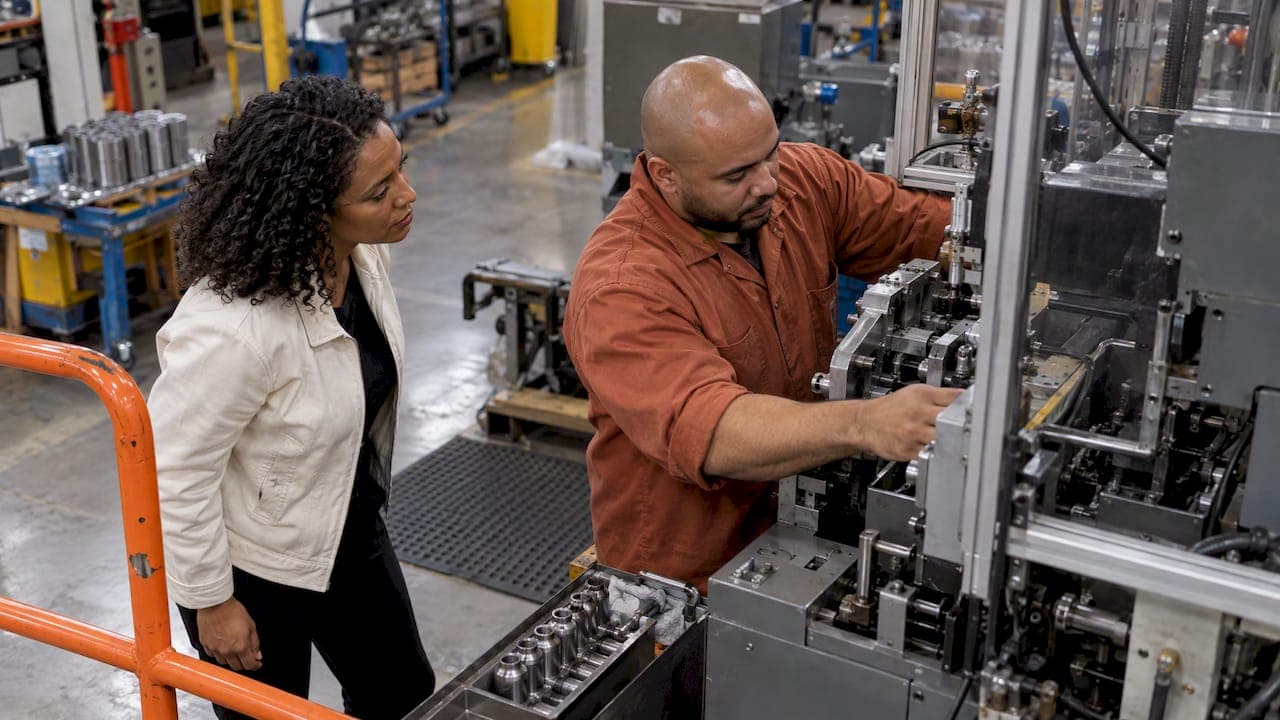
A good gemba walk checklist does three things: it sets one purpose for the walk, it gives you observable things to check and open questions to ask, and it gives you a place to log facts, owners and due dates. Keep it to a page. It guides the walk, and it should never become the point of the walk.
Below is a checklist you can copy into your own template, the questions worth asking on the floor, a fill-in example, and the follow-up habits that decide whether the walk changes anything.
TL;DR
- Pick one theme per walk (safety, flow, standard work, people) and write down the standard you will compare against before you leave your desk.
- Observe first, then ask open questions. Do not solve problems on the floor.
- Log facts with location and condition, not labels like "poor flow." Every follow-up gets an owner and a due date.
- Tell the area what happens next, and check last walk's actions at the start of the next one.
- Use a detailed checklist for technical walks or for teaching newer managers. For a first walk, a looser structure often works better.
Table of Contents
- What a gemba walk is for
- Before the walk: preparation checklist
- The gemba walk checklist: what to observe
- Gemba walk questions to ask
- A gemba walk template you can copy
- During the walk: a conduct checklist
- After the walk: follow-up that sticks
- Perspective: why checklists alone don't change results
- When to bring in outside help
- FAQ
- Sources
What a gemba walk is for
Gemba is the place where the work happens. The Lean Enterprise Institute describes the walk as a way to understand the current situation through direct observation and inquiry before acting. The leader's aim is to understand the customer purpose, how the process works, and whether people are engaged in creating, sustaining and improving it.
That last part matters. Darren Walsh of LEI warns against reducing a walk to hunting for isolated waste or judging whether individuals look busy. He points leaders toward overburden, unevenness and how well the whole value stream performs. He also argues that walks that keep going badly usually reflect undeveloped observation skills, not bad intent.
So the checklist you build should push you toward flow and system questions, not toward catching someone out.
Is a gemba walk part of Six Sigma?
Not originally. Gemba walking comes from lean thinking and the Toyota tradition of going to see the actual work. It shows up inside Lean Six Sigma programs because those programs borrow lean tools; ASQ's Lean Six Sigma material treats the walk as a learning and continuous improvement activity. You do not need a Six Sigma belt or program to run one.
Before the walk: preparation checklist
Most weak walks fail before anyone leaves the office. Use this list.
- Set a learning purpose. One sentence: "I want to understand why changeovers on Line 2 run long," not "see how things are going." LEI's guidance is to set a learning purpose and plan a route that follows value flow.
- Pick one theme. Safety, quality, flow, standard work, 5S and visual management, or people. LeanSuite recommends one focus and a short list of open-ended prompts.
- Define scope and time. The U.S. EPA's walk guidance tells teams to decide the area and time allocation and gather relevant documents before they go.
- Pull the numbers. Yesterday's output, scrap, safety incidents, on-time shipments. You are comparing the floor with what the metrics claim.
- Choose the route. Follow one product family, order or customer process from start to finish rather than touring disconnected areas, as LEI recommends.
- Tell the team. Give notice, say what you are looking for, and say it is not an inspection of individuals.
- Decide who comes. A process owner, a subject-matter expert, and ideally someone from another function who sees the work with fresh eyes.
That last point has a safety payoff. ASQ notes that cross-functional observers can spot hazards that employees doing repetitive work may no longer notice.
The gemba walk checklist: what to observe
Use the categories below as a menu. Do not try to cover all of them in one walk. The items mirror the kinds of prompts in published templates such as LeanSuite's checklist, which cover PPE, exits, guards, defects, WIP, standard work, visual controls and KPI boards.
Safety
- Is required PPE worn and are exits clear?
- Are machine guards in place?
- Are there near-miss signs: spills, blocked aisles, stacked pallets leaning?
- Do people take shortcuts around a hazard because the right way is slower?
Quality
- Where are defects and rework being created, and where are they found?
- Is nonconforming material identified and segregated?
- Does the operator know what "good" looks like at this station?
Flow and waste
- Is WIP piling up in front of a step? Compare it with any marked maximum.
- Is material available when the operator needs it?
- Where do people wait, walk, search or rework?
- Was today's production target met, and if not, what stopped it?
Standard work
- Is the current standard work posted at the point of use?
- Does the operator follow it, and does it match how the work is really done best?
- When was it last updated, and who updated it?
5S and visual management
- Can you tell at a glance what is normal and what is not?
- Are KPI boards current, or stale from last month?
- Is everything in its marked place?
People
- Is staffing right for the plan?
- Do employees know today's targets and how they are doing against them?
- Who solves problems here, and how are people involved in improvement?
Not only the factory floor
The checklist works outside manufacturing if you swap the observation items. A warehouse walk looks at pick paths, dock-to-stock time and error sources; our piece on reducing picking errors lists what warehouse managers can change within a week. A facilities walk follows an inspection-style list. A cleaning contractor's audit-ready cleaning checklist shows how specific an observable standard can get. The EPA even describes water-focused walks, where employees and managers jointly observe the floor to find water inefficiencies that utility bills alone may not reveal.
For office, sales or SaaS support teams, follow a request through its handoffs instead: where does it wait, who rewrites it, which system does someone re-key it into? If you are weighing tooling for that, this overview of enterprise workflow management is a reasonable starting point for thinking about how a checklist maps onto structured steps.

Gemba walk questions to ask
Questions are where most leaders either learn something or shut the conversation down. LEI's checklist article suggests a core set of five questions:
- What is the purpose of this process?
- Who is responsible for it?
- Is it achieving its purpose? If not, how is it failing?
- What causes those failures?
- How are people consulted and engaged in improving it?
Then add questions suited to the operator in front of you:
- "Where do you find the standard work for this task?" and "How did you learn it?"
- "What got in your way yesterday?"
- "What would you change first if it were up to you?"
- "What do you need from me or from another department?"
Three rules keep these productive:
- Ask why, show respect. John Shook's guide centers the walk on going to see the actual work, asking why and respecting the people doing value-creating work.
- Ask the person, not just the process. ASQ points out that workers often provide insight that observation alone cannot reveal.
- Prefer open prompts to yes/no. "Show me how you handle a rush order" teaches more than "Do you follow the SOP?"
Michael Ballé adds a useful test for yourself: after a good conversation you should come away with ideas from local improvement work and a sense of team morale, engagement, autonomy and the development needs of local leaders. If you left with only a list of defects, the conversation was too narrow.
A gemba walk template you can copy
Published templates differ in detail but agree on structure. LeanSuite says to capture the area, date, walk leader and team, purpose, route, factual observations and what people told you, then record follow-ups with owners and due dates. A SixSigmaKaizen workbook adds shift, walk type and the standard used for comparison. Here is a layout that combines them.
Header
| Field | Entry |
|---|---|
| Walker and participants | Name, role |
| Date and shift | |
| Area or process | |
| Theme and focus question | One sentence |
| Standard compared against | SOP, target, KPI |
| Planned route | Start to finish |
Observation log
| Time | Station or area | Factual observation | Matches standard? | Concern level | Immediate action |
|---|---|---|---|---|---|
| 9:10 | Packing 3 | WIP of 14 totes against a marked maximum of 8 | No | Medium | Told lead, no change made |
| 9:25 | Palletizer | Posted instruction is an older revision | No | High | Photo taken, owner notified |
| 9:40 | Line 2 board | KPI board updated this shift | Yes | Low | None |
Note how each entry names a place and a condition. LeanSuite's own example prefers observations like WIP above a marked maximum or an outdated palletizer instruction over labels like "poor flow".
Conversation notes
Write the question, the answer in the person's words, and who said it (by role if you want people to speak freely).
Action log
| Issue | Hypothesis on cause | Proposed action | Owner | Due date | Status | KPI affected |
|---|---|---|---|---|---|---|
| Outdated palletizer instruction | Revision control gap | Replace at point of use, audit all stations | Area lead | Set at walk | Open | Changeover time |
The issue summary, root-cause hypothesis, action, owner, due date, status and KPI link follow the field grouping LegalClarity describes. Treat the hypothesis column as a guess to test, not a conclusion.
How long should the checklist be?
Short. LeanSuite says it should be theme-specific and short enough to guide rather than dominate. Jim Womack's view is that a detailed checklist is most useful when the walk has a technical focus or when you are teaching inexperienced managers; on an initial walk, a loose structure lets questions develop naturally. He also recommends building the checklist together with the people who will use it and agreeing how and when it will be used. A checklist handed down from above reads as surveillance.
During the walk: a conduct checklist
- Observe for several minutes before you say anything.
- Stand where you can see the work without blocking it.
- Write down facts as you go, not afterward from memory.
- Ask, listen, thank. Do not fix, assign or criticize on the spot. ASQ's guidance is to observe and ask rather than devise solutions during the walk, then bring findings back to the team to brainstorm solutions.
- Collect a few numbers where you can: cycle times, defect counts, inventory levels, as SixSigma.us suggests.
- Before leaving, give feedback on something you saw done well.
After the walk: follow-up that sticks
This is where most programs die. A team that sees leaders walk through, take notes and never return concludes the walk is theater.
- Write up within 24 hours while details are fresh.
- Assign owners and dates to every action. The Learn Lean Sigma audit asks teams to log waste, deviations from standard work, safety issues and improvement opportunities, then assign action items with clear responsibilities and due dates.
- Tell the area what happens next. Share results with the department you visited.
- Do what you said. LeanSuite's guidance includes follow-through on every commitment.
- Open the next walk by checking the last one's actions.
- Look for patterns across walks. Three walks that surface the same missing material is a system issue, not three operator issues. Mapping it end to end is the job of process mapping.
Perspective: why checklists alone don't change results
We see the same pattern in the companies we work with. Leadership has a strategy, the SOPs exist on paper, and the walk produces a thoughtful list of observations. Then three weeks later nothing has moved, because nobody owned the actions and no meeting existed where they got reviewed.

Our view is that a gemba walk is a diagnostic input, not an improvement program. The checklist tells you what is true on the floor. The harder work is converting it into scorecards, a meeting cadence and coaching that a floor manager can run on Monday morning. Our write-up on turning consulting into a 60-day action plan shows what that handoff looks like, and if you want to understand why walks tend to stall, Kotter versus Lewin covers what makes change stick.
We also push leaders to walk with a question about margin, throughput or customer commitments, not a general tour. That is what keeps a walk from becoming a ritual.
— David
When to bring in outside help
If you run walks regularly and the same issues keep coming back, the gap is usually in execution, not observation. Our 90-Day Operations Audit is a fixed-price diagnostic at $3,500 that maps your people, processes and performance systems against your goals and delivers a prioritized 60-day action plan. If you prefer to start smaller, the Operational Diagnostic starts at $3,500 as well and is listed with our other engagement options. For recurring floor-level improvement work, see our continuous improvement program.
FAQ
Why do organizations do gemba walks?
To see the real work, not the reported work. Leaders learn how the process actually runs, what gets in people's way, and whether people are engaged in improving it. Decisions made with that firsthand view tend to fit the operation better than those made from reports alone.
How do you lead a gemba walk?
Set one purpose, choose a route that follows the flow of work, and tell the team you are coming. On the floor, observe first, then ask open questions and write down facts. Afterward, assign owners and dates and report back to the area.
What is a good daily checklist for a gemba walk?
For a daily walk, keep it to one theme and five to eight prompts: was the target met and if not why, any WIP above its limit, is standard work posted and followed, any safety concern, are KPI boards current, and what is blocking the team today. Rotate the theme weekly so the list stays fresh.
Do I need a gemba walk template or is a notebook enough?
A notebook works for a first walk, since a loose structure helps questions develop. Move to a template once you need consistency across supervisors, teach newer managers, or track actions over time.
Sources
- Gemba Walk, Lean Enterprise Institute
- Gemba Walks and Lean Leadership, Lean Enterprise Institute
- What kind of conversation should I expect during a gemba walk, Lean Enterprise Institute
- Gemba Walk Checklist, Lean Enterprise Institute
- How to Go to the Gemba, Lean Enterprise Institute
- Lean & Water Toolkit: Chapter 3, US EPA
- Talk the Walk, ASQ
- AGILE, ASQ Lean Six Sigma Review
- Gemba Walk Checklist: Free PDF and Excel, LeanSuite
- Gemba Walk: 7 Steps, a Checklist and Questions to Ask, LeanSuite
- Gemba Walk Checklist Template, SixSigmaKaizen
- A Complete Guide to Gemba Walk, SixSigma.us
- Gemba Walk Audit, Learn Lean Sigma
- How to Fill Out a Gemba Walk Template, LegalClarity