
Kaizen events are short, intensive workshops where a cross-functional team focuses entirely on one process problem for 3–5 days and leaves with implemented changes, not just recommendations. That distinction matters more than it sounds. Most improvement efforts produce analysis. A well-run kaizen event produces a changed process by Friday afternoon.
The format goes by several names: rapid improvement event, kaizen blitz, kaizen workshop. The mechanics are the same regardless of what you call it. You scope a specific problem, pull together the right people, give them dedicated time and authority to act, and run a structured agenda that moves from current-state mapping to root cause analysis to tested solutions within the event window. Teams that lack Lean knowledge may need additional days of training before the event itself.
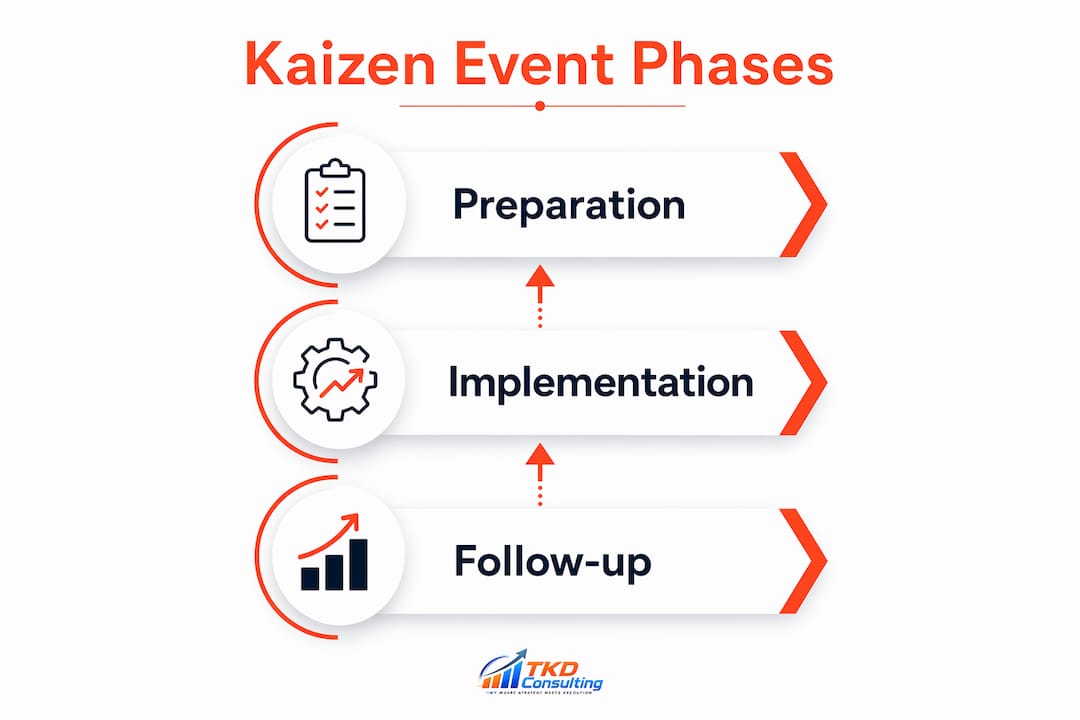
The benefits include waste reduction, faster cycle times, improved quality, better process standardization, and a team that now knows how to solve problems together. But those outcomes depend entirely on three phases going well: preparation, implementation, and follow-up. Without adequate preparation, much of the event time is wasted arguing about scope. Without effective follow-up, the gains erode over time.
- Typical duration: 3–5 days of focused event time
- Team composition: frontline workers, supervisors, a trained facilitator, and cross-functional contributors
- Core phases: preparation, implementation, follow-up
- Common outcomes: waste reduction, quality improvement, process standardization, lead time reduction
- Sustaining factor: daily Kaizen activities between events build the frontline problem-solving muscle that keeps improvements alive
Table of Contents
- What are the three phases of a Kaizen event?
- What types of Kaizen events should you run?
- How do you plan a Kaizen event that actually works?
- What does a day-by-day Kaizen event agenda look like?
- What benefits do Kaizen events deliver, and how do you keep them?
- Why does your project charter determine whether the event succeeds?
- TKD Consulting helps you run Kaizen events that stick
- Key Takeaways
What are the three phases of a Kaizen event?
Every kaizen event runs through three distinct phases. How well you execute each one determines whether you walk away with lasting change or a wall covered in sticky notes.
Preparation
This is where most teams underinvest, and it shows. Effective event planning starts weeks before the event itself. The facilitator structures the agenda, gathers baseline data, and ensures the problem is defined precisely enough to act on. Without that groundwork, most event time gets spent debating scope rather than implementing solutions.
Key preparation activities:
- Draft and sign a project charter with a clear problem statement, measurable goals, defined scope, team roster, and timeline
- Collect current-state data: cycle times, defect rates, throughput, whatever the process produces that you can measure
- Document the existing process at a high level so the team isn't starting from zero on Day 1
- Confirm team availability and secure leadership authorization
- Brief all participants on the event purpose, ground rules, and what "success" looks like
- Identify a "parking lot" mechanism for out-of-scope issues that surface during the event
Pro Tip: Define the problem in measurable terms before the event starts. "Inaccurate weekly work plans" is not a problem statement. "41% of work plans created by Team 4 are incomplete in 7 documented ways" is. The more specific the gap between current and expected performance, the faster the team moves once the event begins.
Implementation
This is the five-day window where analysis, experimentation, and actual change happen on the floor. The team maps the current state, runs root cause analysis using tools like 5 Whys and fishbone diagrams, designs countermeasures, and tests them before the event closes. A3 problem solving fits naturally here: it structures the team's thinking around factual data and root causes before jumping to solutions, which keeps the group from chasing symptoms.

Value stream mapping is another common implementation-phase tool, especially when the problem involves handoffs between departments or steps with significant wait time between them.
Follow-up
The event ends; the work doesn't. Sustainment requires follow-up meetings at 30, 60, and 90 days, metric tracking against the targets set in the charter, and visible leadership involvement to signal that the new standard is the standard. Without a formal follow-up structure, teams drift back to old habits, often within weeks.

What types of Kaizen events should you run?
Not every process problem calls for the same event format. The type you choose should match the problem's nature, the team's readiness, and the business priority driving the improvement.
-
5S workplace organization: Targets cluttered, disorganized work areas where time is lost searching for tools, materials, or information. Common first event for teams new to Lean. The outcome is a clean, labeled, standardized workspace with visual controls. Works in manufacturing cells, warehouses, and office environments alike.
-
Total Productive Maintenance (TPM): Focuses on equipment reliability and unplanned downtime. The team analyzes failure patterns, establishes preventive maintenance schedules, and trains operators on basic equipment care. Best applied when machine downtime is a primary constraint on throughput.
-
Value Stream Mapping (VSM): Maps the entire flow of a product or service from order to delivery, identifying where waste accumulates. VSM events are typically more analytical than hands-on; they produce a future-state map and a prioritized improvement roadmap rather than immediate floor-level changes.
-
Waste reduction: Targets the eight wastes of Lean (overproduction, waiting, transport, overprocessing, inventory, motion, defects, and underutilized talent) in a specific process. Broad in scope but highly effective when the team has already identified which waste type is the primary driver of poor performance.
-
Error-proofing (Poka-yoke): Addresses recurring defects or errors by designing the mistake out of the process. The team identifies where errors occur, traces them to their root cause, and builds physical or procedural safeguards. Healthcare and manufacturing both use this format heavily.
-
Lead time reduction: Focuses on compressing the time between customer order and delivery. The team maps the current process, identifies delays and unnecessary steps, and redesigns the flow. Particularly valuable in B2B service environments where response time is a competitive differentiator.
-
Visual management: Creates real-time visibility into process status, performance, and problems. The team designs and installs visual controls: production boards, andon signals, color-coded inventory zones, and daily huddle boards. The goal is making abnormal conditions immediately obvious to anyone on the floor.
Popular event types span 5S, TPM, value stream mapping, waste reduction, error-proofing, and visual management, and the format applies across manufacturing, healthcare, logistics, and professional services.
Pro Tip: If your team has never run a kaizen event before, start with 5S. It's visible, fast, and produces results the whole organization can see. That early win builds credibility for harder, more complex events later.
How do you plan a Kaizen event that actually works?
Planning is where most kaizen events are won or lost before they begin. A well-structured preparation phase removes the friction that kills momentum during the event itself.
Build a real project charter
A signed project charter with clear scope, measurable targets, team assignments, and a timeline is non-negotiable. The charter does two things: it forces the team to agree on what problem they're solving before the event starts, and it gives leadership a concrete commitment to hold the team accountable to. A charter that says "improve the shipping process" is useless. One that says "reduce order-to-ship cycle time from 4.2 days to 2.0 days for standard SKUs by the end of the event" gives the team a target to work backward from.
Charter components worth getting right:
- Problem statement with a measurable performance gap
- Business case: why this problem, why now, what it costs the organization
- Scope boundaries: what's in, what's out
- Measurable goals with a baseline and a target
- Team roster with roles and time commitments
- Milestones and event dates
- Stakeholder list and communication plan
Select the team deliberately
Team composition shapes everything. You need people who actually do the work, not just people who manage it. A team of supervisors and managers without frontline workers will design solutions that look good on paper and fail in practice.
A well-balanced kaizen event team typically includes:
- A trained facilitator who runs the agenda and keeps the team on track
- Two to four frontline workers who perform the process daily
- One supervisor or team lead from the affected area
- One or two cross-functional contributors (quality, maintenance, IT, finance) depending on the problem
- A process owner or sponsor who attends key sessions and removes roadblocks
Pre-work that actually matters
- Gather baseline data before the event, not during it. Cycle times, error rates, throughput, customer complaints: whatever the process produces that you can count.
- Walk the process (Gemba walk) with a small group before the event to identify obvious waste and confirm the problem statement reflects reality.
- Allocate resources: floor space for testing, materials for pilots, time for staff who will be pulled from their regular duties.
- Communicate the event purpose to the broader team. Surprise changes to a work area breed resistance. Transparency builds buy-in.
Pro Tip: Use a parking lot from the first hour of the event. When out-of-scope issues surface, write them down visibly and promise to route them to the right owner after the event. This keeps the team focused without dismissing legitimate concerns.
What does a day-by-day Kaizen event agenda look like?
A structured day-by-day agenda keeps the team moving from analysis to action without losing momentum. Here's how a typical five-day event runs:
-
Day 1: Orientation and current state. The team reviews the charter, confirms the problem statement, and completes a Gemba walk to observe the process firsthand. The facilitator leads training on Lean basics if needed. By end of day, the team has a shared picture of what's actually happening versus what's supposed to happen.
-
Day 2: Root cause analysis. The team digs into why the problem exists using 5 Whys, fishbone (Ishikawa) diagrams, and data review. Brainstorming sessions generate potential countermeasures. The goal is to identify the two or three root causes that, if addressed, would close most of the performance gap.
-
Day 3: Solution design and pilot. The team designs countermeasures for the confirmed root causes and runs rapid experiments on the floor. Layout changes, new work sequences, updated standard operating procedures: whatever the solution requires, the team tests it at small scale before committing.
-
Day 4: Testing, adjustment, and measurement. The pilot runs under real conditions. The team collects process metrics, identifies what's working and what needs adjustment, and refines the solution. This is where the future state starts to look real rather than theoretical.
-
Day 5: Standardization and handoff. The team documents the new process, updates SOPs, trains affected staff, and prepares a communication plan for the broader organization. The event closes with a report-out to leadership showing results against the charter targets.
Days in a Kaizen event typically follow this sequence: initial orientation, current state mapping, root cause analysis and brainstorming, solution design and piloting, measurement and adjustment, then final standardization and reporting. Each day builds on the last to move from understanding to sustained improvement.
A Kaizen newspaper (a visual project board tracking open action items, owners, and due dates) keeps accountability visible throughout the event and into the follow-up period. PDCA cycles run continuously across Days 3 and 4, with each experiment generating data that informs the next adjustment.
What benefits do Kaizen events deliver, and how do you keep them?
The case for running kaizen events isn't theoretical. Teams that execute them well see faster problem resolution, measurable quality improvements, reduced lead times, and lower costs. But the less obvious benefit is what happens to the team itself. People who spend five days solving a real problem together, with authority to actually change things, come out of that experience differently than they went in.
Key benefits:
- Accelerated problem-solving: Concentrated time and cross-functional perspective produce solutions in days that would take months through normal channels.
- Immediate measurable results: Unlike longer improvement projects, kaizen events produce changes you can measure before the team disbands.
- Team engagement: Frontline workers who help design the new process are far more likely to follow it and defend it.
- Capability building: Each event teaches participants how to use Lean tools, which compounds over time as the organization runs more events.
- Culture shift: Daily Kaizen activities between events build the frontline problem-solving habit that sustains performance gains long after the event ends.
The risks are equally real. Teams revert to old habits when follow-up is weak, leadership attention moves on, or the new process isn't documented clearly enough for someone to follow without the original team present. Measuring employee transformation outcomes with structured data collection helps close that gap by making behavioral and process changes visible over time.
Pro Tip: Schedule the 30-day follow-up meeting before the event closes. Put it on the calendar, assign a metric owner, and confirm who will present results to leadership. If you leave the event without those three things locked in, the follow-up rarely happens.
Common sustainment failures and how to prevent them:
- Reverting to old habits: Counter with visual controls and daily process checks that make deviations immediately visible.
- No follow-up structure: Build the 30/60/90-day review cadence into the charter before the event starts.
- Leadership disengagement: Assign a named executive sponsor who attends at least the Day 5 report-out and the 30-day review.
- Undocumented changes: Require updated SOPs as a deliverable before the event closes, not as a post-event task.
Understanding why execution fails after improvement events often comes down to the same root causes: unclear ownership, no measurement cadence, and leadership that moved on before the change was embedded.
Why does your project charter determine whether the event succeeds?
The project charter is the most underestimated document in a kaizen event. Teams treat it as administrative paperwork. The organizations that consistently get results treat it as the contract that makes the event worth running.
A complete charter includes:
- Problem statement: A measurable gap between current and expected performance, not a vague description of frustration
- Business case: The cost or risk the problem represents, expressed in terms leadership cares about
- Goals: Specific, measurable targets with a baseline and a deadline
- Scope: Explicit boundaries defining what the team will and will not address
- Milestones: Key dates including pre-work completion, event days, and follow-up reviews
- Team: Named individuals with defined roles and confirmed availability
- Stakeholders: Who needs to be informed, consulted, or whose approval is required
Leadership's role doesn't end at signing the charter. During the event, leaders need to stay available to remove roadblocks, make decisions when the team hits a constraint outside their authority, and signal to the organization that this work matters. After the event, they need to hold the follow-up cadence accountable and resist the temptation to declare victory at the Day 5 report-out.
Focusing on the count of events rather than measurable improvements is one of the most common ways organizations lose the gains they worked to create. Running 20 kaizen events a year means nothing if 15 of them produce changes that fade within 60 days. The charter is what prevents that: it establishes the standard the team is accountable to and gives leadership a concrete basis for evaluating whether the event actually worked.
Pro Tip: Write the charter so that someone who wasn't in the room can read it and understand exactly what problem was solved, what the team changed, and how you'll know in 90 days whether it held. That test alone will sharpen most charters significantly.
The middle management gap is often where charter accountability breaks down. Supervisors who weren't part of the event inherit a new process without understanding why it was designed that way, which makes them passive at best and actively resistant at worst. Briefing them before the event and involving them in the Day 5 handoff closes that gap.
A3 problem solving reinforces charter discipline by requiring the team to document the current condition, the root cause analysis, the countermeasures considered, and the results in a single structured format. The A3 report originated at Toyota as a way to make problem-solving thinking visible and transferable, and it remains one of the most effective tools for ensuring a kaizen event's logic holds up to scrutiny.
TKD Consulting helps you run Kaizen events that stick
Most kaizen events fail not because the team lacked effort, but because the preparation was thin, the charter was vague, or the follow-up never happened. That's an execution problem, not a methodology problem.
TKD Consulting works with $5–50M operations teams to build the planning rigor, facilitation structure, and follow-up cadence that turns a five-day event into a permanent process change. The starting point is the Operations Audit: a structured diagnostic that identifies which processes are the right candidates for a kaizen event, what baseline data you need before you start, and what your organization's current capacity for sustaining improvements actually looks like. From there, TKD's continuous improvement services cover facilitation, charter development, and the 90-day follow-up structure that keeps gains from evaporating. If your team is ready to run an event but wants experienced operational judgment in the room, that's exactly what TKD delivers. Book a discovery call to get started.
Key Takeaways
Kaizen events deliver lasting results only when preparation is thorough, execution follows a structured daily agenda, and leadership maintains accountability through a formal follow-up cadence over time.
| Point | Details |
|---|---|
| Preparation determines outcomes | Imprecise problem definition wastes event time; define a measurable performance gap before Day 1. |
| Charter accountability is non-negotiable | A signed charter with measurable targets, scope, and named team members is the foundation of every successful event. |
| Follow-up at 30, 60, and 90 days | Schedule follow-up reviews before the event closes to prevent gains from fading after the team disbands. |
| Daily Kaizen sustains event gains | Pairing events with ongoing frontline improvement activities builds the problem-solving habit that makes changes permanent. |
| TKD Consulting | TKD's Operations Audit identifies the right processes for kaizen events and builds the follow-up structure that keeps improvements in place. |