
Yes, founder-led sales is the right early motion for almost every startup, because its job isn't revenue alone. It's to discover a repeatable sales pattern the founder can eventually hand off. The guideline runs from your first paying customer through the early revenue stage typical for founder-led sales, and the signal to stop isn't a calendar date. It's proof that the motion works without you.
TL;DR:
- Founders should focus on personal sales to learn and document a repeatable process before hiring sales reps, typically until reaching around $1 million ARR.
- Moving from instinctive selling to a documented, structured motion involves testing key customer segments, tracking objections, and standardizing outreach and demos.
- Successful transition to hiring occurs only after three similar deals are closed with a consistent sequence, and the process is clearly documented and transferable.
- Building a systematic operational plan, including regular reviews and checklists, enables scaling sales without founder dependence and avoids relying on improvisation.
- Founder-led sales provide critical insights that influence product decisions, pricing, and hiring, but require strict discipline to prevent burnout and maintain process integrity.
Table of Contents
- What Is Founder-Led Sales and What's the Point of It?
- What Are the Real Benefits of Selling It Yourself?
- When Should You Hire a Salesperson Instead?
- How Do You Actually Run Founder-Led Sales Day to Day?
- What Mistakes Derail Founder-Led Sales Most Often?
- How Does an Operations Audit Turn Sales Talk Into a Real Plan?
- What Founder-Led Sales Actually Teaches You About Running the Business
- Sources
- FAQ
What Is Founder-Led Sales and What's the Point of It?
Founder-led sales means the founder personally runs prospecting, discovery calls, demos, negotiation, and closing, instead of handing any of it to a salesperson. That's the mechanical definition. The real purpose is learning, and most founders miss this distinction entirely.
Every conversation is a live experiment. You're testing your ideal customer profile, the triggers that make a prospect actually pick up the phone, the exact words buyers use to describe their pain, and what price range doesn't make them flinch. A hired rep can't run that experiment for you. They'll sell what you tell them to sell, but they won't know what to test.
The duration guideline (up to roughly $1M ARR) matters less than the signals behind it. Fndtns' B2B playbook frames the goal plainly: move from founder instinct to a documented, repeatable motion. What that motion typically requires:
- A founder who owns the full cycle, not just the pitch
- Direct exposure to objections, pricing pushback, and buying committees
- A written record of what's working, updated weekly
- A clear exit signal, not an arbitrary revenue number
What Are the Real Benefits of Selling It Yourself?
The obvious benefit is saving a salary. The bigger one is speed. When you're in every call, product feedback doesn't pass through a rep's summary. You hear the exact sentence a buyer uses to describe their frustration, and you can walk that straight into your product roadmap the same afternoon.
Founders also sit on an underused asset: their own network. Warm introductions from investors, advisors, and existing customers convert notably better than cold outreach.
Warm intros convert 5 to 10 times better than cold outreach, according to GrowLeads' analysis of outreach data. That's not a marginal edge. It means your first 100 conversations should skew heavily toward people who already trust someone in your orbit.
There's a third benefit that's harder to quantify but shows up later: sales DNA. HubSpot's research on startup sales points out that founders who sell first build the operational clarity to hire well. You'll know what a good rep sounds like on a call, because you've been on that call yourself.
The trade-off is real. Every hour on a sales call is an hour not spent on product or hiring. Founders who manage this well time-box selling into predictable blocks rather than letting it swallow the calendar.
When Should You Hire a Salesperson Instead?
Revenue targets are a lagging indicator. The signals that actually matter are structural, and they show up before any specific ARR number does.
- You've closed three similar deals using the same sequence of steps, not three deals that each required a different miracle.
- The motion is written down. Not in your head, on paper: the outreach sequence, the discovery questions, the demo structure, the objections and how you answered them.
- Someone else could run it without you inventing something new mid-call. If every deal still needs founder improvisation, the motion isn't ready to transfer.
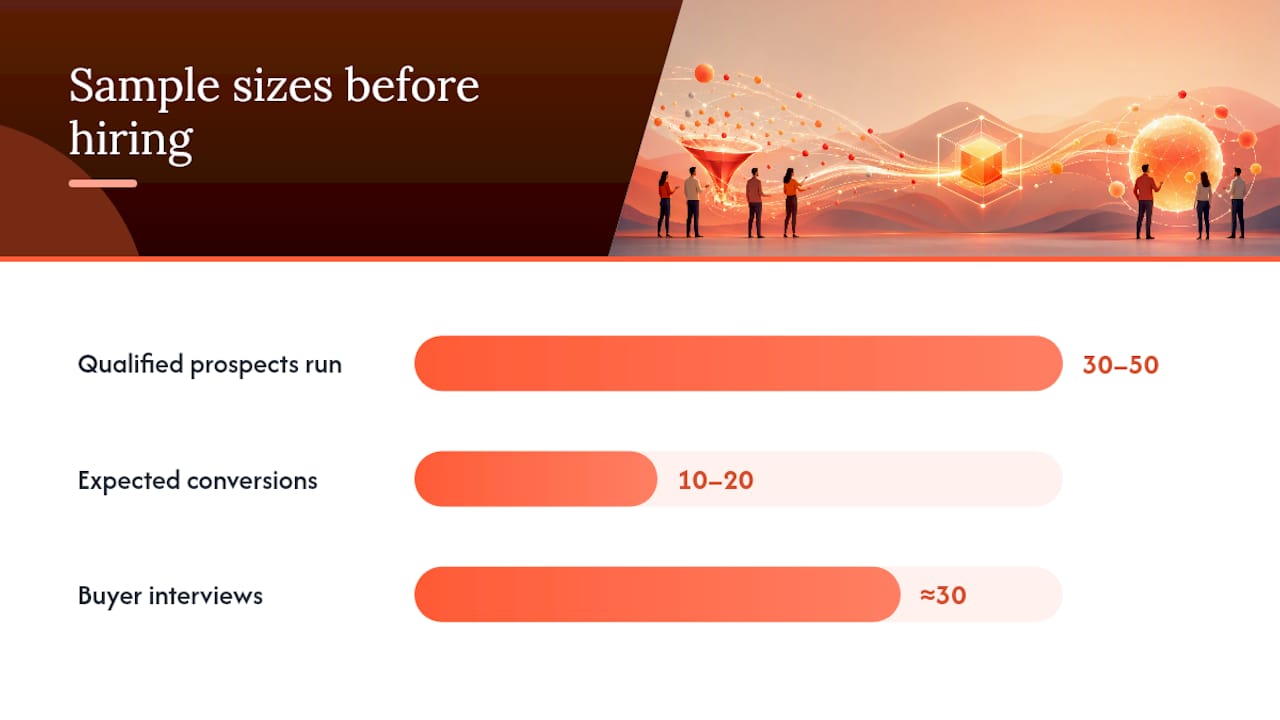
Before you even think about hiring, Worklife VC's guide to repeatable sales motions recommends running 30 to 50 qualified prospects through your process. Expect 10 to 20 of them to convert. That sample size is what makes a pattern statistically meaningful instead of a lucky streak.
GTMNow's staged framework breaks this down cleanly: zero to $100k ARR is discovery, built on roughly 30 buyer interviews. $100k to $500k is pattern testing. $500k to $1M is documentation and handoff prep. Hire too early and your new rep is discovering the business on your dime. Hire too late and you're the bottleneck strangling growth.
Pro Tip: Before you extend an offer, run a transfer test. Hand your documented sequence to a candidate or a contractor and track whether their close rate lands anywhere near yours within 60 days. If it doesn't, the motion isn't documented well enough yet.
How Do You Actually Run Founder-Led Sales Day to Day?
This is where most advice gets vague. Here's the operational sequence.
1. Define your ICP with specifics, not adjectives. Firmographic criteria (company size, industry, tech stack), trigger events (a funding round, a leadership change, a compliance deadline), and the actual persona who feels the pain. Vague ICPs produce vague pipelines.
2. Work warm channels first. Your first 100 conversations should draw heavily on investor and advisor networks, since warm intros convert 5 to 10 times better than cold outreach. This isn't about being lazy. It's about spending your limited time where the return is the highest while you're still figuring out what to say.
3. Build a targeted cold list of a manageable number of named accounts. Cleverly's framework for founder-led sales argues against mass outreach entirely. A short list you can personalize beats a spreadsheet of 2,000 names you'll email once and never think about again. Tools like a well-built buyer persona framework help sharpen exactly who belongs on that list.
4. Run discovery calls that listen more than they talk. Use a structured 30-minute script: current workflow, specific pain, past solutions they tried and why those failed, budget range, who approves the purchase, and a dated trigger event that made them take the call now. Capture their exact phrasing. You'll reuse it in your demo and your marketing copy later.
5. Structure demos around outcomes, not features. Gangly's founder-led sales playbook recommends a three-part structure: confirm the pain in the buyer's own words, narrate the resolution path tied directly to that pain, then close on mechanics like price and timeline. Show three or four features maximum, and only the ones that solve what they told you hurts.
6. Build a follow-up cadence and stick to it. A recap within 24 hours, a piece of genuine value on day three, a scheduled next step (never "let me know"), and five to eight total touches before you write someone off as gone cold.
- Track every touch in a spreadsheet if you don't have a CRM yet
- Note which touch actually produced a response
- Flag deals that stall past touch six for a different approach
7. Document everything as you go, not at the end. Buyer language, objection responses, your demo script, and conversion rates at each stage of the funnel. This becomes the one-page playbook you hand your first sales hire.
Pro Tip: Modern B2B buyers often walk into a formal evaluation with a vendor already picked, according to Thunderbit's research on B2B buying behavior. Founders who show up during that early research phase, before a formal RFP exists, win deals competitors never get a shot at.
What Mistakes Derail Founder-Led Sales Most Often?
The single biggest trap is mistaking a founder-dependent win for a repeatable one. If you closed a deal because you personally charmed the CFO on a call at 11 PM, that's not a motion. That's you. Dock's practitioner guidance on founder-led sales is blunt about this: a motion only counts as real once it's documented and has run successfully without founder-only intervention.
A few patterns to watch for:
- Feature-dump demos. If your demo walks through every screen in the product, you've lost the buyer's pain in a pile of features they don't care about yet.
- Deals that "love the call" but never sign. That's usually a qualification failure, not a closing failure. Go back and check whether you confirmed budget and decision authority early, not just enthusiasm.
- Hiring before the sequence is written down. A new rep inherits your instincts, not your notes, and instincts don't transfer.
- Skipping objection tracking. If you can't list your five most common objections and how you handled each, you don't have a playbook yet. You have a memory.
Pro Tip: Run a simple test on your last ten deals: could a stranger read your notes and know exactly what to say next at every stage? If not, tighten the documentation before you tighten anything else.
How Does an Operations Audit Turn Sales Talk Into a Real Plan?
Conversations pile up fast. Without a structure to convert them into action, even a founder running 50 great calls ends up with a notebook full of insight and no system. That's the exact gap TKD Consulting's 60-day sales consulting audit is built to close: it takes the raw material from your sales conversations and turns it into a prioritized, sequenced action plan instead of a pile of good intentions.
A few pieces worth borrowing regardless of whether you formalize the process:
- A weekly scorecard tracking conversations run, conversion rate by stage, and objections logged
- A recurring meeting cadence (even 15 minutes) where you review what changed in your pitch that week
- A discovery checklist, a demo checklist, and a handoff checklist your first hire can pick up cold
Building a sales enablement framework early, even a rough one, means your first hire inherits a system instead of a personality. That distinction is what separates founders who scale sales cleanly from founders who spend six months untangling why the new rep can't close anything.
What Founder-Led Sales Actually Teaches You About Running the Business
Selling forced decisions I wouldn't have made from a spreadsheet. Every objection I heard on a call changed something: how we priced, who we hired first, which feature we cut from the roadmap because nobody asked about it in 40 conversations. That's the part nobody mentions when they talk about founder-led sales as a cost-saving measure.

The harder lesson is time discipline. Selling is addictive in a bad way, because it produces immediate feedback that building product doesn't. Block your selling hours the same way you'd block anything else non-negotiable, and treat the moment your pipeline starts repeating itself as the real signal to start documenting your exit, not a revenue milestone on a spreadsheet.
If you want a structured way to convert what you're learning into a plan your team can run without you, TKD Consulting's Operations Audit is built for exactly that handoff point, and the strategy execution gap work addresses the same problem from the leadership side.
— David
Sources
- Tyler's B2B playbook — Fndtns
- Warm outreach vs cold email — GrowLeads
- The founder's guide to building a repeatable sales motion — Worklife VC
- The founder-led sales playbook — GTMNow
FAQ
What Are Founder-Led Sales?
Founder-led sales is a motion where the founder personally handles prospecting, discovery, demos, and closing, typically from the first customer through roughly $1M in ARR, with the goal of discovering a repeatable pattern to hand off later.
What Is an Example of Founder-Led Marketing?
A founder personally publishing content, engaging in industry forums, or showing up in early buyer research (rather than waiting for a formal sales process) mirrors founder-led sales: it puts the founder directly in front of demand before competitors engage.
Is There a Well-Known Founder-Led Sales Playbook?
Several practitioner guides cover this territory in depth, including Gangly's founder-led sales playbook and GTMNow's staged framework, both of which break the motion into discovery, pattern testing, and handoff stages.
What Makes a Company a Founder-Led Firm?
A founder-led firm is one where the founder still drives core commercial functions, most often sales, rather than delegating them entirely to hired executives, usually because the company hasn't yet validated a repeatable motion worth handing off.