
What is a sales enablement framework, and why does it matter?
A sales enablement framework is the structured system that aligns your sales, marketing, and product teams around shared content, training, tools, and performance measurement. Not a project. Not a training event. A living operating model that determines whether your reps show up to deals prepared or improvising.
The business case is concrete: organizations with mature enablement programs see higher win rates on forecasted deals compared to those without one. That gap compounds fast across a full pipeline.
A well-built framework delivers:
- Aligned messaging across sales, marketing, and product, so buyers hear one coherent story
- Predictable ramp times because onboarding follows a documented path, not manager instinct
- Repeatable revenue driven by defined selling behaviors, not individual heroics
- Measurable ROI tied to win rates, deal size, and cycle length rather than training completion counts
The core components that make it work: strategy and planning, content management, technology and tools, learning and development, and performance measurement. Each one reinforces the others. Pull one out and the system leaks.
The five pillars every effective enablement program needs
Effective frameworks organize around four to six core pillars. Here is how each one functions in practice.
Strategy and planning is where the framework starts. You define which selling behaviors you want reps to repeat, tie each behavior to a revenue outcome, and decide how you will measure progress. A good strategy fits on one page and names two or three specific behaviors, not a list of aspirations.

Content management means organizing your assets around the moments reps actually face in deals, not around how the marketing team files things. Every piece of content should solve a specific problem at a specific buyer stage. Reps waste real time hunting for materials that should be one search away.
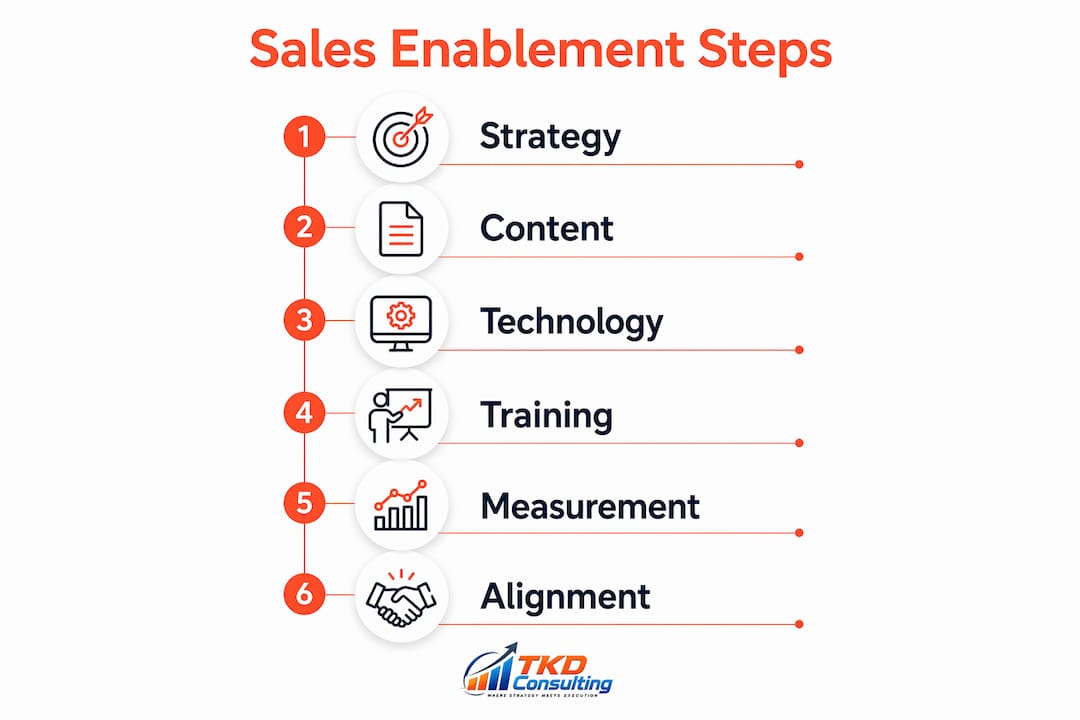
Technology and tools function as a force multiplier when they are integrated with your CRM and existing workflows. When they are not, they become another source of admin drag. The goal is a connected stack where your CRM, content library, and enablement platform share data without requiring reps to toggle between five tabs.
Learning and development extends well past onboarding. Continuous training and coaching keep rep skills current as products, markets, and buyer expectations shift. Spaced repetition over weeks beats a three-day bootcamp every time, because retention comes from repetition, not intensity.

Performance measurement closes the loop. You track leading indicators (content usage, call review completion, talk-track adoption) alongside lagging indicators (win rate, quota attainment, cycle length), then check whether the two actually move together. When reps set firmer next steps, do deals close faster? That connection is what earns the program its budget.
Cross-functional alignment sits underneath all five pillars. Marketing and product teams must be active contributors, not passive recipients, because relevant content and coherent messaging depend on their input throughout the buyer journey.
How to build and implement your framework step by step
Getting this right requires a sequence, not a sprint.
-
Audit your current state. Map what content exists, how reps actually use it, where deals stall, and which behaviors your top performers share. This baseline tells you what to fix before you build anything new.
-
Set SMART objectives. Vague goals produce vague results. "Increase win rate from 22% to 28% by Q3 by getting 80% of reps to cover three stakeholders per opportunity" is a goal you can build a program around. "Improve sales performance" is not.
-
Secure executive buy-in early. A clear roadmap with defined stakeholder roles, timelines, and technology decisions is what gets leadership on board and keeps the program from dying at the first budget conversation. Write a one-page charter that states your mission, target outcomes, RACI model, and review cadence.
-
Build your content strategy. Develop both internal assets (playbooks, battle cards, discovery guides) and external assets (case studies, demos, ROI tools) mapped to buyer stages. Audit what already exists before creating anything new.
-
Select and integrate your technology. Choose tools based on the behavior you need to change, not the feature list. Technology must connect to your CRM and performance data, or it becomes another silo. Start with your CRM as the foundation, add a content management layer, then layer in an enablement platform.
-
Structure onboarding around milestones. Day 30: product knowledge and a first mock discovery call. Day 60: full-cycle practice and core skill certification. Day 90: live deals with coaching support. That path beats a firehouse.
-
Build behavior-based coaching loops. Run one-on-ones around specific behaviors, not just pipeline. Review call data together, pick one or two behaviors to work on, role-play the skill, agree on a next action, and check progress the following week.
-
Implement in phases. Trying to launch everything at once is how programs collapse under their own weight. Sequence the rollout so each phase has a clear owner, a defined deliverable, and a measurement checkpoint before the next phase begins.
Pro Tip: Write your strategy document before you touch a single tool. Teams that buy technology first and build strategy second spend months retrofitting their process to their software instead of the other way around.
Why most enablement programs fail to close the execution gap
Despite documented sales processes, a minority of reps consistently follow them. That statistic captures the execution gap: the distance between what the program teaches and what reps actually do when a deal is on the line.
The primary reason programs fail is not bad content or weak training. It is that behavioral changes are not reinforced or rewarded by leadership after the training ends. Managers revert to pipeline reviews. Coaching becomes optional. The new behaviors fade.
Closing that gap requires:
- Behavioral clarity: Define observable, coachable actions ("uncover three pain points before pitching") rather than vague directives ("be more consultative"). Managers can hear the specific behavior on a call; they cannot coach an abstraction.
- Coaching cadences: Replace the "how's it going?" check-in with a repeatable loop built on call data, scorecards, and deal-health flags. Data-backed coaching loops that managers apply consistently are what separate programs that stick from programs that fade.
- Leadership reinforcement: Recognize reps publicly when they execute the target behaviors. Recognition tied to specific actions signals to the whole team what actually matters.
- Continuous iteration: Treat the framework as a living system. Frontline feedback and performance data should feed back into content updates, training adjustments, and coaching priorities on a regular cadence.
The middle management layer is often where execution breaks down. Managers who lack coaching structure default to deal inspection, and skill development never gets equal weight. Fixing that layer is usually the highest-leverage move available.
How modern enablement platforms support your framework
Technology does not replace a well-designed framework. It amplifies one that already works.
Modern enablement platforms integrate AI-driven content delivery, coaching tools, and analytics that connect with your CRM and content management system to support sellers in real time. The practical capabilities that matter most:
- Content findability: Search and version control so reps pull the right asset for the right deal stage without asking a colleague or guessing.
- AI-driven coaching: Platforms like Mindtickle use AI-powered sales simulations, conversation intelligence, and real-time feedback to accelerate readiness without requiring a manager on every call.
- Deal intelligence: Flags that surface risk before the forecast call, not after the deal is lost.
- Analytics: Usage data that shows which content actually moves deals forward, so you stop producing assets nobody uses.
- CRM integration: Activity data flows between systems so reps spend time selling, not logging.
ZoomInfo adds buyer context, including org charts, decision-maker intelligence, and engagement history, that helps reps prioritize the right accounts before they even open a call. That kind of signal, fed into an enablement platform, is what turns a generic outreach into a targeted conversation.
The selection principle is straightforward: pick tools that fit the behavior you need to change and the workflow your reps already use. A platform that requires reps to change how they work will get abandoned. One that sits inside their existing workflow will get used. For a broader look at how operations consulting methods apply to technology selection and framework design, the principles translate directly to enablement stack decisions.
What successful enablement looks like in practice
The companies that get this right share a few patterns worth noting.
A mid-market B2B technology firm that rebuilt its enablement program around three observable behaviors (stakeholder coverage, confirmed next steps on every first call, and documented pain points before pitching) saw its coaching conversations shift from pipeline inspection to skill development within one quarter. Managers had scorecards. Reps knew exactly what "good" looked like. The behaviors became the language of the team.
A consumer products organization that had invested heavily in content but saw low adoption traced the problem to findability, not quality. Once content was reorganized by buyer stage and integrated into the CRM, rep usage climbed and the time spent searching dropped. The content had always been good. It just could not be found when it was needed.
Both examples point to the same truth: the framework is connective tissue. Strategy, content, training, and tools only produce results when they are wired together and reinforced daily. A measurement culture that tracks both leading and lagging indicators is what tells you whether the wiring is working or where it is breaking down.
Ready to close your own execution gap?
If your team has a strategy but the results are not following, the problem is almost always in the execution layer, not the plan itself. TKD Consulting's Operations Audit maps your people, processes, and performance systems against your stated goals, then delivers a prioritized 60-day action plan your team can execute starting Monday. No slide decks that sit in a shared drive. Just a clear path from where you are to where you need to be.
For sales-specific design and implementation support, TKD Consulting's sales consulting services are built for exactly this kind of work.
Key Takeaways
A sales enablement framework only produces results when strategy, content, training, technology, and measurement operate as one connected system, not as separate initiatives.
| Point | Details |
|---|---|
| Win rate impact | Mature enablement programs achieve a 49% win rate on forecasted deals vs. 42.5% without one. |
| Execution gap | a minority of reps consistently follow documented sales processes, making reinforcement the critical variable |
| Behavioral clarity | Define observable, coachable behaviors before building any content or selecting any tools. |
| Technology alignment | Tools must integrate with your CRM and existing workflows, or they add admin burden instead of removing it. |
| Continuous iteration | Treat the framework as a living system; frontline feedback and performance data should drive regular updates. |