
Change fatigue is the accumulated stress and disengagement employees feel when the pace of organizational change outstrips their capacity to absorb it. It shows up as slower adoption, quiet resistance, and rising attrition. The fix is not more communication. It starts with measuring how much change is actually in flight and cutting or sequencing it before morale and output collapse.
TL;DR:
- Change saturation occurs when multiple initiatives compete for employees' attention, causing overload and increasing the risk of failure for over half of change efforts.
- Rapid sequencing, clear buffers between initiatives, and reassigning sponsorship help prevent overload and stabilize team capacity.
- Measuring change fatigue through pulse surveys, tracking training, absenteeism, and turnover provides early warning signs before morale collapses.
- Limiting communication volume and running short, focused training sessions can alleviate immediate signs of fatigue, but structural fixes are necessary long-term.
- Conducting an operations audit helps identify overload points within the organization, enabling targeted action to reset the change portfolio effectively.
Table of Contents
- What Does Change Fatigue Look Like? Signs Managers Miss
- Root Causes: Change Saturation and Sponsor Overload
- Practical Strategies to Stop Change Fatigue Now
- How to Prioritize and Sequence Competing Initiatives
- How to Measure Change Fatigue Before It Becomes a Crisis
- Recovery Techniques That Rebuild Team Capacity
- What an Operations Audit Reveals About Change Overload
- A Manager-First Take on Fixing Change Fatigue
- How TKD Consulting Helps You Fix the Root of Change Fatigue
- Sources
- FAQ
What Does Change Fatigue Look Like? Signs Managers Miss
Change fatigue rarely announces itself. It shows up as a slow drift: meetings that used to generate ideas now generate silence, and people who once volunteered for pilot programs now find reasons to avoid them.
Watch for these signals:
- Elevated stress and visible burnout across a team that was fine six months ago
- Decision paralysis, where employees stall on choices they used to make quickly
- Apathy toward new initiatives, including the good ones
- Absenteeism creeping up, especially around training sessions or rollout dates
- Missed deadlines that cluster around change milestones, not just workload spikes
- Rising voluntary turnover, particularly among your best performers
The Center for Creative Leadership documents these exact symptoms: increased stress, decision-making difficulty, overwhelm, lower motivation, and higher absenteeism or turnover. The distinction that trips up most managers is fatigue versus resistance. Resistance targets one specific change. Fatigue is cumulative. It builds across the third, fourth, and fifth initiative, regardless of how good any single one is.
Root Causes: Change Saturation and Sponsor Overload
Change fatigue is not a communication failure. It is a capacity problem. Your organization is running more concurrent initiatives than its people, managers, and sponsorship structures can actually support, and no amount of better messaging fixes an oversubscribed calendar.
The mechanics are straightforward:
- Change saturation occurs when overlapping initiatives compete for the same employees' attention and time
- Diluted sponsorship happens when executives sponsor too many projects to give any one of them real attention or authority
- Conflicting metrics across initiatives force teams to guess which priority actually wins
- Middle managers absorb the gap between strategic intent and floor-level execution, and they burn out first
IMA Worldwide frames this precisely as a capacity issue: saturation happens when the volume of change exceeds what the organization's structures were built to handle. The research backs the stakes here. Between 50 and 70% of planned change efforts fail, often because the pace of change outran what employees could reasonably absorb.
Practical Strategies to Stop Change Fatigue Now
Fixing change fatigue takes two different clocks: things you do this week, and structural fixes that take a quarter or more. Confusing the two is how most recovery plans stall.
- Cut communication volume, not increase it. When teams are already saturated, more emails and town halls add noise, not clarity. IMA Worldwide recommends targeted, sparse messages tied to specific behaviors, not broad updates about program status.
- Run short, focused training instead of long rollouts. Prosci's ADKAR model treats fatigue partly as a readiness gap. Building knowledge and ability through tight, skill-specific sessions closes that gap faster than a lecture-heavy kickoff.
- Let middle managers set boundaries. They are the buffer between executive intent and daily execution, and giving them explicit permission to push back on scope or timing is one of the highest-leverage moves available.
- Rotate the workload, not just the tasks. Protect your highest performers from carrying every initiative by spreading ownership across the team, even if it slows early progress.
- Adjust deadlines before people burn out, not after. A two-week extension is cheap. Replacing a resigned team lead is not.
Immediate triage buys you time. It does not fix a portfolio that has too many active initiatives chasing the same people. That requires the sequencing work covered next.
Pro Tip: Before your next kickoff, ask each team lead to list every active initiative touching their group right now. Most managers are surprised to learn the real number is double what they assumed.
How to Prioritize and Sequence Competing Initiatives
Sequencing is where most change fatigue actually gets solved, and it is the step most leadership teams skip because it forces uncomfortable trade-offs — a topic well covered in Digital Transformation in Operations: A Leader's Guide.
Start with a simple impact-effort or risk-scoring matrix. Score every active initiative on business impact and implementation risk, then be honest about which ones can wait. Next, map initiatives against the employee groups and sponsors touching each one. Overlap becomes obvious fast: the same warehouse team on three separate process changes, or one VP sponsoring five projects at once.
From there:
- Build in 3 to 6 month buffers between major initiatives wherever the business can tolerate it
- Declare explicit "no change" windows around peak seasons, audits, or other high-stakes periods
- Reassign sponsorship so no single executive owns more change than they can genuinely champion
- Combine or delay initiatives that hit the same team rather than running them in parallel
A strategy execution framework that forces this kind of sequencing conversation early prevents the pileup that causes saturation in the first place. Treat buffers as scheduled deliverables on the roadmap, not soft time you can quietly reclaim.
How to Measure Change Fatigue Before It Becomes a Crisis
You cannot manage what you refuse to measure, and change fatigue is measurable well before it turns into resignation letters.
Run short pulse surveys every two to four weeks during any major rollout, tracking specific items like clarity on priorities and confidence in leadership, not generic satisfaction scores. Pair that with hard numbers:
- Training completion rates by team and by initiative
- Adoption metrics for the specific tool or process being rolled out
- Absenteeism trends around key milestones
- Voluntary turnover, segmented by tenure and performance rating
IMA Worldwide flags specific warning signs worth tracking directly: sponsors repeatedly missing commitments, thin training participation, and teams that cannot name their organization's top three priorities when asked. Given that 50 to 70% of change efforts fail, catching these signals early is the difference between a course correction and a program restart.
Recovery Techniques That Rebuild Team Capacity
Recovery is not a day off. It is a scheduled phase with its own deliverables, and skipping it is why so many organizations relapse into fatigue within a quarter of finishing a big rollout.
Build these into the calendar, not into the "if we have time" category:
- Short post-implementation pauses where the only task is consolidating what was just learned
- Recognition rituals tied to specific milestones, not vague year-end thank-yous
- Small-group coaching sessions that give people space to admit what is not working
- Explicit rest cycles between major initiatives, treated as mandatory, not optional
Recovery windows and recognition rituals rebuild behavioral bandwidth faster than informal morale efforts because they are scheduled, visible, and repeatable.
Pro Tip: Schedule the recovery period on the same calendar invite as the go-live date. If it is not booked in advance, it gets consumed by the next fire.

What an Operations Audit Reveals About Change Overload
Recognizing change fatigue is one thing. Diagnosing exactly where it is concentrated in your organization is another, and that gap is where most leadership teams get stuck.
David Karpatkin built TKD Consulting after running warehouse operations, home services, solar, and consumer products organizations under operational pressure. That background shapes how TKD's Operations Audit works: it maps people, processes, and performance systems against a company's stated goals, then highlights where change load may be stacking up on teams or sponsors. The output is a prioritized 60-day action plan built for a floor manager to execute Monday morning, not a strategy document that sits in a shared drive. That approach mirrors the sequencing and sponsorship-reallocation work covered in the 60-day digital transformation audit, applied specifically to the overload problem.
A Manager-First Take on Fixing Change Fatigue
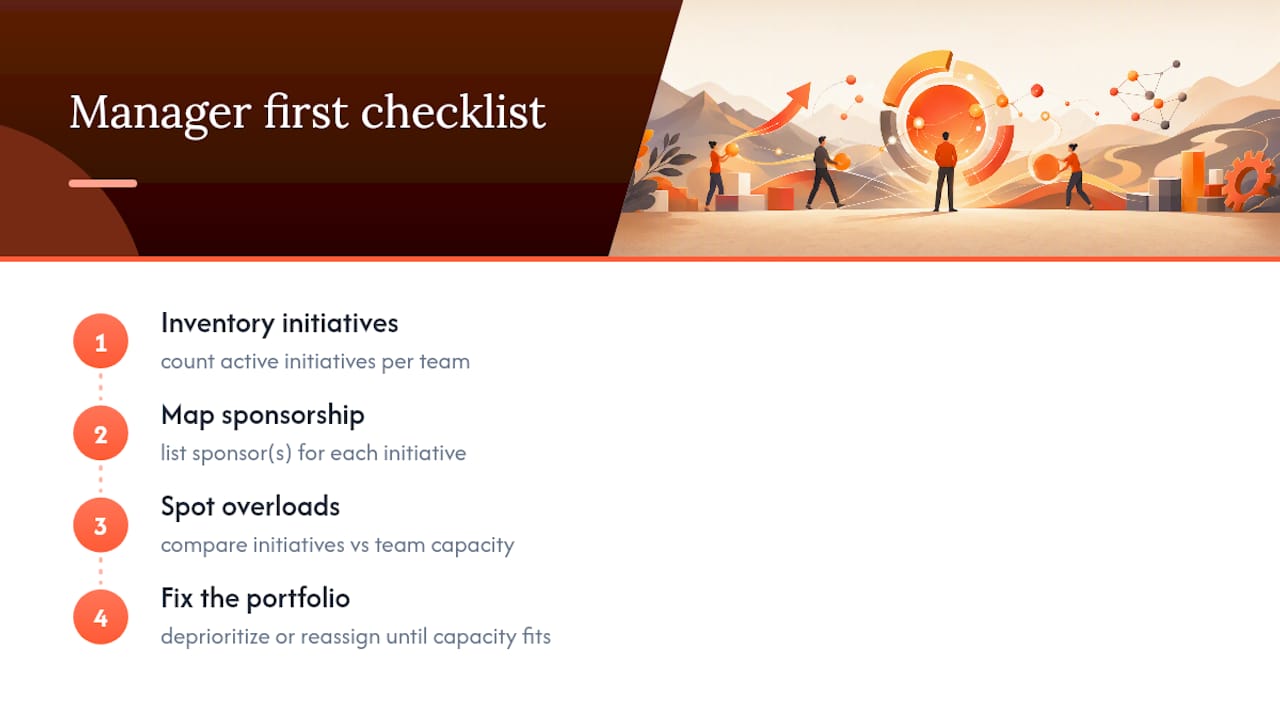
Most advice on change fatigue treats it as a messaging problem: communicate more, communicate better, get people excited about the vision. That advice is backwards. If your organization is running eight initiatives when your teams can absorb three, no amount of eloquent town hall content solves that math. The problem is capacity, and capacity is a portfolio decision, not a communication tactic.
The conventional playbook also overrates executive sponsorship as a cure. Sponsorship matters, but a VP who sponsors six projects at once is not really sponsoring anything. Diluted attention from the top is often what causes saturation in the first place, not what fixes it. If I had to pick one place for a manager to start, it would not be a communication plan. It would be an honest count of active initiatives per team, cross-referenced against who sponsors each one. That single exercise usually exposes the overload before any survey does. Fix the portfolio first. The morale problem tends to follow the workload problem, not the other way around.
— David
How TKD Consulting Helps You Fix the Root of Change Fatigue
Most consultants hand you a deck full of recommendations and leave the execution to you. TKD Consulting's 90-Day Operations Audit maps where change load is concentrated on people and processes, then delivers a prioritized 60-day plan designed for execution, including scorecards and meeting cadences to support sustained progress after the engagement.
If your leadership team suspects saturation but cannot yet point to where it is concentrated, diagnostic work can surface those issues, without adding another open-ended retainer. TKD also offers a Paid Discovery Call for $500 if you want a lower-commitment first step before committing to the full audit. Start with the Operations Audit page to see the deliverables and book a diagnostic.
Sources
- Change fatigue: continual evolution (Center for Creative Leadership)
- Change fatigue is a capacity problem (IMA Worldwide)
FAQ
What Is Meant by the Term Change Fatigue?
Change fatigue is the cumulative stress, disengagement, and reduced capacity employees experience when the volume or pace of organizational change exceeds their ability to absorb it, distinct from resistance to a single specific change.
How Do You Overcome Change Fatigue?
Overcoming change fatigue starts with reducing the number of concurrent initiatives, sequencing the rest with buffers between them, and replacing broad communication with targeted, behavior-specific messaging. A structured Operations Audit can identify exactly where overload is concentrated before you decide what to cut.
What Does Change Fatigue Look Like in Practice?
It looks like rising stress, decision paralysis, apathy toward new programs, higher absenteeism around training or rollout dates, and increased voluntary turnover, according to research from the Center for Creative Leadership.
Is Change Fatigue Real?
Yes. It is well documented in organizational research, and it carries real business consequences: 50 to 70% of planned change efforts fail, often because change outpaced what employees could realistically absorb.