
Batch picking shortens picker travel by grouping identical SKUs across multiple orders into one pass through the warehouse. Wave picking improves schedule predictability by releasing work in timed windows tied to shifts or carrier cutoffs. Pick batch when SKU overlap is high, wave when cutoffs are strict, and a hybrid when you're running a mid-market operation with both problems at once.
TL;DR:
- High SKU overlap, loose carrier cutoffs, and low packing capacity indicate batch picking is more suitable for your operation.
- Strict delivery deadlines and low SKU overlap favor wave picking, especially with high order volumes above 500 orders daily.
- Hybrid models combining wave and batch strategies are best for mid-market warehouses handling 200 to 1,000 orders per day with mixed SKUs.
- Implementing wave picking requires advanced WMS features for scheduling and sorting, while batch picking can often be managed with simpler systems or manual processes.
- Conduct pilot tests and evaluate accuracy, throughput, and staff feedback before scaling to ensure your chosen strategy aligns with your system capabilities and order profile.
Table of Contents
- Batch Picking vs Wave Picking: What Each Method Actually Does
- Labor, Accuracy, and Throughput: What Actually Changes
- A 5-Question Framework for Choosing Batch, Wave, or Hybrid
- Hybrid Picking: Where Zone, Batch, and Wave Meet
- What Your WMS and Floor Need Before You Flip the Switch
- Why Practitioner Experience Beats Picking Theory
- Sources
- FAQ
Batch Picking vs Wave Picking: What Each Method Actually Does
Batch picking and wave picking solve different problems, which is why comparing them head-to-head only gets you so far. Batch picking groups multiple orders that share the same SKUs, then sends one picker through the warehouse once to grab everything for that batch. The picker doesn't know which item belongs to which order until sorting happens at the pack station, so accuracy there depends heavily on how well that sort step is built.
Wave picking organizes work around time, not SKU overlap. A "wave" is a scheduled release of orders, usually timed to a shift, a truck departure, or a carrier's last pickup of the day. Everything in that wave gets picked, packed, and staged together, which is what makes wave picking so useful for hitting dispatch deadlines. According to NetSuite's breakdown of wave mechanics, the method is fundamentally about when orders move, while batch picking is about how picks are grouped.
Zone picking deserves a mention here too, mostly because it often gets folded into both methods. In zone picking, pickers stay in a fixed area and only handle the SKUs located there, passing partial orders down the line for consolidation. It's rarely used alone in mid-market operations. Instead, it usually shows up as an ingredient inside a batch or wave strategy, which is where the real hybrid models start to take shape.
Labor, Accuracy, and Throughput: What Actually Changes
The numbers here are where operations leaders start paying attention. Moving from discrete picking (one picker, one order, one trip) to batch or wave picking can cut labor cost per order by roughly 20 to 40%, depending on your starting point and order profile.
That range reflects operations moving off discrete picking entirely. If you've already got some batching in place, your remaining upside is smaller, so benchmark your current picks-per-hour before promising leadership a number.*
Each method pulls a different lever to get there:
- Batch picking cuts travel time by letting one picker satisfy several orders in a single walk, which is the biggest source of labor savings on most floors.
- Wave picking cuts idle time and staffing mismatches by aligning labor to actual work volume instead of a constant drip of orders.
- Accuracy risk shifts downstream in batch picking. Because sorting happens after the pick, a bad batch sort can misroute items across several orders at once, not just one.
- Wave picking's main risk is timing, not sorting. A wave that runs late cascades into every order inside it, which is why carrier cutoffs are the real constraint to design around.
- Technology closes most of the accuracy gap. RF scanning, pick-to-light carts, and voice-directed picking all reduce batch-sort errors, and accuracy often determines how large a batch you can safely run: without automated sort or light-directed carts, smaller batches limit the damage from a mis-sort.
Implementation complexity runs in roughly the opposite direction of the labor savings. Batch picking is the easier lift. It needs decent slotting and a WMS that can group orders by SKU, but the sorting logic at pack can often run on paper checklists in a pinch. Wave picking asks more of your systems: you need a WMS that can schedule releases, coordinate with dock staff, and adjust wave size when order volume spikes. That's a bigger training lift and a bigger capital ask if your current WMS doesn't support it out of the box.
A 5-Question Framework for Choosing Batch, Wave, or Hybrid
Most managers overthink this decision by researching picking theory instead of just scoring their own operation. Five questions get you most of the way to an answer.
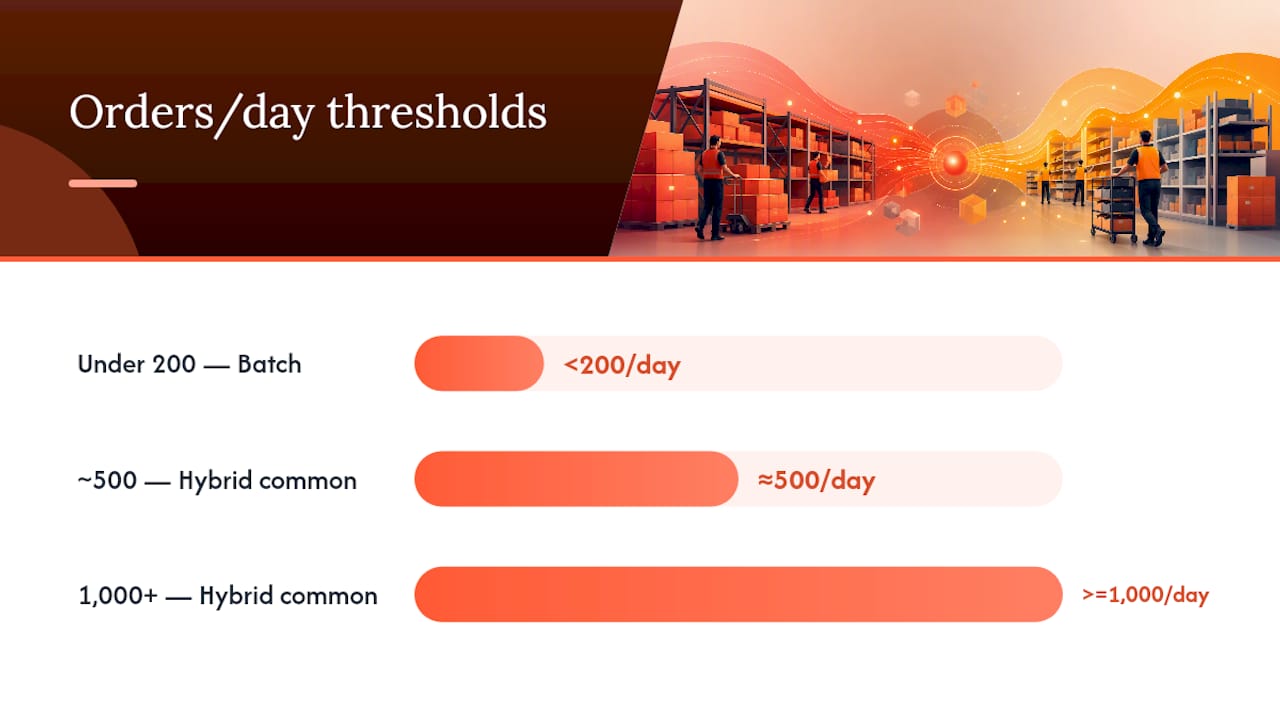
- How many orders do you ship per day? Under 200 orders a day, discrete or simple batch picking usually beats the overhead of running scheduled waves. Above 500 to 1,000 orders a day, hybrid models involving both batching and waving become common because neither method alone handles that volume cleanly, a pattern reflected in Supply Chain Desk's operational guidance.
- What percentage of your orders share top SKUs? High overlap (several orders requesting the same handful of best sellers) is the single strongest signal that batch picking will pay off. Low overlap means batching saves little travel time and you should weight toward wave.
- What does your order mix look like? A warehouse with mostly single-line orders behaves very differently from one full of multi-line orders. Multi-line orders usually need more sorting infrastructure to batch safely.
- How strict are your carrier cutoffs? If you're chasing a specific truck departure or a same-day cutoff, wave picking's scheduled release gives you a much more predictable path to on-time dispatch than an unstructured batch queue.
- What's your packing capacity? Batch picking dumps a wave of sorted items on the pack station at once. If pack can't absorb that volume quickly, you've just moved the bottleneck instead of removing it.
Score your answers honestly and a pattern usually appears. Heavy SKU overlap plus loose cutoffs points toward batch. Strict cutoffs plus low overlap points toward wave. Most mid-market operations land somewhere in the middle, which is exactly why hybrid models keep showing up in the practitioner checklists that experienced operations leaders build for this decision.
Before you commit to a full rollout, run readiness checks on three things: slotting quality (are your fast movers actually placed for efficient batch routes?), WMS wave and batch capability, and downstream sorting capacity. Then pilot in one zone or one shift for two to four weeks. Track lines per hour, picks per hour, error rate, and on-time dispatch percentage against your current baseline before scaling anything warehouse-wide. Good labor planning going into that pilot matters as much as the picking logic itself, since a pilot staffed wrong will produce misleading numbers either way.
Hybrid Picking: Where Zone, Batch, and Wave Meet
Pure batch and pure wave are the exception in mid-market operations, not the rule. Most floors running efficiently have blended the two into some version of zone, batch, wave, sometimes shortened to ZBW in warehouse management circles.
The logic is straightforward once you see it: waves control when work releases, while batching inside each wave controls how that work gets grouped for travel efficiency. A wave might release at 2 PM to hit a carrier cutoff, and inside that wave, the WMS batches orders sharing SKUs into efficient pick routes, then routes each batch to the zone where those SKUs actually live.
A few patterns show up repeatedly:
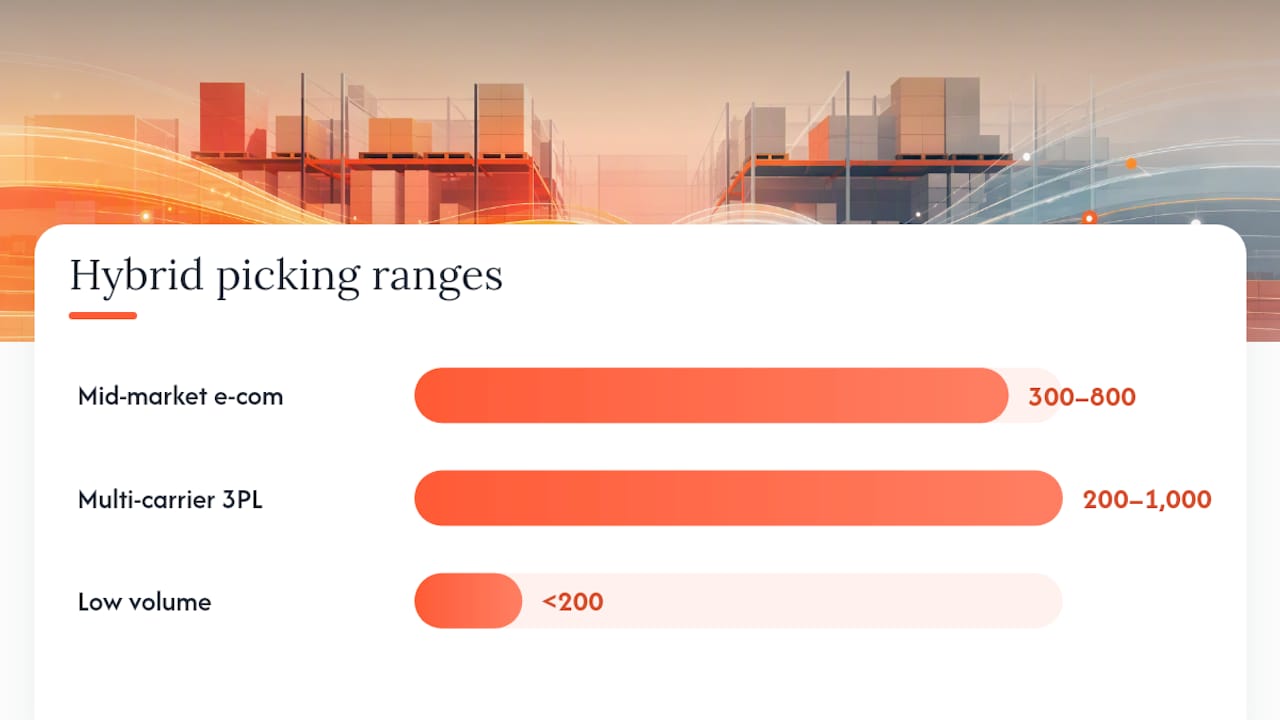
- Mid-market e-commerce operations running 300 to 800 orders a day often use wave-based batching to hit multiple daily carrier cutoffs while still capturing travel savings on high-overlap SKUs.
- Multi-carrier 3PLs lean on waves heavily because they're juggling several cutoff times a day, then layer batching inside each wave to keep labor cost per order down.
- Mixed-SKU operations (some fast movers, some long-tail items) often batch only the fast-moving zone and run discrete or small-batch picking for the long tail, rather than forcing everything through one system.
Hybrids become overkill fast, though. If you're shipping under 200 orders a day with a single cutoff and moderate SKU overlap, a zone-batch-wave setup adds coordination overhead you don't need. The instinct to "build the sophisticated system now" before volume justifies it is one of the more common expensive mistakes mid-market operations make. Atomoving's rundown of picking strategies backs this up directly: hybrid wave-based batching earns its complexity in roughly the 200 to 1,000 orders per day range, not below it.
What Your WMS and Floor Need Before You Flip the Switch
None of this works without a WMS that can actually support it. At minimum, you need batch creation logic, wave planning with configurable release windows, zone routing, and exception handling for when a pick fails or an item is out of stock mid-wave. If your current system can't do all four, evaluating WMS options built for mid-market volume should come before any picking-strategy redesign, not after.
Hardware choices shape your accuracy ceiling. RF scanners are the baseline for most implementations. Pick-to-light systems and voice-directed picking both push accuracy higher, which lets you run larger batches without the sort-error risk climbing alongside them. Deciding which automation investment actually pays back at your volume is worth a real analysis, since conveyor and light systems carry meaningful capital cost.
A few pitfalls show up again and again during rollout:
- Skipping the pilot and going straight to full deployment, which means you find out about a bad batch algorithm after it's already cost you a week of errors.
- Underestimating pack station capacity, turning a picking win into a packing bottleneck.
- Ignoring staff coaching on the new workflow, since pickers used to discrete picking often resist batch sorting logic at first.
Pro Tip: Measure your pilot on a weekly cadence, not daily. Daily numbers bounce around too much with order-mix noise to tell you anything reliable in the first two weeks.
Why Practitioner Experience Beats Picking Theory
Picking strategy looks clean on a whiteboard and messy on the floor, which is the gap that trips up most rollouts. Every warehouse has a version of "the wave planner didn't account for a callout" or "the batch algorithm optimized travel but broke the pack station." Those problems don't show up in a framework. They show up when someone who has actually run a distribution center under pressure walks the floor and watches the handoff points fail in real time.
If your pilot numbers look fine on paper but frontline staff are quietly working around the new process, that's the signal to bring in outside eyes before you scale. TKD Consulting's Operations Audit is built for exactly that gap: a structured diagnostic that maps your current picking workflow against your actual order profile and hands your team a prioritized 60-day plan.
Such plans usually break into three phases: immediate fixes in the first two weeks (slotting corrections, pack station staffing adjustments), tuning and calibration in the following weeks, and staff coaching and accountability checkpoints to ensure the process sticks after implementation.
— David
Sources
Figures and framework guidance in this article draw on Supply Chain Desk's picking strategy benchmarks, NetSuite's wave picking explainer, Atomoving's comparison of picking strategies, and SKU.io's practitioner checklist. For a broader look at sustaining process change after rollout, see Leanscape's guide to leadership in business transformation.
- What Is Wave Picking? How It Works, Methods & Tips | NetSuite
- Warehouse Picking Strategies: Which Method Cuts Labor Costs? — Supply Chain Desk
- Warehouse picking strategies explained: discrete, batch, zone and more — Atomoving
FAQ
What Does Batch Picking Mean?
Batch picking means grouping multiple orders that share the same SKUs so one picker collects everything for that batch in a single trip through the warehouse. Sorting into individual orders happens afterward, usually at the pack station, which is why sort accuracy matters so much in this method.
What Is the Most Efficient Way to Pick Items in a Warehouse?
There's no single most efficient method. Batch picking tends to be more efficient for high SKU overlap and loose deadlines, wave picking tends to be more efficient for strict carrier cutoffs, and a hybrid combining both is common for mid-market operations running 200 to 1,000 orders a day.
What Are the Three Order Picking Systems?
The three most commonly referenced order picking systems are discrete picking (one picker, one order at a time), batch picking (grouping orders by shared SKUs), and wave picking (releasing orders in scheduled time windows). Zone picking is often treated as a fourth variant, and many operations blend it into batch or wave setups rather than running it alone.
What Are the Different Types of Picking?
The main types are discrete, batch, wave, and zone picking, along with hybrids like zone-batch-wave that combine elements of each. Discrete picking handles one order per trip, batch picking groups orders by SKU overlap, wave picking releases work on a schedule, and zone picking assigns pickers to fixed warehouse areas.
How Do I Decide Between Batch Picking and Wave Picking?
Score your operation on order volume, SKU overlap, carrier cutoff strictness, order mix, and packing capacity. High SKU overlap with flexible timing favors batch picking, strict cutoffs with lower overlap favor wave picking, and most mid-market floors end up piloting a hybrid that blends both.