
Effective warehouse labor planning converts forecasted volume into staffed hours by function, using engineered labor standards instead of gut-feel headcount guesses. The three pillars are forecasting, standards, and scheduling, built to work together rather than in isolation. Get this right and you'll see two signals fast: variance to plan shrinks week over week, and last-minute overtime scrambles become rare instead of routine.
TL;DR:
- Accurate labor standards should be built by function and process, avoiding averaged or blended UPH to ensure reliable planning and scenario testing.
- Scheduling must prioritize cutoff-critical work with buffer times, staggered shifts, and cross-trained floaters to improve responsiveness during volume surges.
- Integrated WMS, LMS, and real-time data triggers are essential for converting forecasts into actionable daily staffing plans and tracking performance.
- A flexible staffing mix, including agencies, float pools, and part-timers, reduces overtime and turnover, but requires honest modeling of new-hire ramp-up productivity.
- Regular reviews of variance to plan, adjusted assumptions, and a safety lens prevent chronic overtime, safety violations, and unplanned staffing crises.
Table of Contents
- What Is Warehouse Labor Planning and Why Does It Matter?
- Core Components: Forecasting, Labor Standards, and Demand Drivers
- Scheduling and Shift Design That Holds Up During the Day
- Technology and Data: WMS, LMS, and Real-Time Triggers
- Flexible Staffing, Hiring, and Training to Manage Variability
- Measure and Improve: KPIs and Variance-to-Plan Reviews
- 60-Day Implementation Checklist for Warehouse Labor Planning
- Safety and Labor Compliance Considerations
- Cost Optimization Techniques in Labor Planning
- Training and Skill Development Aligned With Labor Plans
- Author Perspective: Common Pitfalls and Why an Audit Accelerates Results
- How TKD Consulting Helps You Build a Labor Plan That Sticks
- Sources
- FAQ
What Is Warehouse Labor Planning and Why Does It Matter?
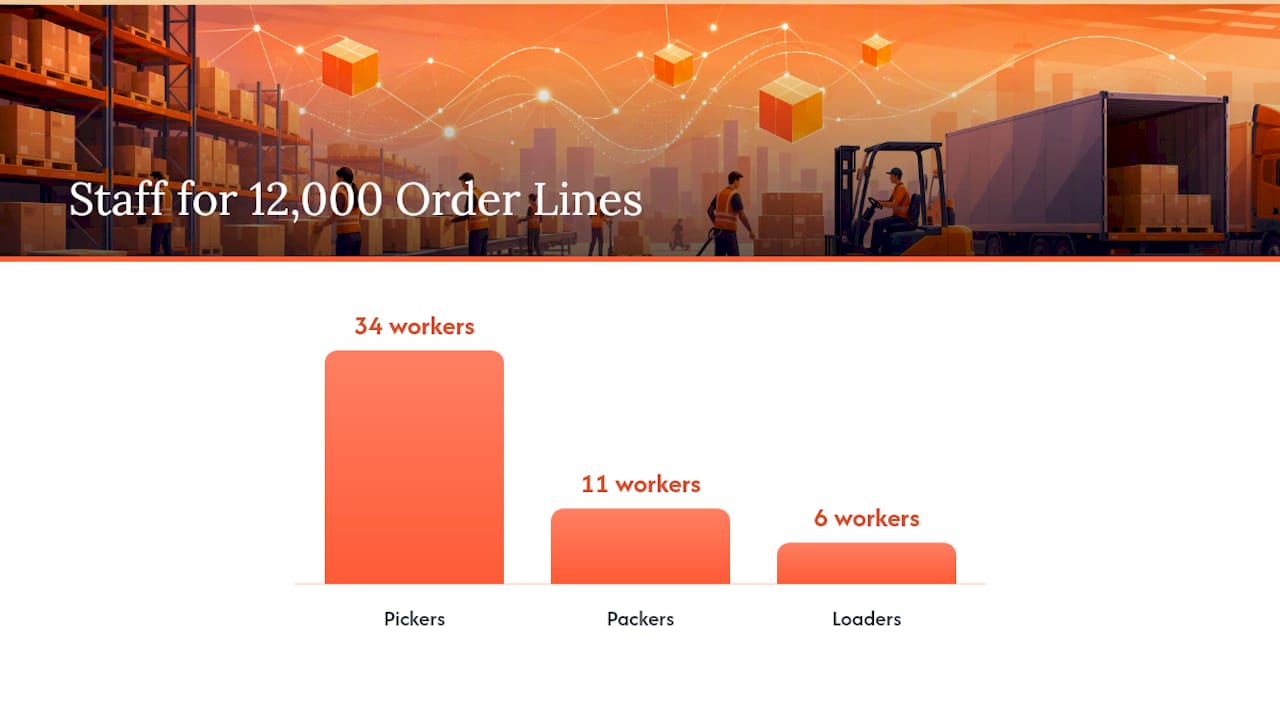
A forecast tells you how much volume is coming. Warehouse labor planning tells you how many people, in which roles, for how many hours, to move that volume without blowing your budget or missing a truck cutoff. That distinction trips up more operations than it should. Plenty of planners have a solid demand forecast and still get caught flat because nobody translated "12,000 order lines on Tuesday" into "we need 34 pickers, 11 packers, and 6 loaders on second shift."
The payoff for getting this translation right shows up in three places: lower labor cost per unit, fewer service failures, and less of the daily firefighting that burns out supervisors. It also affects retention, since chronic overtime and chaotic scheduling are two of the fastest ways to lose good hourly workers to the warehouse down the road.
The pressure to fix this is not theoretical. A majority of warehouse operators report difficulty sourcing enough labor to meet current demand, and the Bureau of Labor Statistics projects nearly 570,000 new warehouse workers will need to be hired over the next decade just to keep pace. Labor is getting harder to find and more expensive to keep, which means the plan matters more than it did five years ago.
What a functioning labor plan actually buys you:
- Predictable staffing costs that scale with real volume, not last quarter's average.
- Fewer emergency temp requests placed the morning of a peak day.
- Supervisors who spend time coaching instead of scrambling to cover gaps.
- A defensible number when finance asks why headcount went up.
Core Components: Forecasting, Labor Standards, and Demand Drivers
The engine underneath any workable plan is the engineered labor standard, usually expressed as units per hour (UPH). Without it, labor planning becomes a negotiation instead of a measurable plan — supervisors argue over headcount instead of checking it against a number everyone agreed to in advance. A good UPH standard is built by process, not by building. Measuring pick-by-zone or pack-by-carton-type separately, rather than one blended warehouse-wide UPH, captures the real variability in how hard the work actually is.
Building the conversion model means identifying what actually drives labor in each function:
- Receiving — driven by PO lines and pallet counts, not just total units.
- Putaway — driven by pallet moves and slot distance.
- Picking — driven by order lines and pick density.
- Packing — driven by units per order and carton complexity.
- Shipping/loading — driven by pallet counts and dock scheduling windows.
- Value-add services — kitting, labeling, or returns processing, each with its own standard.
Once you have drivers by function, stress-test the plan with scenario modeling. Run the expected case, then scenarios simulating higher and lower surges in volume, to see which function breaks first and where you'd need to pre-position flex labor.
Pro Tip: Don't average new-hire drag into your overall UPH. Model it as a separate line tied to your actual turnover rate, so a hiring surge doesn't quietly erode your whole plan's accuracy.
Scheduling and Shift Design That Holds Up During the Day
A plan is only as good as the schedule that executes it, and schedules fall apart when everyone is treated as interchangeable. Split your headcount into two buckets early. Fixed coverage includes roles that must be staffed regardless of volume swings, like dock supervisors, quality checkers, and equipment operators tied to safety certifications. Variable labor includes pickers, packers, and general laborers whose numbers should flex with the hourly workload curve.
The first rule of shift design: protect cutoff-critical work before anything else. If a truck leaves at 3 p.m., the labor supporting that wave gets priority placement, breaks scheduled around it, and the most experienced staff, not whoever happened to punch in first.
A short protection checklist for cutoff-critical work:
- Identify every hard cutoff and the functions feeding it.
- Assign your most reliable performers to those waves first.
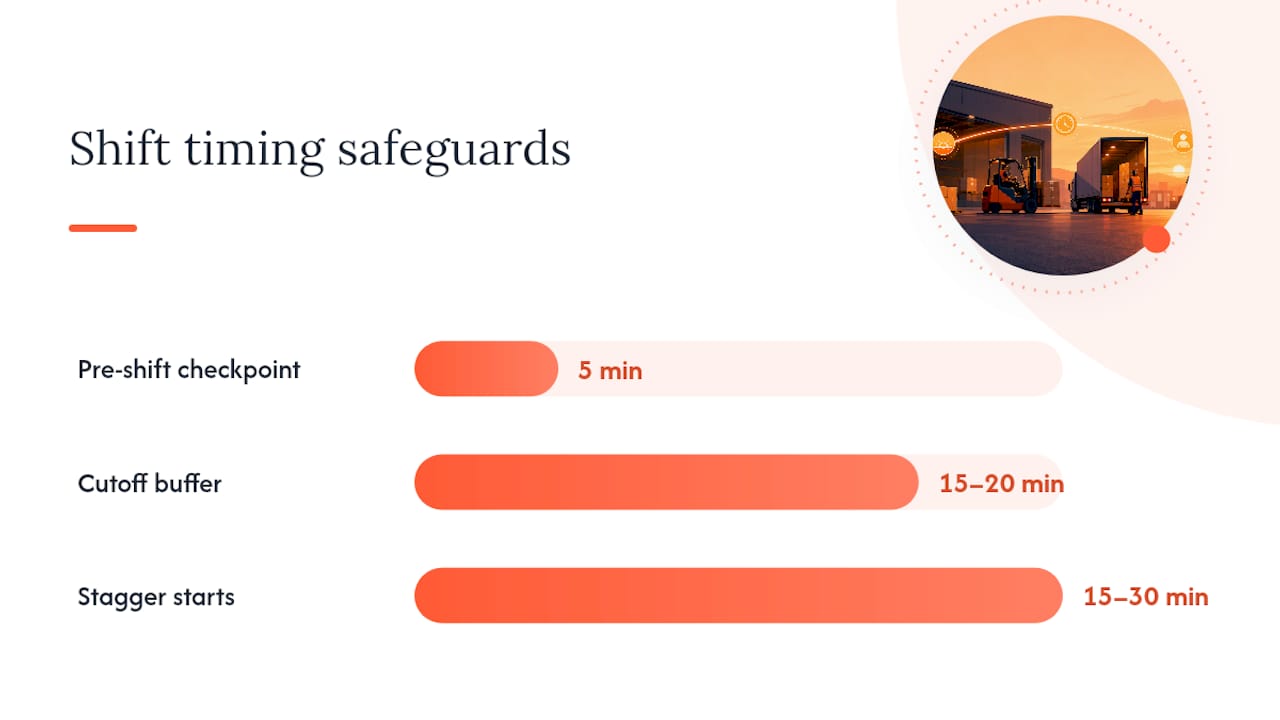
- Build in a 15 to 20 minute buffer before the cutoff, not after.
- Confirm staffing levels at the shift's pre-shift huddle, not an hour before the truck leaves.
Beyond that, a few tactical moves make schedules resilient instead of brittle: stagger shift starts by 15 to 30 minutes to avoid a single bottleneck at the time clock and in the break room, keep a small pool of cross-trained floaters who move based on defined volume triggers rather than supervisor instinct, and run a five-minute pre-shift checkpoint where leads confirm actual headcount against the plan before the first pallet moves.
Technology and Data: WMS, LMS, and Real-Time Triggers
Software has moved past passive reporting. Integrated systems now let planners convert forecasted volume directly into daily labor hours using the engineered standards you've already built, automating the routine math so people can focus on exceptions instead of spreadsheets.
The systems that actually matter, in priority order:
- Warehouse management system (WMS) — the source of truth for order and unit volume.
- Labor management system (LMS) — where engineered standards live and where actual performance gets tracked against them.
- Time and attendance (T&A) — feeds real headcount and hours, not planned headcount.
- Demand and forecast feeds — sales or replenishment data that trigger the whole conversion process upstream.
For measurement, capture timestamps at each process handoff, queue ages between stations, UPH broken out by zone and process (not one building average), and exception reason codes when a wave falls behind. Those exception codes are gold. They tell you whether a miss was a staffing problem, an equipment problem, or a demand surge nobody flagged.
Pro Tip: If your WMS and LMS don't talk to each other, fix that integration before buying anything new. Tooling amplifies good process and exposes bad process — automation on top of a broken standard just gives you a faster way to be wrong. A dashboard built around clean, shared data is far more useful than one more disconnected report nobody checks.
Flexible Staffing, Hiring, and Training to Manage Variability
No fixed headcount survives contact with real demand variability, which is why every mature labor plan includes a deliberate mix of flex capacity.
- Staffing agencies work best for short, unpredictable surges where you need bodies fast and don't need deep product knowledge.
- Temp-to-hire pools fit steady growth, letting you evaluate fit over a few weeks before extending a permanent offer.
- Float pools of cross-trained internal staff cover planned peaks like month-end or holiday season, since they already know your systems.
- Part-time scheduling fills predictable short peaks, like a two-hour afternoon wave, without paying a full shift for two hours of need.
Whichever mix you use, model new-hire productivity honestly. Ramping workers running at 60 to 75% of standard for four to six weeks should show up as a capacity haircut proportional to your annual turnover rate, not as a rounding error.
For cross-training sequencing, start with the roles adjacent to your cutoff-critical functions first. Train your best pickers on packing before you train packers on receiving. That way your float pool can plug the gaps that actually threaten a truck departure, not the gaps that are merely inconvenient.
Measure and Improve: KPIs and Variance-to-Plan Reviews
Track a compact set of numbers, not a dashboard full of vanity metrics: variance to plan by function, labor utilization (productive hours against paid hours), cost per unit, and forecast accuracy measured both day-of and a week out.
Run a weekly review with one rule: every meaningful variance gets tied to a single planning assumption you're willing to change, whether that's a UPH standard, an absenteeism buffer, or a forecast lag. A feedback loop measuring variance by function and adjusting assumptions accordingly produces the fastest gains in labor utilization of anything on this list.
- Track variance at the function level, not just the building level.
- Building-wide KPI averages mask exactly the process that's failing, since a bad picking day can hide behind a great receiving day in a blended number.
- One assumption change per week beats five untested tweaks fired off at once.
**The number that should worry you most isn't total labor cost.
60-Day Implementation Checklist for Warehouse Labor Planning
Turning this into practice doesn't require a massive rollout. It requires sequence.
- Week 1: Capture baseline UPH by function, identify every cutoff-critical role, and start a rolling 4-week variance log at the function level.
- Weeks 2 to 4: Build your conversion model turning forecast volume into hours per function, incorporating absenteeism and ramp-up haircuts.
- Day 30: Pilot a revised shift pattern on one shift or one function, and lock in at least two flex staffing sources before you need them.
- Days 30 to 60: Institutionalize the weekly variance meeting, train your first cross-trained cohort, and stand up a simple dashboard tracking plan versus actual by function.
| Milestone | Deliverable | Owner |
|---|---|---|
| Week 1 | Baseline UPH and cutoff-critical role map | Operations manager |
| Week 4 | Forecast-to-hours conversion model | Labor planner |
| Day 30 | Revised shift pilot and confirmed flex sources | Shift supervisors |
| Day 60 | Weekly variance cadence and live dashboard | Operations leadership |
A rollout this size fits neatly into a short, accountable execution window rather than a multi-quarter transformation project.
Safety and Labor Compliance Considerations
A labor plan that ignores safety and compliance is not actually a plan. It's a liability with a spreadsheet attached. Overtime-heavy schedules increase fatigue-related incident rates, and understaffed shifts push workers to skip steps, like proper lifting technique or forklift pre-checks, just to keep pace with the plan.
Build compliance into the standard itself, not as an afterthought. If your engineered UPH assumes a pace that only holds up when someone cuts corners on personal protective equipment or safe lifting form, the standard is wrong, not the worker. Fair Labor Standards Act requirements around overtime pay, meal and rest breaks (which vary by state), and accurate time tracking all intersect directly with scheduling decisions, so your T&A system needs to flag violations before they happen, not after payroll runs.
Cross-training also has a compliance dimension. Anyone floating into a role that requires certification, like powered equipment operation, needs that certification current before they're scheduled there, regardless of how badly you need the coverage. Building a flex pool without tracking certifications is how a labor shortage turns into an OSHA incident.
Finally, make sure your variance reviews include a safety lens, not just a cost lens. A function running consistently over standard might be understaffed, or it might be running unsafely to hit a number nobody double-checked. Treat a spike in near-misses the same way you'd treat a spike in cost per unit: as a signal that an assumption needs to change.
Cost Optimization Techniques in Labor Planning
The biggest cost lever in most warehouses isn't wage rate. It's overtime driven by poor forecasting, and the second biggest is turnover driven by chaotic scheduling. Fix the plan and both drop before you touch a single pay rate.
Start with schedule efficiency: matching staggered start times to your actual hourly volume curve, rather than one blanket shift start, can cut the first two hours of overstaffing that many warehouses accept as normal. Review overtime authorization weekly, tied to the same variance data you're already tracking, so overtime becomes a deliberate exception rather than a quiet default.
Flex labor mix matters as much as flex labor volume. Agency staff typically cost more per hour than your own float pool, so the sequencing from earlier, cross-training internal staff before leaning on external labor, pays for itself in the difference between an agency bill rate and an internal hourly wage.
Cross-training itself is a cost play, not just a flexibility play. A warehouse where three people can run receiving needs less agency backup during a call-out than one where only a single specialist can do it. That redundancy is cheaper than the emergency staffing it prevents.
Finally, revisit your engineered standards on a fixed cadence, at least twice a year. Standards that quietly drift out of date, because a new SKU mix or a layout change altered real work content, will misprice every shift built on them until someone catches it.
Training and Skill Development Aligned With Labor Plans
Training only earns its budget when it's built around the roles your labor plan actually needs covered, not a generic onboarding curriculum handed to every new hire regardless of function.
Sequence training around your cutoff-critical map from the scheduling section. New hires headed into picking or packing during peak waves need faster ramp-up support, shadowing, tighter feedback loops, than someone joining a lower-variance function like slow-moving inventory putaway.
Build a simple skills matrix mapping every employee against every function they're certified or trained for. That matrix is what makes your float pool actually usable during a surge, instead of a list of names with no clear sense of who can safely and productively cover what. It also surfaces your single points of failure, the one person who's the only one trained on a critical process, before that gap costs you a shift.
Refresher training deserves a place on the calendar too, not just initial certification. Skills decay when someone hasn't run a process in months, and a refresher session ahead of peak season costs far less than the productivity dip of relearning on the floor during your busiest week.
Author Perspective: Common Pitfalls and Why an Audit Accelerates Results
Most labor plans fail for the same handful of reasons: standards set once and never revisited, data sitting in three disconnected systems that nobody reconciles, and no real-time trigger telling a supervisor when a wave is falling behind until it's already late. Each of those looks small on paper and compounds fast on the floor, usually showing up as chronic overtime that leadership treats as a staffing problem when it's actually a process problem.
That's the gap a structured, time-boxed diagnostic closes quickly. A focused audit maps where the plan and the floor diverge, prioritizes the fixes that matter most, and hands the team an implementation runway, not just a slide deck, so the changes survive past the engagement. Leaders hiring outside help should expect a clear deliverable, a defined timeline, and a way to measure whether variance actually shrank.
— David
How TKD Consulting Helps You Build a Labor Plan That Sticks
Most warehouse leaders don't need another framework. They need someone to sit in the building, find where the plan and the floor disagree, and hand back a prioritized list the team can start on Monday. That's the 90-Day Operations Audit: a structured diagnostic of your people, processes, and performance systems, followed by a prioritized 60-day action plan and the implementation support, scorecards, meeting cadences, and coaching, to make sure it actually gets executed instead of filed away.

It's built for owner-operators and operations leaders at $5 to $50 million industrial and B2B companies who are busy but not aligned, with SOPs that exist on paper but don't survive contact with a Tuesday surge. The typical outcome is what this article has been pointing toward: tighter variance to plan, fewer overtime fire drills, and a team that trusts the numbers because they finally match what's happening on the floor. If your labor plan feels more like negotiation than measurement, book a paid discovery call or review the Operations Audit details to see how the 60-day plan would apply to your building.
Sources
- Labor Challenges: Strategies for Warehouse Labor Planning — Prologis
- Hand laborers and material movers — Occupational Outlook — BLS
- Warehouse Labor Planning — Sizelabs
- How to Forecast Warehouse Labor When Demand Swings — CognitOps
FAQ
What Are the 5 S's in a Warehouse?
The 5S system, sort, set in order, shine, standardize, and sustain, is a workplace organization method that reduces wasted motion and search time, which directly improves the UPH your labor plan is built on.
What Are the 7 Principles of Warehousing?
Common frameworks list principles like accurate demand forecasting, efficient space utilization, standardized processes, inventory accuracy, safety compliance, technology integration, and continuous performance measurement, all of which feed directly into labor planning decisions.
What Are the Key KPIs for Warehouse Labor Planning?
The core set includes variance to plan by function, labor utilization, cost per unit, forecast accuracy, and safety incident rate, tracked weekly rather than reviewed only at month's end.
What Are the Key Skills of a Warehouse Worker?
Strong warehouse performers combine physical stamina, attention to accuracy, basic technology literacy for scanners and WMS systems, teamwork under time pressure, and safety awareness, which is why cross-training sequencing matters so much for building flexible coverage.
How Much Does a Warehouse Labor Planning Diagnostic Cost?
TKD Consulting's 90-Day Operations Audit includes a diagnostic plus a prioritized 60-day action plan with implementation support.