
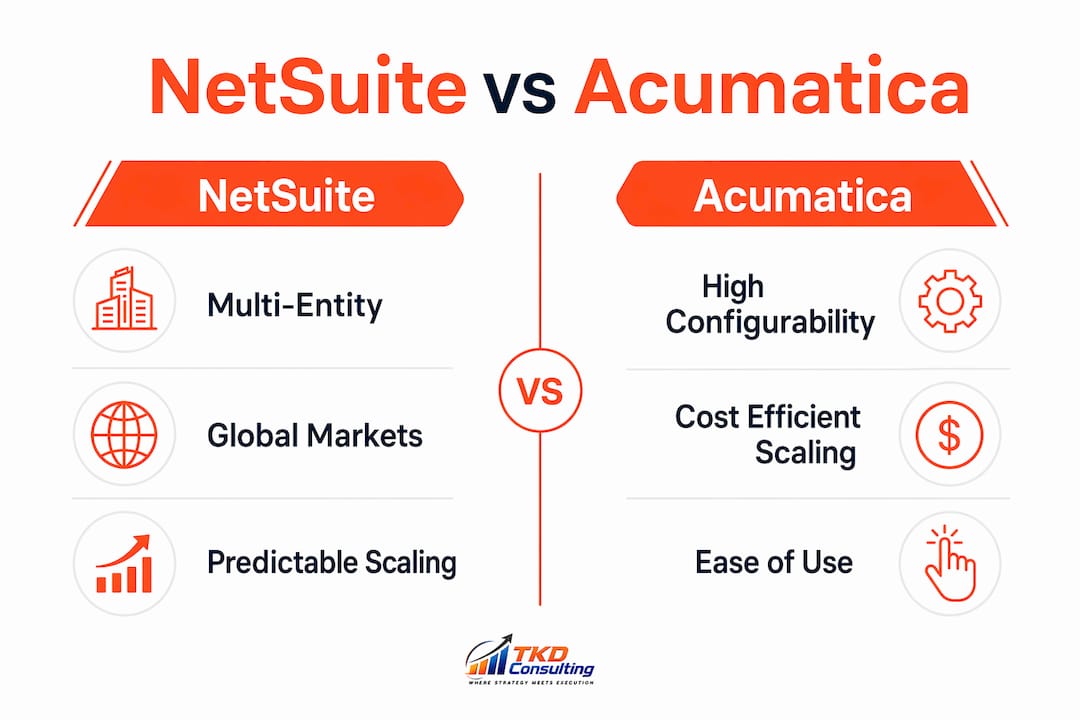
Pick NetSuite when multi-entity consolidation, multi-currency operations, and global scale are the primary requirements. Pick Acumatica when domestic mid-market workflows, heavy user counts, and industry-specific depth matter more. That's the short version. Here's how to use it:
- Multi-entity or international footprint: NetSuite's native consolidation automates intercompany eliminations and minority interest accounting, whereas Acumatica handles these tasks manually beyond a certain number of entities.
- User-heavy domestic operations: Acumatica's consumption-based pricing includes unlimited users, which cuts licensing costs for warehouse, field service, or seasonal workforces.
- Faster ROI horizon: G2's Spring 2025 data shows Acumatica users report ROI at roughly 17 months versus 22 months for NetSuite, though NetSuite's five-year total cost is typically lower for multi-entity organizations.
- Distribution, construction, or make-to-order manufacturing: Acumatica's industry editions are purpose-built for these verticals.
- Pre-implementation readiness: Neither platform fixes broken processes. TKD Consulting's Operations Audit maps people, process, and performance before you select a vendor, so you're not digitizing inefficiency.
Renewal risk: NetSuite customers report renewal uplifts of 10–25% after initial contract terms. Budget for it before you sign.
Table of Contents
- NetSuite vs Acumatica: core dimensions compared
- How does user training and adoption differ between the two platforms?
- Can these platforms scale with your business over five years?
- What security and compliance certifications matter for mid-market US companies?
- How do post-implementation support models compare?
- Before you choose a platform, fix your processes first
- Key Takeaways
NetSuite vs Acumatica: core dimensions compared
| Dimension | Oracle NetSuite | Acumatica Cloud ERP | Operations Audit | TKD Consulting | |---|---|---|---| | Best for | Multi-entity, international, finance-driven | Domestic mid-market, high user count, vertical depth | Owner-operators needing process clarity before ERP selection | | Deployment | Multi-tenant SaaS only | Cloud, hybrid, or on-premises | N/A (consulting engagement) | | Licensing model | Per-user, per-module (predictable) | Consumption/resource-based, unlimited users (variable) | Project-based or day-rate diagnostic | | Multi-entity / multi-currency | Native OneWorld consolidation | Solid domestic; manual overhead beyond some entities | Scopes entity complexity before vendor selection | | Industry vertical depth | Strong for finance, wholesale distribution | Deep editions for construction, manufacturing, field service | Vertical-agnostic process mapping | | Customization | Governed, version-safe environment | High configurability via xRP platform; customization drift risk | Governance frameworks reduce drift post-go-live | | Integration / ISV ecosystem | Large, mature partner network | Open REST APIs; integrates well with Power BI, Tableau | Partner-vetting checklist included in audit deliverables | | Implementation timeline | up to a year (OneWorld scope) | several months typical | diagnostic period overlaps vendor selection | | TCO / renewal behavior | Higher upfront; 10–25% renewal uplifts reported | Lower upfront; overage risk as transaction volume scales | Fixed-scope engagement; no renewal surprises | | Reporting & analytics | Real-time unified database | Configurable dashboards; scheduled refresh cycles | Scorecard and KPI framework delivered in audit |
Cost traps to watch:
- NetSuite renewal uplifts of 10–25% are common after the initial term. Negotiate multi-year pricing before signing, not at renewal.
- Acumatica's unlimited-user model is genuinely advantageous for large teams, but transaction volume growth can push consumption costs higher than projected. Model peak usage scenarios before committing.
- Both platforms carry significant implementation risk when partner quality is low. Prioritize partners with proven experience in your specific vertical and ask for multi-entity consolidation projects in their portfolio.
Pro Tip: Acumatica's high configurability is a strength that becomes a liability without governance. Document every customization decision during implementation and assign a configuration owner. Undisciplined customization drift is one of the leading causes of costly re-implementations.
How does user training and adoption differ between the two platforms?
Acumatica consistently scores higher on ease of use. Nucleus Research ranked it number one for usability in 2025, and on G2 it leads NetSuite in ease-of-use ratings (85% vs. 77%). For operations teams with mixed technical backgrounds, that gap matters at go-live.
NetSuite's learning curve is steeper, particularly for non-finance users. Adoption quality depends heavily on implementation partner choices and the depth of role-based training built into the project scope. Skimping on training during implementation is where most adoption failures start.
Both platforms benefit from leadership development investment at the middle-management layer and embracing automated reporting to drive better business intelligence insights. Change management is not a vendor feature; it's an organizational capability you build before go-live.
Can these platforms scale with your business over five years?
NetSuite scales more predictably when you're adding subsidiaries or entering new markets. Its multi-tenant architecture means automatic twice-yearly updates with no version management overhead. For organizations growing through acquisition or international expansion, that matters more than it looks on a feature checklist.

Acumatica scales well for headcount growth without proportional cost increases. The risk appears when transaction intensity grows faster than anticipated, making licensing costs harder to forecast. Companies that outgrow Acumatica often find the migration cost exceeds what they saved during early ownership.
What security and compliance certifications matter for mid-market US companies?
Both platforms carry SOC 1 and SOC 2 Type II certifications, which satisfy most mid-market audit and compliance requirements. NetSuite's SaaS-only model means Oracle manages infrastructure security, patching, and data residency. Acumatica's hybrid and private cloud options give organizations with strict data residency requirements more control, though that control comes with the responsibility of managing your own infrastructure security posture.
For US companies in regulated industries, confirm that your specific deployment option and module set meet your compliance obligations before signing. Neither vendor's standard contract substitutes for your own compliance review.
How do post-implementation support models compare?
NetSuite support runs through Oracle's global support centers and a partner network. Response quality varies significantly by partner. For ongoing continuous improvement post-go-live, the partner relationship matters more than the vendor's support tier.
Acumatica routes support through its VAR network, which means your day-to-day support experience is almost entirely determined by your implementation partner. That's an argument for investing heavily in partner selection upfront, not after go-live problems surface.
Before you choose a platform, fix your processes first
Choosing between NetSuite and Acumatica before you've mapped your current workflows is the most expensive mistake mid-market operators make. ERP selection is an architecture decision, and architecture decisions made on broken foundations produce expensive re-implementations.

TKD Consulting's Operations Audit is a structured, time-boxed diagnostic that maps your people, processes, and performance systems against your stated goals, then delivers a prioritized 60-day execution plan. It's designed specifically for owner-operators and operations leaders at $5–50M industrial and B2B service companies who need to know what they're actually buying before they commit to a platform.
What you get: process maps, accountability scorecards, a partner-vetting checklist, and an implementation readiness assessment. What you avoid: scope creep, hidden integration costs, and the organizational chaos of a go-live that lands on a team that wasn't ready. David Karpatkin brings the perspective of someone who has personally run distribution operations, carried a P&L, and built commercial infrastructure from zero. The operations consulting engagement includes the implementation runway, not just the slide deck. Book a discovery call to get started.
Key Takeaways
NetSuite fits multi-entity, international organizations best; Acumatica fits domestic mid-market operators with large user counts and deep vertical needs, but neither platform replaces the process work that determines implementation success.
| Point | Details |
|---|---|
| Platform fit by profile | NetSuite suits multi-entity and international operations; Acumatica suits domestic mid-market with high user counts. |
| Renewal and cost risk | NetSuite renewal uplifts of 10–25% are common; Acumatica overage risk grows with transaction volume. |
| Implementation timeline | Acumatica typically deploys in 3–8 months; NetSuite multi-entity projects run 6–12 months. |
| ROI timing vs. TCO | Acumatica users report ROI at roughly 17 months, while for NetSuite it's around 22 months; NetSuite's five-year TCO is typically lower for multi-entity organizations. |
| TKD Consulting's role | The Operations Audit maps process and governance gaps before vendor selection, reducing scope creep and implementation risk. |