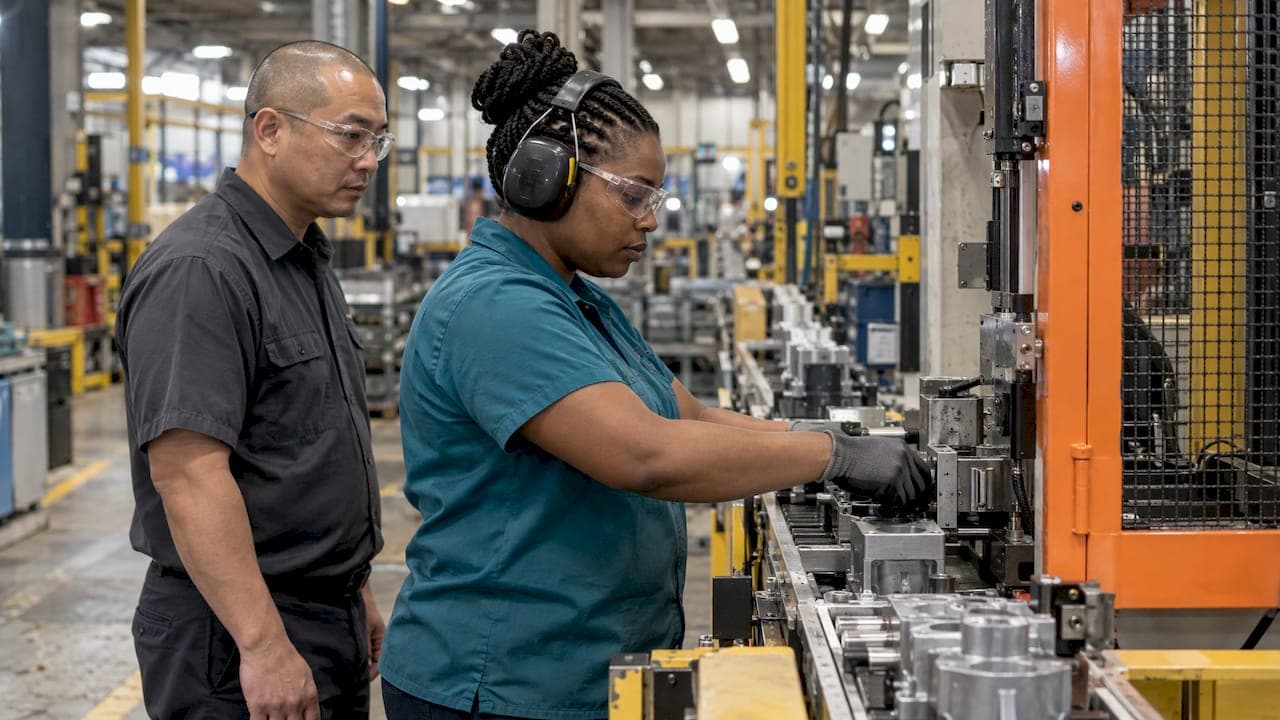
Shop floor change management is the discipline of getting a new process, layout, system or standard adopted by the people who run the line, on every shift, without losing production or safety along the way. It works when frontline people help define the problem, supervisors are ready before their teams are, a pilot proves the change on one line, and adoption is measured against a baseline for at least the first 90 days. This guide walks through each of those pieces for owners and operations leaders.
TL;DR
- Change management in manufacturing has two halves: the paperwork that controls the change (request, review, approval, validation) and the people work that gets it adopted. Most failures happen in the second half.
- Involve operators early, brief supervisors first, and pilot on one line and one shift before you scale.
- Reach the night shift on purpose. Put managers on the floor doing the work, not just walking through it.
- Write success criteria and a baseline before launch, then track adoption weekly through at least the first 90 days.
- Where a change touches hazardous processes, run it through a formal management of change (MOC) procedure and train people before startup.
Table of Contents
- What shop floor change management actually covers
- The control track: how a manufacturing change is documented
- Who does what: executives, supervisors and operators
- A four-phase rollout that fits a real plant
- Communicating change so it reaches every shift
- Why changes fail: the pattern behind the numbers
- Safety, training and production continuity
- Measuring whether the change stuck
- Perspective: why plans die between the conference room and the line
- How we help with shop floor change
- FAQ
- Sources
What shop floor change management actually covers
Two terms get mixed up. Shop floor management is a leadership routine: tiered daily meetings, visual boards, escalation paths and problem-solving at the point of value creation. SYMESTIC describes it as a method that originated in the Toyota Production System, with short meetings of roughly 5 to 15 minutes per tier.
Shop floor change management is something else: how you introduce a change to that system. IndustryWeek defines it as a consistent, systematic approach to implementing changes in product design or manufacturing processes while minimizing disruption and protecting quality and efficiency.
The floor adds constraints an office never faces. One practitioner guide notes that plant change has to account for shift-based workforces, safety-critical environments and deeply embedded operator routines. A new standard that works on days can quietly die on nights because nobody explained it there.
In practice you run both tracks at once:
- The control track. A documented request, an impact review, approval, implementation and verification.
- The adoption track. Communication, involvement, training, coaching and measurement.
Companies that only run the first track end up with beautifully approved changes that nobody follows.
The control track: how a manufacturing change is documented
The formal side is well established. Changes can originate in market demand, problems on the floor, new materials or supply-chain disruption. According to Arena's overview, a change often starts when an operator, supervisor or engineer spots an issue on the line, such as a line backup, and it ends when a solution agreed by the key stakeholders is implemented. It is documented through a Manufacturing Change Request (MCR) and approved through a Manufacturing Change Order (MCO).
A workable five-step version, as laid out by Jodoo:
- Submit a structured request that captures the business reason, the affected line, urgency, expected benefits and timing.
- Assess the operational impact.
- Route approvals.
- Plan implementation.
- Update documents, train affected roles, verify effectiveness and close the change when results are stable.
Notice what step 5 asks for: training and verification are part of the change, not an afterthought. We see owner-operated plants skip this step most often, because the approval feels like the finish line.
Who does what: executives, supervisors and operators
A change that lacks a clear owner at each level stalls at the first level that is unclear. A useful split:
| Role | Their job in the change | What goes wrong without it |
|---|---|---|
| Executives and owners | Set the reason and the boundaries, fund the time, review adoption numbers, stay visible on the floor | The change reads as a passing initiative and gets quietly dropped |
| Plant and operations managers | Sequence the rollout, protect production, remove blockers, own the scorecard | Pilots never scale, or scale everywhere at once |
| Frontline supervisors | Translate the change into daily work, coach, escalate problems | Teams hear the change secondhand and fill gaps with rumor |
| Operators and technicians | Define the problem, test the solution, expose what will not work on a real shift | The design fails the first time it meets real equipment |
The supervisor row deserves emphasis. A podcast discussion on frontline supervisors frames it clearly: senior executives initiate change, while supervisors are responsible for integration and results. Dozuki's coverage of Taylor Harlin advises getting frontline leaders on board before they face their teams. Brief supervisors first, give them the answers to the obvious questions, and let them raise objections in private rather than in front of the crew.
A four-phase rollout that fits a real plant
The most practical sequence in the research is Oxmaint's four-phase rollout. Here it is, with how we would apply it.

Phase 1: Walk the floor and set the baseline
Interview operators and supervisors on every shift, map who influences whom, and document baseline metrics. Do not skip the baseline. Without a before number, you cannot show the change worked, and skeptics will say it did not.
Choose a handful of measures tied to the problem. JIT Base suggests measures such as setup time, cycle time, first-pass yield, throughput and OEE components. Tyler Holt's playbook for wood manufacturers suggests a one-page baseline of on-time delivery, first-pass yield, rework as a percent of sales, raw-material yield and cash conversion days. Pick the five that matter to your plant and put them on one page.
Phase 2: Build a coalition on every shift
Identify respected operators on each shift and bring them in as co-designers. The aim is credibility, not cheerleading. People trust a peer who says, "I ran it, here is what to watch for."
Phase 3: Pilot on one line, one shift, one department
A pilot limits the damage of a bad idea and generates local proof. MX.0 Media reports Kiera Wells advising leaders to walk employees through the recommended solution before it is final and then let them see it working in a demo or pilot, so launch day brings familiarity rather than fear.
Write your acceptance threshold before the pilot starts. One example from JIT Base: accept a setup-reduction pilot if average setup drops 30% or more without raising scrap by more than 1%. Your numbers will differ, but deciding them in advance prevents arguments afterward.
Phase 4: Scale in stages
Roll out shift by shift, and track adoption weekly for the first 90 days after launch. That window is where most changes either lock in or slide back.
Communicating change so it reaches every shift
One-way communication is the default and it is the weakest option. Dozuki's reporting on Harlin says two-way communication beats email blasts and posters because people can ask questions and understand why the change matters to them personally.
What to do on Monday:
- Open with facts. Share the baseline and say plainly what is not working. Holt recommends a cadence such as walking the floor twice daily and publishing a Friday note on what improved, what still hurts and what comes next.
- Acknowledge past attempts. If a previous initiative stalled, say so and say what is different now.
- Invite input inside boundaries. Be clear about what is decided and what is open. Promise no surprises, and preview significant changes early.
- Name the real worries. Employees fret about competence, status and hours. Empathize and bring the conversation back to the next piece of work.
- Spend time doing the work. The World Economic Forum's report on US plants, built on 40+ operator interviews, describes a 'live my life' format in which managers perform tasks alongside operators. It was found particularly helpful for visibility across shifts, since night-shift operators often get less engineering and supervisory support.
The same WEF report recommends training in groups of up to 20, pairing technology champions across generations and seniority levels, and offering continuing learning.
Don't let the night shift get the leftovers
The handoff between shifts is where change messages leak. A consistent written handover keeps new standards, open issues and known workarounds from getting lost between crews. A shift handover notes template is a good starting point for structuring that, and you can adapt the fields to your own line.
Why changes fail: the pattern behind the numbers
Oxmaint reports these causes of plant change failure, which is a practitioner's estimate rather than a controlled study, but the pattern matches what we see in the field:
| Failure cause | Share of failures reported |
|---|---|
| Insufficient frontline involvement in planning | 73% |
| Communication that never reaches the night shift | 65% |
| Training disconnected from actual equipment | 58% |
| No visible metrics tracking adoption | 52% |
| Change abandoned after the launch event | 44% |
Every item on that list is fixable with management attention, not capital. Involve operators, brief every shift, train on the real machine, post the numbers where the crew can see them, and keep showing up after launch day. Our own writing on change fatigue covers what happens when a team has watched too many launches fade, and our 60-day change adoption plan lays out the runway we use after launch.
Safety, training and production continuity
On the floor, change is also a safety event. Washington State's Division of Occupational Safety and Health, in its VPP best practices on management of change, says a proper MOC system evaluates changes before implementation and informs and trains affected employees, maintenance workers and contract workers before startup. Its guidance also recommends gathering employee input through interviews, group discussions or surveys, writing clear instructions covering safety information and emergency procedures, and training people before they operate changed equipment.
For processes covered by OSHA's Process Safety Management standard, 29 CFR 1910.119, MOC is a legal requirement. OSHA states the standard requires written MOC procedures addressing the safety and health impacts of changes to process chemicals, technology, equipment, procedures and facilities, and it has addressed organizational changes that affect safety in covered processes. After physical changes, a pre-startup safety review verifies readiness. If your plant handles hazardous chemicals, confirm with your EHS lead or a qualified safety professional whether a given change is covered before you schedule it.
Plan continuity in the same breath:
- Schedule trials for planned downtime or a single line, not across the whole plant.
- Keep the old method available during the pilot, then formally retire it. Oxmaint recommends removing access to old systems and workarounds once the new way is established, since leaving them open invites reversion.
- Keep staffing steady on the changeover shift, so supervisors have time to coach.
Plants with perimeter, access or contractor concerns during a major change may also want to review how security for manufacturing plants is handled while routines are in flux.
Measuring whether the change stuck
Going live is not success. TEEPTRAK states that success is measured against the pre-go-live baseline, using OEE and its components, unplanned downtime, MTTR, MTBF, scrap and rework rate, and operator adoption, and that it means sustained, measurable improvement in those numbers.
A simple measurement plan:
- Write success criteria before the pilot. Fabrico recommends specific targets and an adoption metric, for example 80% or more of technicians completing work orders in the system daily, as a leading indicator.
- Report at shift level early. JIT Base suggests shift-level reporting during the first two weeks of a pilot, then weekly summaries.
- Give the Check phase enough data. SYMESTIC says a credible PDCA check needs at least 2 to 4 weeks of data, depending on the process.
- Close only when stable. Jodoo's rule is to close when results are stable, open actions are done and the old method has been formally retired.
- Keep tracking for 90 days. Recognize early adopters publicly, and handle persistent resistance with one-on-one coaching rather than mandates.
For a sense of scale, the NIST Manufacturing Extension Partnership reported that a Kaizen event at a Michigan manufacturer cut changeover time by 70 percent and saved $125,000 in costs. One company's result, not a promise, but it shows what a well-measured event can deliver.
Perspective: why plans die between the conference room and the line
We have sat in a lot of plants where the strategy was sound and the change still did not land. The gap is almost never intelligence. It is that nobody translated the intent into something a floor manager could act on Monday morning.
That is why we build engagements around the runway, not the slide deck. Scorecards, meeting cadences, coaching frameworks and accountability mechanisms are what keep a change in place after the consultant leaves. Our approach is designed to transfer those systems to your team, so results hold without us.
Our founder has run warehouse operations and carried a P&L, so we write recommendations the way a plant manager needs to receive them: specific, sequenced and owned by a named person. If your team is busy but not aligned, or your SOPs exist on paper but nobody follows them, you do not need more analysis. You need a prioritized plan and someone to help you execute it.
David
How we help with shop floor change
If you want an outside, senior view before committing to a rollout, our 90-Day Operations Audit is a fixed-price, $3,500 one-off diagnostic that maps your people, processes and performance systems against your goals and produces a prioritized action plan your team can execute. We structure it to deliver measurable outcomes within a 90-day window, and for teams that want help beyond the audit there are implementation and embedded options.

For larger programs, see our operations consulting and continuous improvement services. You can also read how we think about a management operating system and an operational readiness review before a major launch.
FAQ
What is the difference between change management in manufacturing and shop floor management?
Shop floor management is the ongoing leadership routine of tiered meetings, visual boards and problem-solving at the line. Change management in manufacturing is the structured way you introduce a new process, design or system into that routine. You need both: the first gives you a cadence, the second gets a specific change adopted.
How long does it take for a shop floor change to stick?
Plan on at least the first 90 days after launch. Practitioner guidance recommends weekly adoption tracking for that period, and a PDCA Check phase needs 2 to 4 weeks of data at minimum. Close the change only when results are stable and the old method is retired.
How do you handle resistance from operators?
Start earlier than you think: bring operators in to define the problem, walk them through the proposed solution before it is final, and let them see a pilot. Use two-way conversations rather than posters and email. For persistent resistance, one-on-one coaching works better than mandates.
Do all plant changes need a formal management of change procedure?
Not all, but changes to processes covered by OSHA's Process Safety Management standard do. Even outside that standard, evaluating the safety impact and training affected people before startup is sound practice. Ask your EHS lead whether a specific change is covered.
Sources
- Mastering the Manufacturing Change Management Process, IndustryWeek
- Shop Floor Management: Pillars & Implementation, SYMESTIC
- Manufacturing Plant Change Management: Organizational Guide, Oxmaint
- Effective Manufacturing Change Management, Arena
- Change Management Process in Manufacturing, Jodoo
- The Frontline Supervisor's Role in Leading Change
- How to Manage Change on the Plant Floor, Dozuki
- 5 Kaizen Experiments to Cut Setup and Cycle Time, JIT Base
- A Four-Stage Persuasion Playbook for Change in Secondary Wood Manufacturing, Wood Industry
- The Novice Farmer's Mistake, MX.0 Media
- Insights on introducing new technology into US manufacturing, World Economic Forum
- Voluntary Protection Program Best Practices, Washington State DOSH
- Management of Organizational Change, OSHA
- How to Measure Automation Success, TEEPTRAK
- How to Run a CMMS Pilot Program, Fabrico
- PDCA Cycle: 4 Phases, Worked Example, SYMESTIC
- Success Story: Improvement Effort Reduces Changeover Time, NIST
- Shift handover notes template
- Security guards for manufacturing plants