
What is vendor performance management and why does it matter?
Vendor performance management (VPM) is the ongoing process of measuring, analyzing, and improving how third-party vendors deliver against agreed standards. It covers everything from setting clear KPIs and SLAs at contract signing to conducting structured reviews, triggering corrective actions, and deciding at renewal whether a vendor has earned more business or needs to be replaced.
The case for doing this well is straightforward. Without a defined process, procurement teams end up managing vendors reactively, chasing problems instead of preventing them. Failure to define shared KPIs in contracts leads to defensive, accountability-free relationships that fall apart at renewal.
A recognized starting point for structuring evaluation is the 10 C's framework: Competency, Capacity, Commitment, Control, Cash, Cost, Consistency, Culture, Communication, and Corporate Social Responsibility. It forces procurement teams to look beyond price and delivery history before committing to a supplier relationship.
The benefits of a structured approach include:
- Risk reduction: Early detection of compliance gaps, financial instability, or delivery failures before they become operational crises
- Cost control: Monitoring performance prevents delays, errors, and non-compliance penalties that quietly erode margins
- Service consistency: Regular reviews hold vendors to agreed standards rather than letting performance drift
- Stronger partnerships: Clear feedback loops build trust and open the door to vendor-led innovation
Key benefits of structured supplier performance programs
A well-run supplier performance evaluation program does more than catch underperformers. It shifts the entire vendor relationship from transactional to collaborative.

Vendors who receive structured, data-backed feedback know exactly where they stand. That clarity tends to produce better behavior than vague dissatisfaction communicated at renewal. When vendors understand your priorities, they can align their own operations accordingly, which often surfaces cost-saving ideas you would never have found through a standard RFP process.
The operational reliability benefit is also real. Teams that track delivery rates, quality compliance, and response times consistently catch problems weeks earlier than teams relying on complaint-driven feedback. That lead time is the difference between a manageable supplier issue and a production stoppage.
How to measure vendor performance: key metrics and KPIs
Choosing the right KPIs is where most programs either gain traction or stall. The goal is a mix of quantitative and qualitative indicators that together give a complete picture of vendor effectiveness.
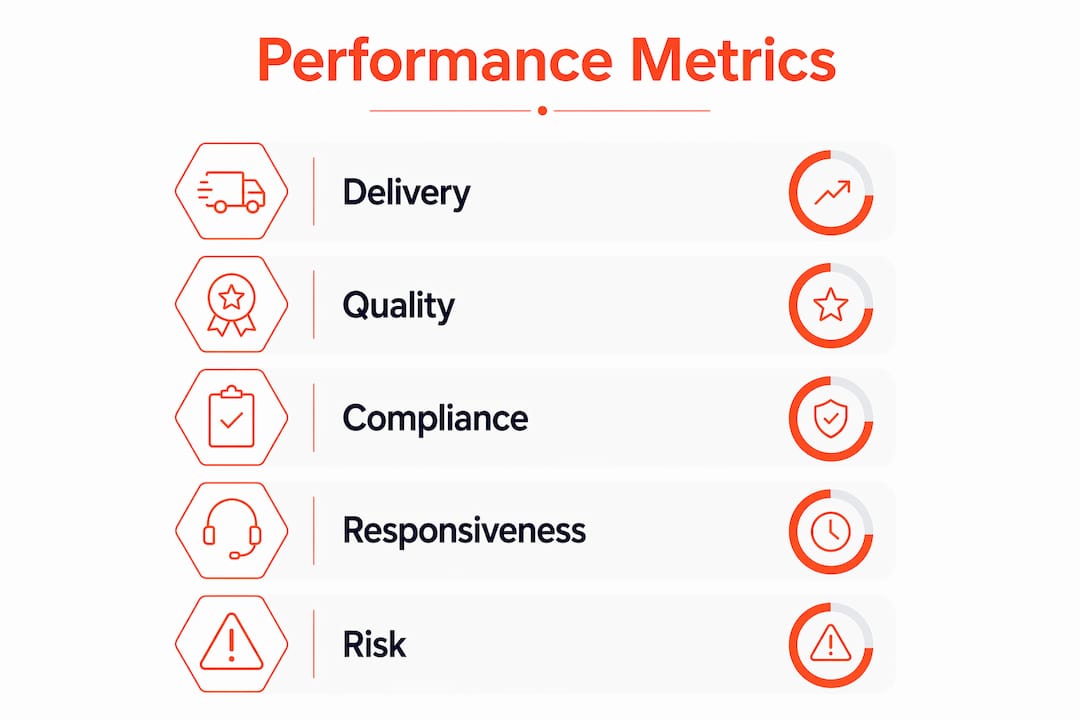
Common KPI categories and example targets:
| KPI Category | Example Metric | Target |
|---|---|---|
| Delivery | On-time delivery rate | a very high on-time delivery rate of orders on or before the agreed date |
| Quality | Defect/non-conformance rate | a low defect or non-conformance rate of delivered units |
| Cost | Cost variance vs. contract | a small variance from agreed pricing |
| Responsiveness | Response time to inquiries | a rapid response time for standard requests |
| Compliance | Regulatory/contractual compliance rate | full compliance with mandatory standards |
| CSR | Sustainability and ethics adherence | Annual audit pass |
Weighted scoring models assign different weights to each criterion based on strategic priorities, which reduces bias and aligns evaluation with what actually matters to your business. A vendor supplying a commodity component gets weighted differently than one providing a mission-critical service. The weighting conversation is where the real strategic debate happens.
Pro Tip: Supplement lagging indicators like defect rates with qualitative relationship data. A vendor who scores well on delivery but is consistently slow to flag problems is a higher risk than their scorecard suggests.
How vendor performance management fits the vendor lifecycle
Supplier performance evaluation is not a one-time event. It runs across every phase of the vendor relationship.
- Selection: Apply the 10 C's framework and weighted scoring to shortlist vendors before signing. Past performance data from references and prior contracts is the most reliable predictor of future delivery.
- Onboarding: Set KPIs and SLAs explicitly in the contract. Both parties should sign off on the scorecard format before work begins.
- Ongoing monitoring: Track performance continuously using dashboards and automated alerts, not just at scheduled review intervals.
- Periodic evaluation: Performance evaluations should occur at least every six months during a contract, with a final evaluation at contract end.
- Corrective action: When a vendor misses targets, trigger a structured improvement plan with defined deadlines and follow-up checkpoints.
- Renewal or termination: Use accumulated scorecard data to make a defensible, data-driven decision rather than defaulting to the incumbent out of convenience.
Embedding performance reviews into each lifecycle phase turns VPM from an annual checkbox into a continuous management discipline.
Common challenges in vendor performance management
Most programs run into the same obstacles. Knowing them in advance makes them easier to route around.
- No shared standards: When KPIs are not written into contracts, vendors have no clear target to hit and procurement has no defensible basis for holding them accountable.
- Inconsistent data collection: Sporadic or manual tracking produces gaps that make trend analysis unreliable and audits difficult to defend.
- Weak feedback loops: Vendors who only hear about problems at renewal cannot course-correct in time. Regular, structured communication is the fix.
- Resistance to change: Some vendors push back on new reporting requirements or process changes. A root cause analysis followed by targeted training tends to work better than escalation.
- Resource constraints: Lean procurement teams cannot audit every vendor at the same depth. Segmenting suppliers by risk and strategic value lets you concentrate intensive oversight where it matters most and reduce unnecessary audits on lower-risk vendors.
Which tools support vendor performance management?
Digital platforms have made it practical for lean teams to manage vendor performance at scale. The core features to look for are centralized data storage, automated performance alerts, scorecard generation, and contract management integration.

SafetyCulture Americas is a mobile-first workplace operations platform built around safety and operational excellence. It offers over 10,000 customizable checklists and automated workflows that support real-time tracking, streamlined audits, and compliance documentation across industries including manufacturing, logistics, healthcare, and construction. For procurement teams managing frontline vendor compliance, its mobile-first design means field teams can capture and report performance data without returning to a desk.
| Provider | Core Service | Specializations | Platform Features | Pricing | Rating |
|---|---|---|---|---|---|
| SafetyCulture Americas | Workplace operations platform | Safety, manufacturing, logistics, healthcare, construction | 10,000+ checklists, automated workflows, mobile-first, real-time tracking | Free sign-up available | 4.6★ (9 reviews) |
Centralizing vendor data and automating performance signals are the two practices that most reliably shift procurement from reactive firefighting to proactive management. When contracts, KPIs, compliance certificates, and renewal dates live in one system, audit readiness is continuous rather than a sprint before a review.
Expert insights on vendor management strategies that actually work
The single most useful reframe in vendor management is this: treat vendors with the same operational discipline you apply to internal employees. That means clear expectations, defined responsibilities, and a regular cadence of performance conversations, not just annual reviews.
Scorecards measure what already happened. To get ahead of problems, you need to combine that data with qualitative relationship intelligence: how responsive is the vendor's account team? Are they flagging risks proactively or waiting to be asked? Combining quantitative scorecard data with qualitative feedback provides forward-looking insight that lagging indicators alone cannot deliver.
The other principle worth building into your program from day one: evaluations should trigger structured improvement plans, not just scores. A scorecard that sits in a shared drive without a follow-up conversation changes nothing. The corrective loop is where vendor development actually happens.
Pro Tip: Segment your vendor base into tiers before designing your review cadence. Critical vendors warrant monthly or quarterly reviews; lower-risk vendors can be reviewed annually. Applying the same intensity across all vendors wastes resources and dilutes focus.
How to conduct vendor performance reviews and audits
A vendor review that actually drives change follows a consistent structure. Start by pulling scorecard data for the review period and comparing it against agreed KPI targets. Identify the two or three gaps that had the most operational impact, not every minor variance.
In the review meeting, present data first and invite the vendor's perspective before drawing conclusions. Vendors often have context that changes the interpretation of a missed metric. From there, agree on specific corrective actions with named owners and deadlines on both sides. Document everything and schedule a follow-up checkpoint before the next full review.
For audits, the same principle applies: scope them to the areas of highest risk or recent underperformance rather than running a full audit on every vendor every cycle. A continuous improvement mindset treats each audit as an input to a development plan, not a pass/fail verdict.
How to set vendor expectations and SLAs that hold up
SLAs are only as useful as the specificity behind them. A clause that says "timely delivery" is not an SLA. One that says "95% of orders delivered within the agreed lead time, measured monthly, with a remediation plan triggered at two consecutive months below threshold" is.
Write SLAs at contract signing, not after a problem surfaces. Cover response times, quality thresholds, compliance requirements, escalation paths, and the consequences of sustained underperformance. Both parties should review and sign the scorecard template alongside the contract so there are no surprises when the first evaluation arrives.
Revisit SLAs at each major renewal. Market conditions change, your operational requirements change, and an SLA written three years ago may no longer reflect what good performance looks like today.
Risk management and vendor performance
Vendor risk is not a separate workstream from performance management. It runs through every metric you track. A vendor with declining on-time delivery rates is a supply chain risk. One with lapsing compliance certifications is a regulatory risk. One with deteriorating financial health is a continuity risk.
Build risk indicators directly into your scorecard alongside operational KPIs. Flag vendors who show two or more consecutive periods of underperformance for a deeper review before the issue compounds. For high-criticality vendors, maintain a contingency plan that identifies alternative sources or internal fallback options, so a vendor failure does not become a business crisis.
Flexible contract structures also matter here. Contracts that allow for renegotiation of terms when external conditions shift give both parties room to adapt without triggering a default, which tends to produce better outcomes than rigid agreements that force a vendor into non-compliance.
Tkdconsult brings vendor management from the whiteboard to the floor
If your vendor program exists on paper but not in practice, the gap is usually execution, not strategy.
Tkdconsult's Operations Audit is a structured diagnostic that maps your current vendor oversight processes against your actual business goals, then delivers a prioritized 60-day action plan your team can execute the following Monday. David Karpatkin brings direct P&L and distribution center experience to every engagement, so the scorecards, meeting cadences, and accountability frameworks he builds are designed for floor-level use, not a shared drive. For owner-operated businesses and mid-market teams that need senior operational judgment without adding a full-time executive, Tkdconsult offers a concrete alternative to a traditional consulting retainer.
Key Takeaways
Effective vendor performance management requires shared KPIs set at contract signing, structured review cadences, and corrective loops that trigger improvement plans rather than just scores.
| Point | Details |
|---|---|
| Set KPIs at contract signing | Shared, measurable standards prevent defensive vendor relationships and weak accountability at renewal. |
| Review at least semi-annually | Performance evaluations should occur at least every six months during a contract, with a final evaluation at contract end. Structured reviews covering cost, quality, schedule, and management keep performance on track throughout the contract lifecycle. |
| Segment vendors by risk | Apply intensive oversight to critical vendors and lighter cadences to lower-risk suppliers to focus resources where they matter. |
| Combine data types | Pair scorecard metrics with qualitative relationship feedback to catch risks that lagging indicators miss. |
| Tkdconsult for execution | Tkdconsult's Operations Audit translates vendor management strategy into floor-ready scorecards and accountability frameworks. |