
A customer onboarding playbook is an internal, stage-based standard operating procedure that gets customers to first value predictably instead of by accident. Its job is to convert your team's tribal knowledge into a repeatable sequence of milestones, owners, and touchpoints. The first move, before you write a single template, is defining what "first value" means for your product and mapping the exact milestone that proves a customer has reached it.
TL;DR:
- Only automate or self-serve onboarding for low-value accounts with simple products and technically skilled customers to avoid resource wastage.
- Developing a playbook should start with specific success metrics and observable milestones, customized for each customer segment and account complexity.
- Assign clear ownership, automate routine signals, and review KPIs monthly to ensure the onboarding process stays effective and adaptable.
- Use a structured six-stage framework from preboarding to handoff, with one key metric per stage to maintain clarity and accountability.
- Enforce a 60-day implementation plan with regular governance to prevent the playbook from becoming an unused shared document.
Table of Contents
- What Is a Customer Onboarding Playbook, and Why Does It Matter?
- What Should an Onboarding Playbook Include?
- Which Onboarding Model Fits Your Customer Base?
- How to Build a Customer Onboarding Playbook Step by Step
- The Six Stages: Preboarding Through Handoff
- What KPIs Should You Track to Measure Onboarding Success?
- A Copyable 30-Day Onboarding Checklist and Templates
- Practitioner Notes: Operational Pitfalls and Execution Rules
- Make the Playbook an Operating Tool, Not a Slide Deck
- Turn This Playbook Into a 60-Day Implementation Plan
- Sources
What Is a Customer Onboarding Playbook, and Why Does It Matter?
A customer onboarding playbook is the operational document that tells your customer success, onboarding, and sales handoff teams exactly what to do, in what order, and who owns each step. It's not a slideshow. It's a working reference that a new hire on your CSM team could pick up on their first day and run without guessing.
The goal is guiding customers toward the business outcome they bought your product for, not just walking them through features. Intercom's onboarding research makes this distinction directly: onboarding activities should tie back to the customer's stated business result, not a generic tour of the dashboard.
A playbook beats a welcome email or a one-off training call because it:
- Standardizes what "success" looks like across every account, not just the ones with an attentive CSM
- Creates accountability by naming an owner for every milestone
- Gives new team members a script instead of forcing them to shadow a veteran for three months
- Produces data you can actually measure and improve, instead of anecdotes
What Should an Onboarding Playbook Include?
A playbook that sits in a shared drive and never gets used is worse than no playbook at all. The fix is structuring it so every section is something a team member can act on the same day.
- Customer profile. Segment, ARR band, technical maturity, and number of internal stakeholders.
- Milestones. The 3 to 5 checkpoints between signature and full adoption, each tied to a specific action the customer takes.
- Touchpoints. Every call, email, and in-app message, mapped to the day it fires.
- Owners. One named role per milestone, not "the CS team."
- Timeline. A dated sequence, usually 30 to 90 days depending on complexity.
- Escalation path. Who gets looped in when a milestone slips, and how fast.
Beyond the framework itself, prepare the artifacts your team will actually reuse: a kickoff call agenda, an intake form that captures the customer profile before day one, a configuration checklist, a role-based training plan, and a vendor onboarding checklist for the account manager who inherits the relationship. Zendesk's onboarding guide points to these exact artifacts as common denominators across the playbooks that actually get followed.
Pro Tip: Write every template as a fill-in-the-blank document, not a narrative. If a CSM has to write full sentences to use your kickoff agenda, they'll skip it under deadline pressure.
Which Onboarding Model Fits Your Customer Base?
Not every account deserves the same amount of human attention, and pretending otherwise burns your team out on low-value accounts while starving your biggest customers of the support they need.
- Low-touch. Self-serve or mostly automated onboarding, driven by in-app guides and email sequences. Fits low ARR-per-account, simple products, and technically comfortable customers.
- Hybrid. A blend of automated sequences and scheduled human check-ins at key milestones. Fits mid-market accounts with moderate configuration needs.
- High-touch. Dedicated CSM, custom configuration, live training sessions. Fits high ARR-per-account, complex integrations, or customers with several internal stakeholder roles to coordinate.
The decision criteria come down to three variables: ARR per account, product complexity, and customer technical maturity. A useful fourth variable that gets missed is integration complexity and internal user role count. For mid-market B2B accounts, those two axes often predict configuration effort more accurately than seat count or contract size alone. Livestorm's onboarding guide makes a similar case for automating what doesn't require judgment and reserving human time for the moments that do.
How to Build a Customer Onboarding Playbook Step by Step
Building a playbook from scratch feels overwhelming until you break it into a sequence anyone can follow. Here's the order that works, whether you're an onboarding specialist writing your first version or an operations leader rebuilding one that's clearly broken.
- Define first value and success criteria. Get specific. "The customer logs in" is not first value. "The customer's team submits its first completed report through the platform" is.
- Turn that outcome into observable milestones on a timeline. Break the path into weekly checkpoints across a 30 or 60 day window, each with a pass/fail signal.
- Build segment-specific paths. A low-touch account and a high-touch enterprise account should not run the same sequence. Map touchpoints separately for each segment.
- Assign owners, timelines, and dependencies. Use a RACI structure: who's Responsible, Accountable, Consulted, and Informed at each milestone. Vague ownership is the single most common reason playbooks fail in practice.
- Connect signals to responses. Decide in advance what happens when a customer misses a milestone by three days versus ten. Automate the low-stakes nudges; route the high-stakes ones to a human.
- Measure impact and iterate. Pull completion rates and time-to-value numbers monthly. Adjust the milestones that consistently slip.
A few things make this sequence hold up under real workloads:
- Write the RACI table before you write the templates. Ownership gaps show up faster in a table than in prose.
- Automate confirmations, reminders, and low-risk nudges. Reserve human judgment for configuration decisions and escalations.
- Review the playbook quarterly against actual completion data, not gut feel.
OnboardingHub's process framework recommends assigning a single metric per stage rather than tracking a dozen numbers nobody reviews. That discipline alone fixes half the playbooks that collapse under their own complexity.
The Six Stages: Preboarding Through Handoff
A six-stage structure gives you a scalable skeleton that works whether you're onboarding your fifth customer or your five hundredth, and each stage should carry exactly one metric worth watching.
- Preboarding. Collect intake data, contract details, and stakeholder names before day one. Success signal: intake form completed before kickoff.
- Kickoff. Confirm goals, timeline, and stakeholders on a live call. Keep the agenda to four items: goals, roles, timeline, and next steps. Success signal: kickoff completed within five business days of signature.
- Configuration. Set up integrations, permissions, and data migration. Test before handing off to training. Success signal: configuration passes a test checklist.
- Training. Role-based sessions with hands-on exercises, not passive demos. Success signal: each user role completes its assigned exercise.
- Adoption. Monitor usage against the milestone plan. Send automated nudges for stalled accounts and schedule a milestone review call. Success signal: first-value milestone hit.
- Handoff. Document account history and hand off to the ongoing success or account management team, with a defined cadence for the first 90 days. Success signal: handoff summary delivered and confirmed by the receiving owner.
This staged framework, drawn from OnboardingHub's process research, works because each stage has a clear finish line instead of bleeding into the next indefinitely.
What KPIs Should You Track to Measure Onboarding Success?
The KPIs below are the minimum set worth putting on a dashboard. Anything beyond this list tends to generate noise instead of decisions.
- Time to first value (TTV). Days from contract signature to the first-value milestone you defined in step one.
- Onboarding completion rate. Percentage of customers who finish every stage of the playbook.
- Activation rate. Percentage of users who complete the core action your product depends on.
- 30 and 90 day retention. Whether customers who finished onboarding are still active at those checkpoints.
- CSAT or NPS at handoff. A quick pulse check right before the account transfers to its next owner.
To compute TTV, pick a fixed start point (usually contract signature) and a fixed end point (the milestone you defined). A 30-day onboarding framework with weekly checkpoints gives you a natural benchmark: if most customers aren't hitting first value by week three, that's your signal to shorten the path or cut a step. Build your dashboard around one alert rule per KPI. If completion rate drops below your target for two consecutive weeks, that triggers a playbook review, not just a conversation.
A Copyable 30-Day Onboarding Checklist and Templates
A 30-day timeline works for most low-touch and hybrid accounts; extend it to 60 or 90 days for high-touch, complex integrations.
- Week 1: Intake form completed, kickoff call held, configuration begins. Owner: onboarding specialist.
- Week 2: Configuration tested, role-based training scheduled. Owner: implementation lead.
- Week 3: Training completed, first-value milestone attempted. Owner: CSM.
- Week 4: Milestone review call, handoff summary drafted. Owner: CSM and account manager.
Templates to build once and reuse forever: a kickoff agenda, an intake form with the fields from your customer profile, a milestone review template, and a handoff summary. For enterprise accounts, extend each week by two to three and add a stakeholder mapping step, drawing on the intake and checklist practices in Zendesk's onboarding templates guide.
Practitioner Notes: Operational Pitfalls and Execution Rules
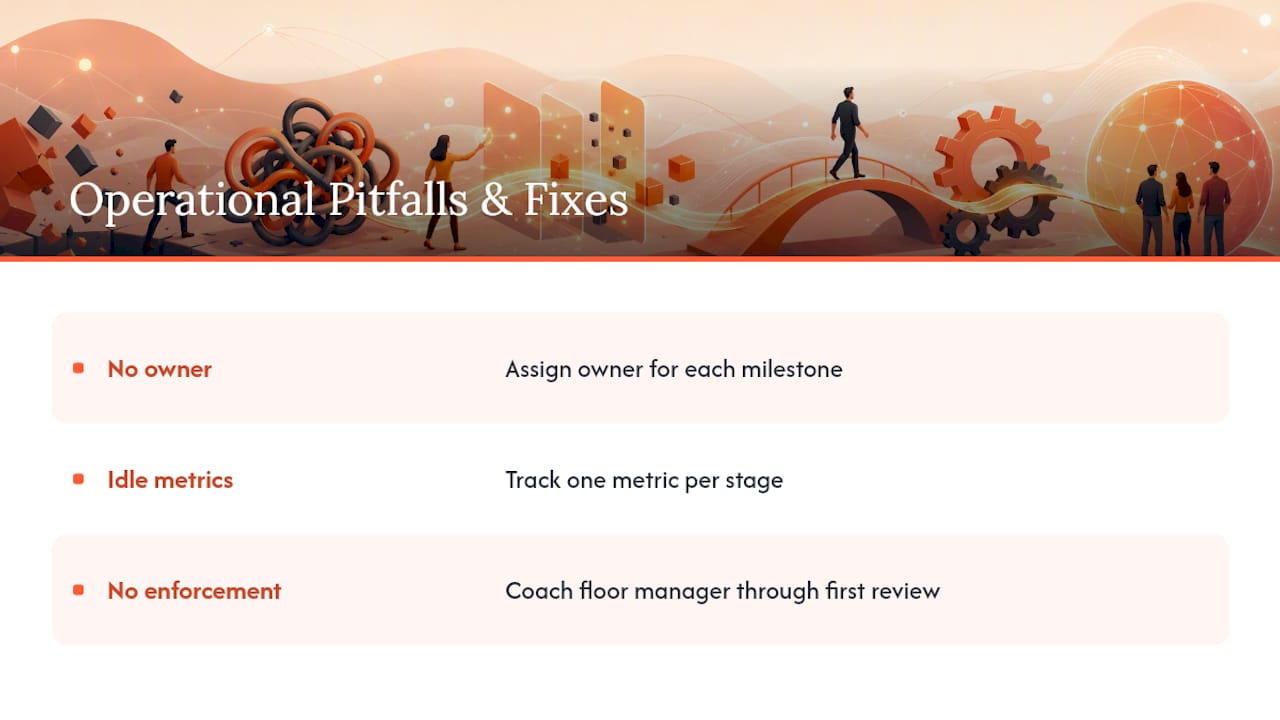
Most playbooks fail for three boring reasons: no named owner per milestone, metrics that get reported but never trigger action, and a playbook nobody actually enforces after the launch meeting. Three rules fix most of it: track one metric per stage, cap kickoff attendees at four, and personally coach the floor manager through the first milestone review before letting the process run unsupervised. An Operations Audit exists precisely to turn a written playbook like this into a governed, 60-day implementation runway instead of a document that quietly stops getting used.
Make the Playbook an Operating Tool, Not a Slide Deck
Treat this as a living SOP with a review cadence, not a launch artifact. Frame the rollout as a 60-day project with named owners and real governance, or it dies in a shared drive by month two.
— David
Turn This Playbook Into a 60-Day Implementation Plan
Writing the playbook is the easy part. Getting a floor manager, a CSM, and a sales handoff team to actually run it the same way every time is where most companies stall. TKD Consulting built the Operations Audit for exactly that gap: a structured diagnostic that maps your current onboarding process, people, and metrics against your stated goals, then hands you a prioritized 60-day action plan instead of a slide deck nobody opens again.
Engage with the consulting service and you get a clear read on where your playbook breaks down (usually ownership, not template quality), scorecards to track the KPIs that matter, and a meeting cadence that keeps the fixes from evaporating once the diagnostic ends. If your playbook exists but nobody follows it, that's a governance problem, and it's the exact one the Operations Audit is built to solve. Reach out to scope a diagnostic and see what a 60-day runway looks like for your onboarding team.
Sources
Grounded in guides from Intercom, OnboardingHub, Zendesk, Scalable Ventures, and Wharton at Work.
- Intercom — Onboarding Guide
- OnboardingHub — Customer Onboarding Process
- Scalable Ventures — The 30-Day Onboarding Playbook
- Zendesk — Customer onboarding guide: templates + best practices