
Most mid-market companies pay typical daily rates in ranges supported by market data for operations or management consulting, with senior specialists commanding notably higher fees. The right way to budget isn't picking a rate off a chart.
TL;DR:
- Generalist operation consultants typically charge moderate daily rates, while specialist and senior roles command significantly higher fees due to expertise scarcity and complexity.
- Day rates include onsite work, preparation, and deliverables, but exclude software licenses, third-party tools, travel, and extended change requests, which should be budgeted separately.
- Building a project budget requires defining scope precisely, estimating days per role, applying respective rates, and adding contingency, travel, and third-party costs upfront.
- Negotiating options like capped time-and-materials, blended team rates, and milestone payments helps manage risk and maintain access to senior expertise.
- Higher rates are justified for high-stakes, complex, and politically sensitive projects, but simpler operational tasks often do not require top-tier talent or premium billing.
Table of Contents
- What Are Typical Consulting Day Rates by Role and Specialization?
- What Do Day Rates Actually Include?
- How Do You Turn a Day Rate Into a Real Project Budget?
- How Do You Evaluate and Negotiate Consulting Proposals?
- When Do Higher Consulting Day Rates Actually Pay Off?
- Get a Predictable Diagnostic With a 60-Day Runway
- Sources
- FAQ
What Are Typical Consulting Day Rates by Role and Specialization?
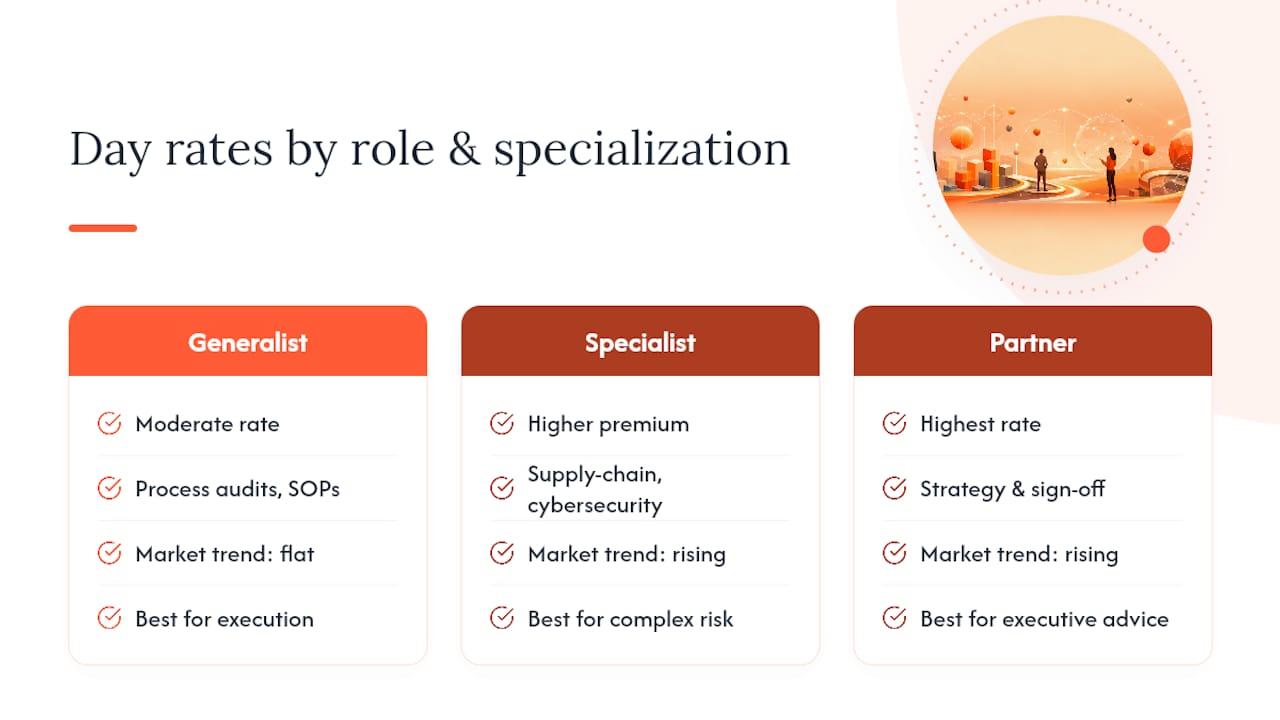
The spread in consulting day rates comes down to two things: how senior the person is and how scarce their expertise are. A generalist operations consultant running process audits or SOP cleanups charges differently than a supply chain specialist untangling a multi-site inventory mess, and both charge differently than the partner who shows up for two days to sign off on strategy.
Generalist operations consultants tend to fall in a moderate daily rate range consistent with typical market benchmarks. They're a strong fit for execution-heavy work: mapping workflows, building accountability cadences, coaching floor managers. You don't need a partner-level thinker to fix a broken shift handoff.
Specialist premiums apply for regulatory or technical complexity such as supply chain design or cybersecurity risk assessments, often commanding substantially higher rates than generalists due to expertise scarcity and risk.
Seniority affects day rates, with analysts charging lower amounts supporting leads, consultants covering diagnostic and implementation work, engagement managers coordinating, principals providing complex decision-making, and partners focusing on strategy and executive advisory, each with increasing pricing tiers consistent with market trends.
Market data confirms this bifurcation is real and widening: generalist rates have stayed relatively flat while specialist and senior rates keep climbing, according to management consultant day rate benchmarks tracked across the U.S. market. One nuance worth knowing before you sign a proposal: a "blended team day rate" (one averaged number covering a mixed team of analysts and a principal) can look cheaper on paper than paying each role separately, but it also hides how much senior time you're actually getting.
What Do Day Rates Actually Include?
A day rate is not just the hours someone spends at your facility. It typically bundles onsite work, pre-engagement prep, and the deliverables tied to that day, whether that's a process map, a scorecard, or a written recommendation.
What it usually excludes matters just as much: software licenses, third-party data or tools, travel and lodging, and extended change requests that fall outside the original scope. Consulting budgets built without accounting for these line items routinely blow past their estimate, which is why Clutch's consulting budget guidance flags team fees, contractor fees, and travel as separate cost drivers you need to ask about upfront.
Pricing models vary by how well-defined your scope is:
- Day rate / time and materials (T&M): best for diagnostic or exploratory work where scope isn't fully known yet.
- Fixed-price: best once scope is locked, giving you cost certainty in exchange for less flexibility.
- Retainer or fractional COO: best for ongoing operational leadership without a full-time executive hire.
- Outcome-based: ties fees to measurable results, but only works when both sides agree on how success gets measured.
Pro Tip: Ask every vendor to unbundle their diagnostic fee from their implementation fee. Consultants who blend the two into one number are usually protecting a premium day rate on the diagnostic by hiding it inside a longer, cheaper-looking implementation phase.
How Do You Turn a Day Rate Into a Real Project Budget?
Budgeting for a consulting engagement is a five-step math problem, not a guess. Start by defining the scope tightly enough that you can estimate a day count. Then assign roles to that day count, apply the appropriate rate per role, add a contingency, and layer in travel or third-party costs separately.
Here's how that plays out across three common engagement types:
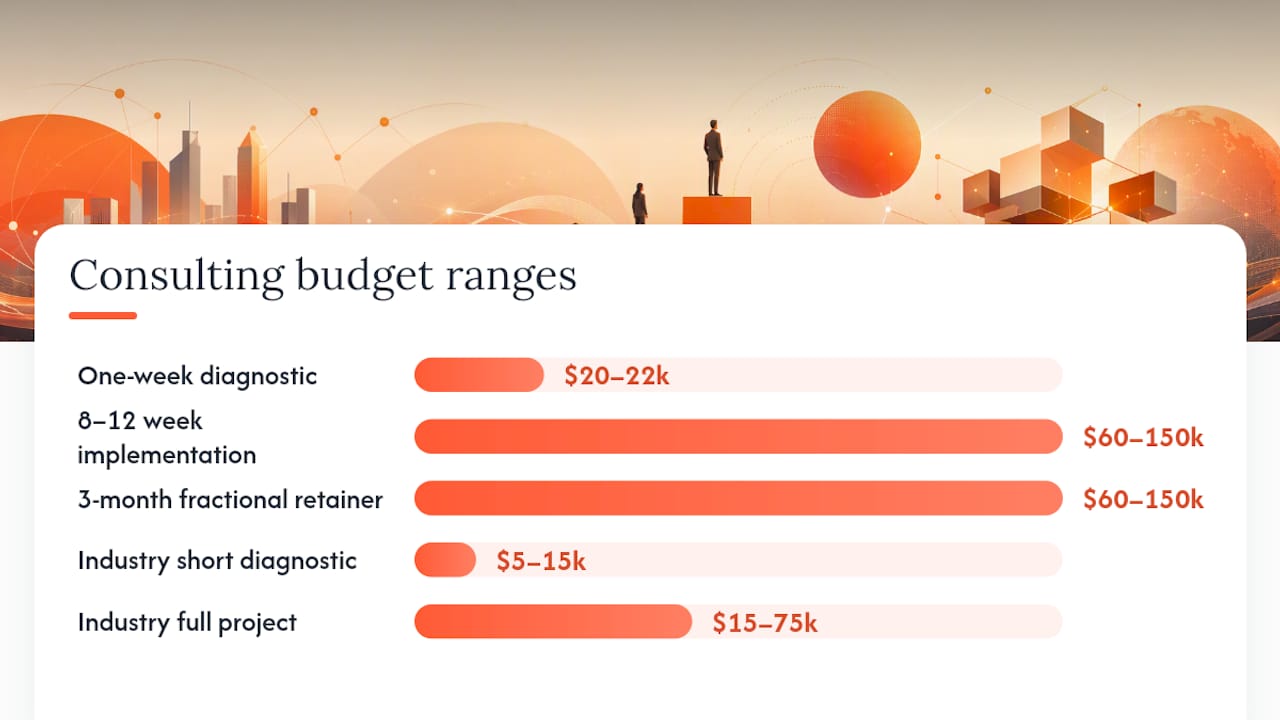
- One-week diagnostic: 5 consultant days at $2,500 plus 1 principal day at $5,000, roughly $17,500 before contingency, landing near $20,000 to $22,000 all in.
- 8 to 12 week implementation: a mixed team running 2 to 3 days per week over 10 weeks can land between $60,000 and $150,000 depending on seniority mix and specialist needs.
- 3-month fractional COO retainer: typically structured as a monthly fee rather than a per-day count, often landing in the same range as the implementation scenario but spread across a longer runway.
These numbers track closely with industry-wide figures: operations consulting engagements for mid-market firms commonly run $5,000 to $15,000 for a short diagnostic and $15,000 to $75,000 for full project-based work.
Governance is what keeps that estimate from drifting. Weekly burn reports, a documented change-order process, and hard scope gates before moving into a new phase all protect the budget. Firms with mature procurement discipline waste meaningfully less on consulting spend than those without it, according to research on management consulting procurement, largely because fluid scope is where consulting budgets quietly balloon.
How Do You Evaluate and Negotiate Consulting Proposals?
Price is the easiest number to compare and the least useful one on its own. A $2,000 day rate from a consultant who sends a junior analyst to do senior-level work costs you more than a $3,500 day rate from someone who shows up themselves.
Before signing, run every proposal through this checklist:
- Who specifically will be onsite, and what's their actual seniority and track record?
- What deliverables come out of each phase, and in what format?
- What are the milestone checkpoints, and what happens if one is missed?
- Can they provide references from a company of comparable size and industry?
- How is escalation handled if the engagement goes sideways?
- How will you jointly measure whether the engagement worked?
Ask vendors directly whether subcontractors will touch your account, what their travel and expense policy looks like, and how invoicing works, monthly, biweekly, or milestone-triggered. Vague answers to any of these are a warning sign.
On negotiation, you have more leverage than most buyers assume. Capped T&M arrangements limit your downside while preserving flexibility. Blended rates across a team can lower your effective cost without sacrificing senior input on the calls that matter. Milestone payments tied to fixed-price gates keep both sides honest about scope. A retained search model comparison offers a useful parallel here: committed engagements with clear terms tend to produce better outcomes than open-ended, pay-as-you-go arrangements.
When Do Higher Consulting Day Rates Actually Pay Off?
Paying a premium day rate makes sense when the decision in front of you is genuinely high-stakes, technically complex, or politically loaded inside your organization. A principal-level operator who has actually run a P&L under pressure will spot the real constraint faster than a generalist working from a framework. That's worth the rate difference.
But not every problem needs that level of seniority. Cleaning up SOP compliance or building a weekly scorecard cadence doesn't require a partner in the room. This is exactly why TKD Consulting structures the Operations Audit as a time-boxed diagnostic with a fixed 60-day implementation runway. It converts a day rate into tracked, measurable change instead of a slide deck nobody opens again. The market is already shifting toward this: coordination-heavy roles are getting squeezed while genuine solution design commands a growing premium, which tells you where your consulting dollars should actually go.
— David
Get a Predictable Diagnostic With a 60-Day Runway
This service is built for owner-operators who want senior operational judgment without the open-ended engagement risk that makes CFOs nervous about consulting budgets. The Operations Audit is offered as a scoped, time-boxed diagnostic, not an hourly meter running in the background.
The engagement provides a known day count upfront, deliverables, and a 60-day action plan with scorecards and coaching frameworks designed to sustain changes after the engagement ends. That predictability is what makes this option easier to defend to your board than a generic time-and-materials proposal with no end date. If you're weighing whether to bring in a fractional COO or a longer engagement instead, the Strategy Execution Gap breakdown explains how that step up can be structured. Start by booking a scoping call to get a fixed quote for an Operations Audit.
Sources
- Consulting pricing guide and budget template — Clutch
- Operations Consultant: What They Do and Cost — ConsultingDemand
FAQ
What is a typical consulting day rate in the US?
Most U.S. operations and management consultants charge daily rates that vary by level, with generalists and consultants at moderate ranges, and principals and partners commanding higher fees depending on specialization.
How do I calculate a consulting project budget from a day rate?
Multiply the estimated number of days by role with each role's day rate, then add a contingency and include travel and third-party costs to finalize the budget.
What's the difference between a day rate and a retainer?
A day rate bills for specific days worked on a defined scope, while a retainer, often used for fractional COO arrangements, charges a fixed monthly fee for ongoing availability and leadership.
How much does an operations audit typically cost?
Short diagnostic engagements for mid-market companies often start around $5,000 to $15,000, though the exact figure depends on scope, team seniority, and travel requirements. TKD Consulting's Operations Audit is structured as a fixed, time-boxed diagnostic so the cost is known before the engagement starts.
Can I negotiate consulting day rates?
Yes. Capped T&M terms, blended team rates, and milestone-based fixed-price gates are all standard negotiation levers that limit your downside while keeping senior expertise on the account.