
Implementation-focused supply chain consulting delivers exactly two things: a scoped operations audit that names the friction actually costing you money, and a prioritized 60-day implementation runway your managers can execute without you in the room. The output isn't a slide deck. It's a diagnostic with named owners, measurable targets, and a first pilot already underway. If that's what you need, the next move is simple: scope a one-week audit or ask for a sample 60-day plan before you commit to anything longer.
TL;DR:
- A targeted one-week operations audit should produce a process map, a friction inventory, and a prioritized impact roadmap with measurable targets and owner names.
- Use swimlane diagrams for mid-market process mapping and validate the process by observing work in action, not just relying on interviews.
- Build a 60-day plan with specific metrics, owners, pilots, impact expectations, and rollback options; avoid vague objectives or wishlists.
- Prioritize verification and ownership from the start, with regular quick stand-ups and scorecards to ensure sustained improvements beyond the pilot phase.
- Seek proof of real experience and sample deliverables from consultants, avoiding vague proposals or lack of measurable targets before engagement.
Table of Contents
- What Does a Supply Chain Consulting Audit Actually Produce?
- What Level Should You Map, and With What Tools?
- How Do You Build a 60-Day Plan That Doesn't Fall Apart by Day 40?
- How Do You Vet a Consultant or Decide to Run This Yourself?
- Where Does the Founder's Operating Background Fit In?
- Which Type of Supply Chain Consulting Fits Your Situation?
- What Goes Wrong in Supply Chain Consulting Engagements?
- What Do Successful Supply Chain Consulting Projects Actually Look Like?
- How Is Digital Transformation Changing Supply Chain Consulting?
- Why the Diagnostic Matters More Than the Technology
- Ready for a Scoped Operations Audit?
- Sources
What Does a Supply Chain Consulting Audit Actually Produce?
A real operations audit runs on a tight clock, not an open-ended engagement that drags for months. The useful version starts with structured interviews across the floor and the office, a physical walk of the process in question, and an inventory of where data actually lives versus where the org chart says it should. A scoped audit can move fast, with a one-week scoping pass producing an impact roadmap before a longer engagement ever gets approved.
The deliverables that matter aren't narrative. They're structural:
- An as-is process map showing how work actually flows, not how the manual describes it
- A friction inventory ranking bottlenecks by cost and frequency, not by who complained loudest
- An impact roadmap that sequences fixes by leverage, starting with the cheapest win that proves the method works
- Named owners for every recommendation, not "the team" or "operations"
- Measurable targets tied to a date, not a vague direction of travel
Skip the targets and you get audit as exercise, not operations: a report that reads well and changes nothing. To scope an audit without disrupting daily work, limit the first pass to one process family, cap interviews at 90 minutes each, and require that the roadmap name a pilot small enough to launch inside two weeks. That constraint is what separates a useful diagnostic from a consulting engagement that produces motion without results.
What Level Should You Map, and With What Tools?
Diagnosis happens at the L3 (process) and L4 (activity) level. Map any deeper than that and you're documenting keystrokes instead of finding friction; map any shallower and you're drawing an org chart, not a process map. Save L5 detail, the click-by-click instruction set, for training material and automation specs once you already know which process is worth that investment.
For notation, swimlane diagrams are the practical starting point for mid-market discovery because they show handoffs between roles, which is where most friction actually lives. BPMN earns its complexity only when you're building toward automation execution. Value stream mapping fits best when the question is speed and waste across an entire order-to-cash or procure-to-pay chain, not a single department's workflow.
Whatever notation you pick, validate the map by watching the work happen, not by trusting what people say in the interview. The stated process and the actual process diverge more often than most leadership teams expect.
On tools, match the choice to how your team already works:
- Miro for live mapping workshops where you need people building the diagram together in real time
- Lucidchart for clean, shareable documentation after the workshop is done
- Visio if your company already runs on Microsoft's stack and IT wants everything in one ecosystem
- Notion when the map needs to live next to the SOPs and get updated as the process changes
Lucidchart and Miro carry a low learning curve for teams that have never formally mapped a process before, which matters more than feature depth in a first engagement.
How Do You Build a 60-Day Plan That Doesn't Fall Apart by Day 40?
The plan fails the moment it becomes a list of good intentions instead of a schedule with teeth. Every action item on a real 60-day runway needs five things attached to it: a named owner, a specific metric, a small pilot group to test on, an expected impact with a number attached, and a rollback plan if the pilot doesn't hold. Cut any of those five and the item is a wish, not a project.
A workable structure looks like this:
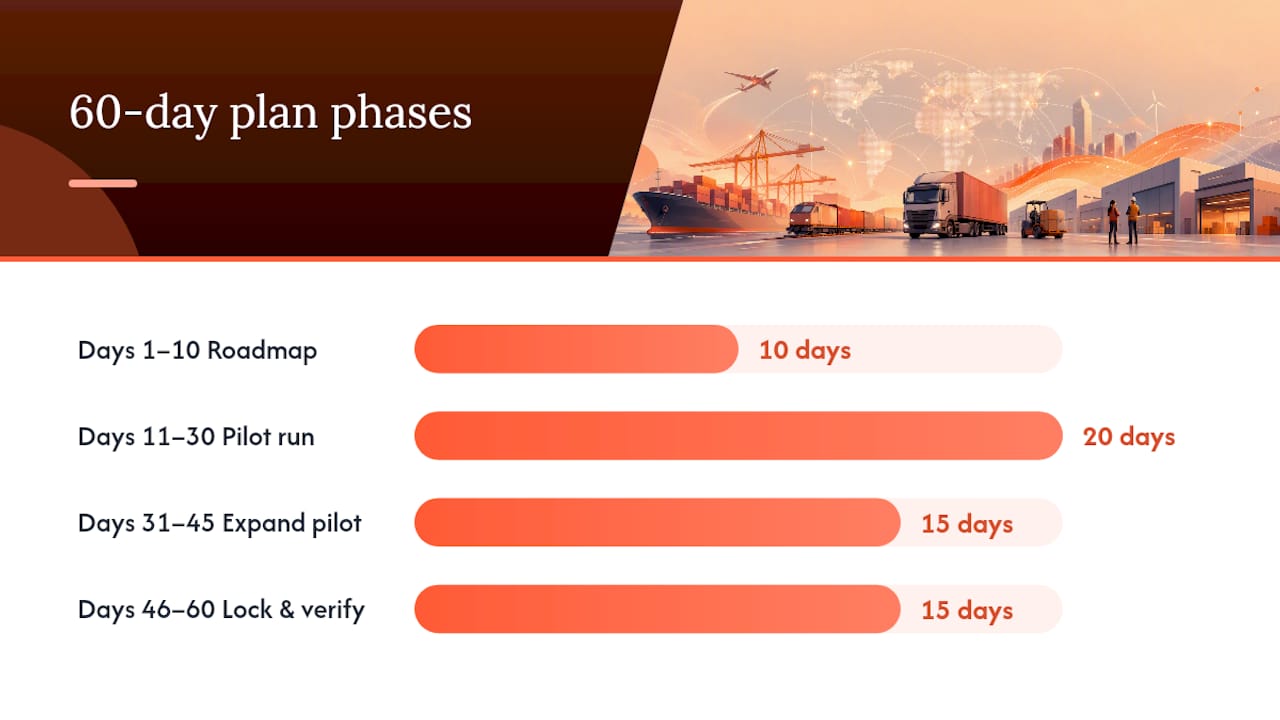
- Days 1 to 10: finalize the audit findings into a ranked roadmap, assign owners, and launch the first pilot on the single highest-leverage fix
- Days 11 to 30: run weekly stand-ups on the pilot, track the target metric against baseline, and adjust scope based on early signal
- Days 31 to 45: expand the pilot to a second team or process if the metric is trending correctly, and start the second-priority fix in parallel
- Days 46 to 60: lock in the wins with manager-facing scorecards, formal training, and a verification checkpoint that confirms the change survived contact with a normal week
Weekly stand-ups should run 15 minutes, cover only the metric and blockers, and escalate anything stalled more than two cycles straight to a named decision-maker. The goal is to keep the gap between a problem starting and someone with authority knowing about it down to hours. Mature mid-market operations hold that gap tight; a multi-day lag is usually the single biggest lever available for improvement.
Pro Tip: Build the scorecard before the pilot launches, not after. A metric you invent retroactively to justify a change already made is not a scorecard. It's a press release.
Embedding the change means putting the new process into a manager-facing document, scheduling a training slot with a date attached, and running a 30-day-later check to confirm the old habit hasn’t quietly crept back in. That last step gets skipped constantly, and it’s the reason so many "successful" pilots evaporate within a quarter.
How Do You Vet a Consultant or Decide to Run This Yourself?
Ask for proof before you ask for a proposal. Anyone claiming implementation experience with $5 to $50 million companies should be able to hand you a sample 60-day plan, not describe one in the abstract, along with named references you can actually call.
Red flags worth walking away from:
- Recommendations delivered as a slide deck with no named owner attached to a single line item
- No measurable target anywhere in the engagement, just directional language like "improve efficiency"
- A refusal to co-deliver, meaning the consultant hands you a plan and leaves the execution entirely to your team
- No willingness to show a real work sample from a comparably sized company
Across a small set of mid-market audits, the repeating patterns were knowledge trapped in spreadsheets, delayed detection of problems that should have surfaced immediately, and constant manual reconstruction of information across disconnected systems. If a prospective consultant can't describe how they'd find those three things in your business specifically, they haven't done this kind of work before.
Before signing anything, request three documents: a sample impact roadmap, a sample scorecard, and a firm timeline for a one-week scoping audit. If they can't produce those on request, they're selling process, not outcomes.
Where Does the Founder's Operating Background Fit In?
TKD Consulting was built around a specific belief: recommendations carry more weight when the person writing them has personally carried a P&L. David Karpatkin holds an MBA in Global Leadership from UT Dallas and spent his career running warehouse operations, home services, solar, and consumer products organizations, along with leading sales teams to quota. That background shapes how the audit gets scoped: less time diagramming for its own sake, more time finding the one fix that changes a number your leadership team already watches.
TKD's diagnostics follow the pattern this article describes closely, because it's the pattern that holds up under pressure. A scoped audit surfaces the friction inventory and impact roadmap. The subsequent 60-day runway incorporates scorecards, regular meetings, and coaching, ensuring changes endure beyond the consultant's departure.
The outcomes worth tracking aren't abstract. They're a shorter problem-to-authority gap, less time spent firefighting the same issue twice a month, and ownership that's actually written down instead of assumed.
Which Type of Supply Chain Consulting Fits Your Situation?
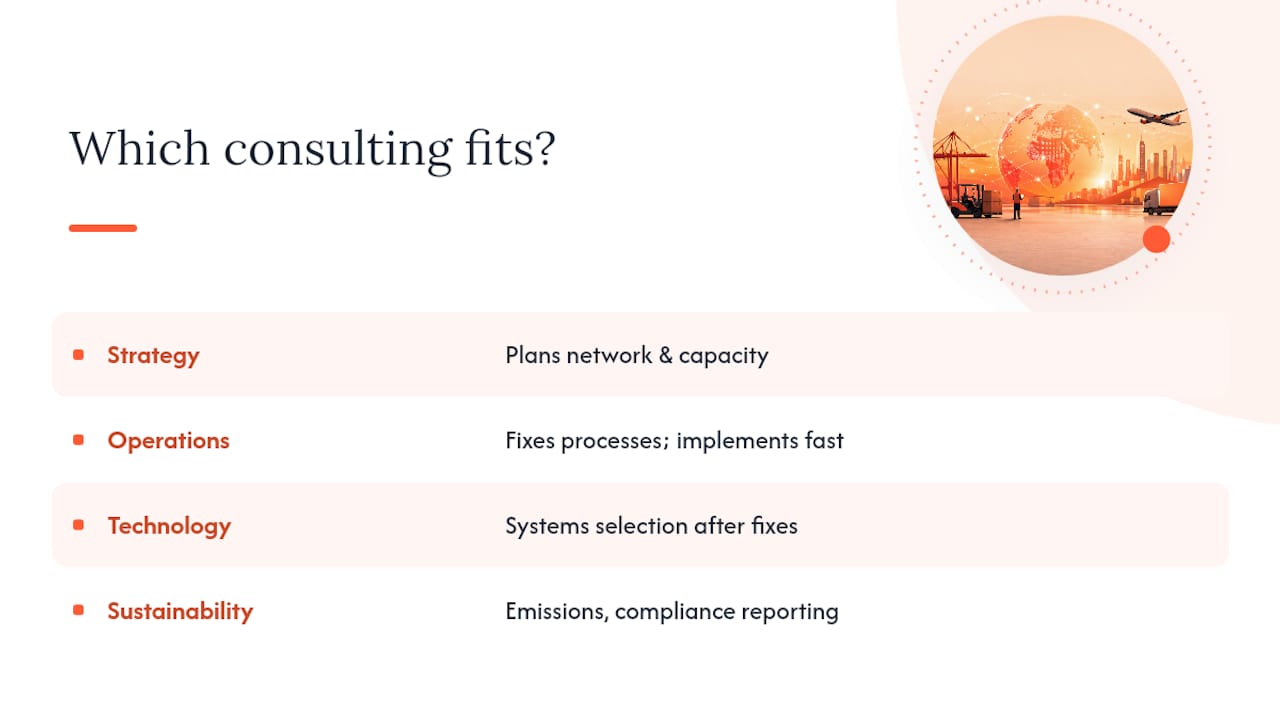
Supply chain consulting isn't one service, and the type you need depends on what's actually broken. Strategy-focused engagements answer questions about network design, sourcing mix, and long-range capacity planning. That's valuable work, but it produces a plan, not a change in Monday morning behavior.
Operations-focused consulting is where implementation lives. It maps current-state process, finds the friction costing you cycle time or margin, and builds the execution plan that turns findings into action inside weeks, not quarters. This is the category most $5 to $50 million companies actually need, because their problem usually isn't a missing strategy. It's a strategy that never made it to the floor.
Technology-focused consulting deals with systems selection, integration, and automation scoping. It matters, but only after the process underneath the technology has been mapped and fixed. Automating a broken process encodes the failure at machine speed instead of eliminating it.
Sustainability-focused consulting addresses emissions tracking, supplier compliance, and environmental reporting requirements, which matters more for companies facing regulatory pressure or large enterprise customers with sustainability mandates than for most owner-operated mid-market firms.
Most companies in the $5 to $50 million range get the most value from operations-focused work, with a technology component that follows once the process itself is sound.
What Goes Wrong in Supply Chain Consulting Engagements?
The single biggest risk isn't a bad recommendation. It's a good recommendation with nowhere to land. Consultants hand off a well-reasoned plan, the engagement ends, and three months later nothing has changed because no one owned the follow-through.
A second common failure is scope creep disguised as thoroughness. An audit that tries to map every process in the business before recommending anything produces analysis paralysis instead of action. The fix is discipline: pick one process family, find the highest-leverage fix, pilot it, and expand only after it proves out.
A third risk is treating the audit as a one-time event instead of the start of an operating rhythm. Process mapping is diagnostic, and the real work starts after the map exists: designing small pilots, measuring outcomes, and iterating on a schedule instead of hoping the change holds on its own.
The mitigation for all three is the same: build named ownership and a verification cadence into the engagement from day one, not as an afterthought once the consultant has left. Ask any prospective partner how they plan to prevent reversion before you ask them what they plan to fix.
What Do Successful Supply Chain Consulting Projects Actually Look Like?
The pattern that shows up across effective mid-market engagements isn't glamorous. It's routing and visibility problems, not headcount shortages, driving most of the friction. A repeated finding across a handful of mid-market audits found that knowledge locked in spreadsheets and delayed detection of revenue-risk signals were the two most common patterns, and the fixes that worked focused on where information lived and how fast it surfaced, not on adding people.
A manufacturer facing recurring quality escapes, for instance, doesn't usually need a new hire in quality control. It typically needs the inspection data currently trapped in a shift supervisor's personal spreadsheet routed into a system the whole team can see in real time. That's a routing fix, and it's cheap relative to the cost of the escapes it prevents.
Process audits paired with real-time operational visibility tools let manufacturers find nonconformances and reduce scrap without the extended disruption a traditional audit implies. The through-line in every effective project is the same: find where the knowledge actually sits, shorten the path between a problem occurring and the right person knowing about it, and measure the result against a number that existed before the project started.
How Is Digital Transformation Changing Supply Chain Consulting?
Digital tools have made the diagnostic phase faster and the evidence harder to argue with. Operational visibility platforms now surface friction in near real time instead of requiring a consultant to reconstruct it from interviews weeks after the fact, which shortens the gap between finding a problem and proving it's worth fixing.
The risk that comes with easier automation access is exactly the one covered earlier: teams reach for a tool before they've mapped and optimized the process it's meant to run. That sequencing error is more expensive now than it used to be, because modern automation platforms make it trivially easy to encode a broken workflow at scale before anyone notices the underlying process was the problem all along.
Inventory and field visibility tools are part of this shift too. Real-time visibility into inventory and field operations gives service and field teams the same advantage manufacturing floors get from operational dashboards: a shorter distance between a stockout or a missed job and someone who can act on it. The technology is genuinely useful. It's just not a substitute for the mapping and diagnosis that has to happen first.
Why the Diagnostic Matters More Than the Technology
Most companies searching for supply chain consulting are actually looking for permission to skip the diagnostic and jump straight to a fix. That instinct is understandable and almost always wrong. The research on mid-market friction points the same direction every time: the expensive problems aren't missing technology or missing headcount. They're knowledge sitting in the wrong place and a gap between when a problem starts and when someone with authority finds out about it.
Conventional consulting advice treats the audit as a formality before the "real" recommendations. That's backwards. The audit is the real work. Everything after it, including the technology choices, the automation, the org changes, is downstream of getting the diagnosis right.
If you take one thing from this, prioritize verification over ambition. A 60-day plan with three modest, verified wins beats a 12-month transformation roadmap that never gets past the first milestone. Start small, measure honestly, and expand only what actually held.
— David
Ready for a Scoped Operations Audit?
TKD Consulting is built for the gap between having a strategy and actually running one: instead of a report that sits in a shared drive, you get a scoped Operations Audit that ends with a 60-day implementation runway your managers can start executing the same week it's delivered.
On day one, expect structured interviews, a process walk, and a straight answer about where your biggest friction actually lives, not a generic checklist. By day 60, you should have a pilot running, a scorecard your team checks weekly, and at least one measurable target moving in the right direction with an owner's name attached to it. If the fix runs deeper than 60 days can cover, the Strategy Execution Gap engagement extends that same hands-on support for as long as embedding the change actually takes. Request a scoped audit or a discovery call, and ask specifically for a sample 60-day plan before you commit to anything longer.
Sources
- Boost efficiency and increase ROI with next-level process automation | Microsoft Power Platform blog
- What Six Operations Audits Reveal About Mid-Market Friction | APFX
- Business Process Mapping: The Proven Guide to Avoid Failure | The SMB Brief
- Why manufacturers should embrace process audits | Thomasnet Insights