
Four method families cover nearly every overhead allocation decision a mid-market controller will face: plant-wide (single-rate), departmental, activity-based costing (ABC), and time-driven ABC (TDABC). The rule of thumb is simple. If overhead is a small share of total cost and products are similar, a plant-wide rate is fine. As overhead climbs and product lines diversify, move to departmental rates, then to ABC or TDABC. Whatever you pick, use a predetermined overhead rate and document your normal capacity assumption for audit purposes.
TL;DR:
- Overhead costs exceeding 15% of total expenses or featuring high product diversity warrant moving from plant-wide rates to departmental, ABC, or TDABC methods.
- Selecting the appropriate overhead allocation method depends on overhead percentage, product mix complexity, and existing data tracking capabilities.
- Building and maintaining an accurate model requires ongoing driver evaluation, documented assumptions, and a structured review process every year or after major operational changes.
- Proper implementation involves a phased approach: diagnosing pools, identifying drivers, piloting new rates, and embedding governance for continuous updates.
- Fixed overapplied or underapplied overhead must be reconciled with documented capacity assumptions, and models need owner accountability to prevent deterioration over time.
Table of Contents
- What Are the Main Overhead Allocation Methods?
- What Is Overhead Allocation and Why Does It Matter?
- How Do You Choose the Right Overhead Allocation Method?
- Which Overhead Allocation Method Fits Your Business?
- How Do You Implement a New Overhead Allocation Model?
- What Accounting Rules Govern Overhead Allocation?
- What Mistakes Undermine Overhead Allocation Accuracy?
- Getting the Model Out of the Spreadsheet and Into the Business
- Get Expert Help Applying These Overhead Allocation Methods
- Sources
- FAQ
What Are the Main Overhead Allocation Methods?
- Plant-wide rate: One rate for the whole facility. Use it when overhead is a small share of total cost and your product mix is narrow.
- Departmental rates: Split overhead by department or cost center. This is the highest-return next step for most manufacturers running mixed labor and automated lines.
- Activity-based costing (ABC): Assign costs to specific activities (setups, inspections, material handling), then allocate based on actual consumption. Reserve this for high-overhead, high-diversity operations.
- Time-driven ABC (TDABC): Uses time equations instead of tracking dozens of drivers. Good fit when product variants multiply faster than your data team can keep up.
Immediate next step: Pull your last twelve months of overhead spend, rank the pools by dollar size, and check whether your current allocation base has any real cause-and-effect link to the top three pools. That fifteen-minute exercise usually tells you which method tier you actually need.
What Is Overhead Allocation and Why Does It Matter?
Overhead allocation is the process of spreading indirect costs, rent, utilities, supervision, depreciation, quality control, across the products or services that actually consume them. It splits into manufacturing overhead (factory costs not directly traceable to a unit) and administrative overhead (costs like accounting or IT that support the whole business). The FEMA guidance on indirect versus direct costs offers a clean baseline for this classification, and it applies just as well inside a private manufacturer as it does in a grant-funded program.
The mechanics run through a predetermined overhead rate: estimated overhead costs divided by an estimated activity base, such as direct labor hours or machine hours. Say a plant budgets $960,000 in annual overhead and expects 24,000 machine hours. The rate is $40 per machine hour. A product requiring three machine hours absorbs $120 in overhead, on top of its direct material and labor cost.
Get this wrong and the damage shows up everywhere at once. Underpriced products lose money on every sale while looking profitable on paper. Inventory valuations skew, which distorts gross margin reporting. And product-mix decisions, what to push, what to drop, get made on bad information.
How Do You Choose the Right Overhead Allocation Method?
Plant-wide or single-rate allocation
The formula is the one above: total overhead divided by one activity base, applied uniformly across every product. It takes an afternoon to build and almost no ongoing maintenance. The catch is accuracy. A single rate assumes every product consumes overhead in the same proportion it consumes the allocation base, and that assumption breaks fast once a facility mixes automated and labor-intensive lines. According to a controller's guide from Wiss, plant-wide rates commonly distort product costs in exactly that scenario, undercosting automation-heavy products and overcosting labor-heavy ones. Use it when overhead is a small slice of total cost and your catalog is narrow. Drop it the moment you add a second production line with a materially different cost structure.
Departmental rates
Instead of one overhead pool, you split costs by department, machining, assembly, finishing, and assign each department its own base. Machining might use machine hours; assembly might use direct labor hours. This is the step most mid-market manufacturers skip past on their way to a complicated ABC project, and that's usually a mistake. The same Wiss analysis notes that departmental splitting often recovers most of the accuracy a company needs for a fraction of the effort a full ABC build requires. If you're deciding between "do nothing" and "build ABC," try departmental rates first.
Activity-based costing (ABC)
ABC follows five steps:
- Identify the activities that actually drive overhead (setups, inspections, purchase orders, material handling).
- Group related costs into activity cost pools.
- Select a driver for each pool that reflects genuine cause and effect (number of setups, number of inspections, number of purchase orders).
- Calculate a rate for each pool: pool cost divided by total driver volume.
- Assign costs to products based on how much of each driver they actually consume.
A practitioner breakdown of overhead allocation methods walks through this process with worked examples, and the accuracy gains are the whole point of the method: products that require frequent small-batch setups finally get charged for the setups they cause, instead of absorbing overhead based on labor hours that have nothing to do with it. ABC tends to improve costing accuracy by a meaningful margin, commonly cited in the 15% to 25% range, but that gain comes with a real cost. You need clean activity data, a willingness to track drivers on an ongoing basis, and staff time to maintain the model. That's precisely why adoption stays limited even though the accuracy case is strong.
Time-driven ABC (TDABC)
TDABC solves ABC's maintenance problem by replacing dozens of activity drivers with time equations, formulas that estimate how many minutes a given transaction type consumes, then multiplies by a cost-per-minute rate for the resource pool. Instead of tracking driver volume for twelve different activities, you update one time equation when a process changes. This approach lowers the ongoing maintenance burden considerably, which makes it the more realistic choice when you have many product variants but limited capacity to capture granular activity data.
Traditional allocation bases
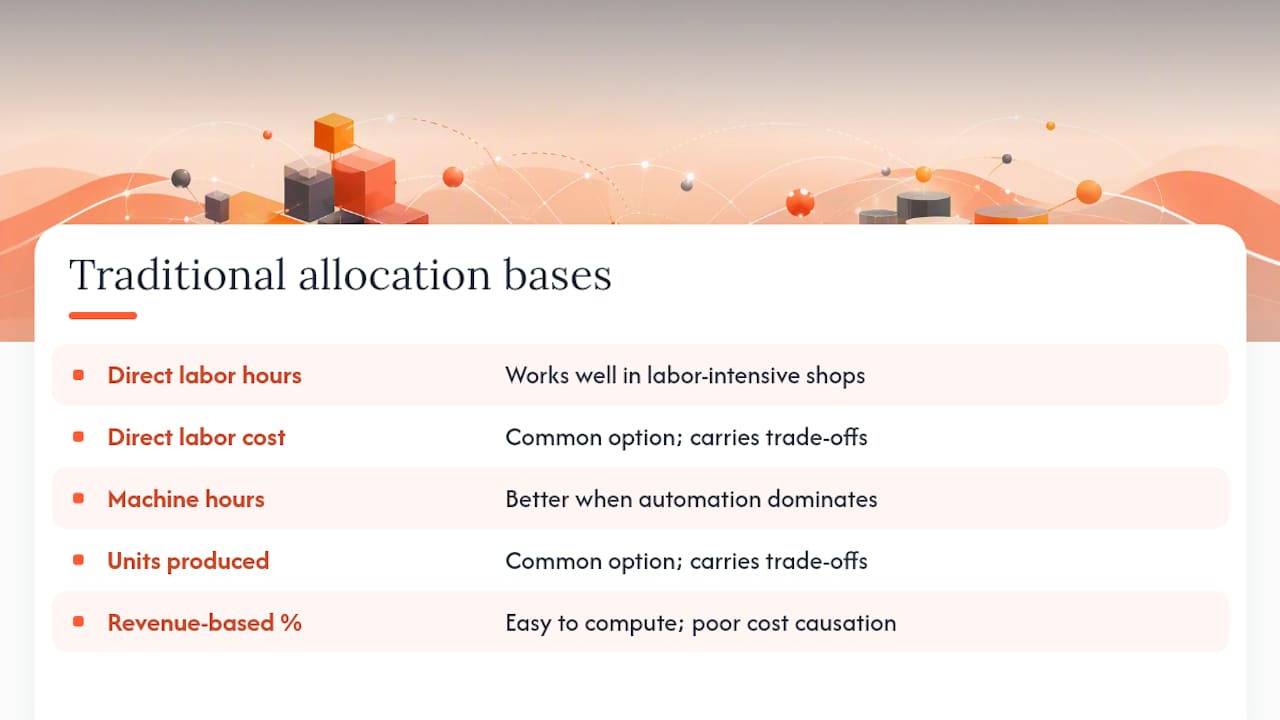
Whichever method you choose, you still need a base. The common options, direct labor hours, direct labor cost, machine hours, units produced, and revenue-based percentages, each carry trade-offs AccountingTools lays out clearly with worked absorption examples. Labor hours work well in labor-intensive shops. Machine hours make more sense once automation dominates. Revenue-based allocation is easy to compute but rarely reflects true cost causation, so treat it as a last resort rather than a default.
Which Overhead Allocation Method Fits Your Business?
Three variables decide this: overhead as a percentage of total cost, product diversity, and how mature your data capture already is.
- Overhead under 15% of total cost, narrow product line: Stick with a plant-wide rate. Building anything more complex won't move your numbers enough to justify the effort.
- Overhead between 15% and 30%, or you run more than one distinct production process: Move to departmental rates. This is the single highest-ROI step change available to most mid-market operations, better accuracy per hour of implementation effort than any other move on this list.
- Overhead above 30%, high product diversity, and setup or batch costs vary widely by SKU: Build ABC around your three to five largest pools. Don't try to model every activity on day one.
- All of the above, plus dozens of product variants and limited staff to maintain driver tracking: TDABC. The time-equation structure keeps the model current without a full-time analyst babysitting it.
The trade-off across all four tiers is consistent: more accuracy costs more maintenance and demands more defensible documentation for auditors. A cost-and-profitability framework built by practitioners makes a point worth repeating here: pick drivers because they reflect real cause and effect, not because the data happens to already sit in your ERP. Four or five well-chosen pools, each tied to a driver you can actually measure and defend, remove most of the distortion a company will ever face. Chasing a fiftieth activity pool for marginal precision rarely earns its keep.
How Do You Implement a New Overhead Allocation Model?
Treat this as a phased project with a defined end date, not an open-ended accounting initiative.
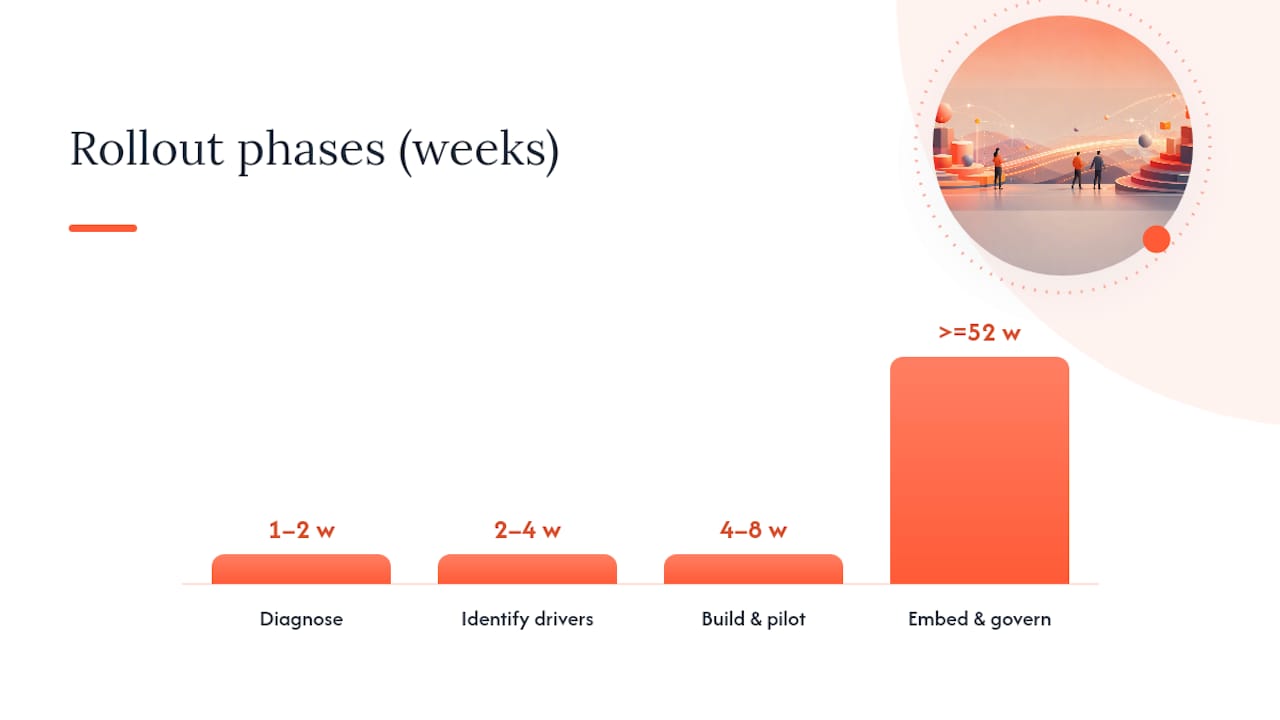
- Diagnose (1 to 2 weeks). Pull the last twelve months of overhead spend by account, rank pools by dollar size, and check current allocation bases against actual cost drivers. Flag the top three pools where the mismatch looks worst.
- Identify drivers (2 to 4 weeks). For each flagged pool, interview the operators or supervisors closest to the process and settle on a driver you can measure consistently, setups, inspection counts, machine hours, order lines.
- Build and pilot (4 to 8 weeks). Construct the new rates, run them in parallel against your current model on last quarter's actuals, and compare product or customer margins under both. Target the SKUs or customers where the shift is largest; that's where the new model actually changes a pricing or mix decision.
- Embed and govern. Lock the new rates into your costing system, assign an owner, and set a recurring review. A common practitioner standard is reviewing allocation bases at least annually, or immediately after a major shift in production volume, product mix, or cost structure.
Expand the model further only when a pilot shows the current tier is still producing distorted margins on a meaningful share of revenue. If departmental rates already resolve most of the distortion, resist the pull toward full ABC just because it sounds more rigorous. Consultants often use Every Client Deck, Perfectly Branded tools to standardize deliverables, which can support clear implementation and governance of such costing models.
If the new allocation doesn't change the margin picture on your biggest accounts, it probably won't be worth the maintenance cost on your smallest ones either.*
What Accounting Rules Govern Overhead Allocation?
Predetermined overhead rates exist because actual overhead costs arrive too late to price a job or value inventory in real time. You estimate overhead and an activity base at the start of the period, apply the rate as production happens, then reconcile against actual costs at period end. The OpenStax managerial accounting text walks through this calculation and the resulting adjustment in detail.
That reconciliation produces either underapplied overhead (you applied less than actual) or overapplied overhead (you applied more than actual). Both need a documented variance analysis and a period-end adjustment, typically to cost of goods sold or allocated across inventory and COGS depending on materiality.
ASC 330 adds a specific constraint here: fixed production overhead must be allocated to inventory based on normal capacity, the production level a facility expects to achieve under normal operating conditions over a representative span of time. Per FASB's ASU 2015-11, when actual production falls below normal capacity, you cannot simply spread the full fixed overhead across the smaller output. The unallocated portion gets expensed in the period instead of sitting on the balance sheet as inventory.
Auditors will look for:
- A documented normal capacity calculation with the methodology behind it.
- Evidence that driver selection reflects genuine cost causation, not convenience.
- A record of the annual (or trigger-based) review of allocation bases.
- Clear treatment of underapplied or overapplied overhead each period.
One nuance worth flagging separately: GAAP compliance and managerial usefulness are not the same test. A controller's guide from Wiss makes the point that a method can satisfy ASC 330 and still give you weak signals for pricing or product-mix decisions. Audit defensibility is the floor, not the ceiling.
What Mistakes Undermine Overhead Allocation Accuracy?
The most common failure is choosing a driver because the data already exists, not because it reflects cause and effect. Direct labor hours are easy to pull from payroll, but if your overhead is mostly machine depreciation and setups, labor hours will misallocate costs no matter how clean the data looks.
- Don't build ABC around forty activities when five cost pools would remove 90% of the distortion.
- Reconcile allocation bases against actual production data at least quarterly, not just at year end.
- Use short-term manual workarounds (a spreadsheet overlay) when ERP data gaps would otherwise delay a needed correction.
- Set a trigger for model review: a new product line, an overhead swing greater than 15%, or a shift in automation level should all force a reassessment, not wait for the next scheduled annual review.
Pro Tip: If nobody on your team can explain, in one sentence, why a given driver was chosen for a given cost pool, that's a sign the model was built for convenience rather than accuracy.
Getting the Model Out of the Spreadsheet and Into the Business
Most companies that struggle with overhead allocation aren't struggling with the math. The formulas are decades old and well documented. What breaks down is everything downstream: nobody owns the model, the driver data lives in three different systems, and the "annual review" that everyone agreed to never actually happens because no one put it on a calendar.
I've watched plenty of well-built ABC models get shelved within a year, not because the accuracy case was wrong, but because nobody built the governance muscle around it. A model is only as good as the meeting cadence that keeps it current. If your controller builds a beautiful departmental rate structure and then leaves the company, does anyone else know how to update the machine-hour estimates next year? If the answer is no, you don't have a costing method, you have a temporary improvement with an expiration date.
This is where a structured, time-boxed diagnostic earns its cost. Running a rapid audit of your largest overhead pools, comparing current allocation against actual cost drivers, and producing a 60-day action plan gets you further in six weeks than most internal ABC projects get in six months, mostly because outside eyes aren't invested in defending the existing model. TKD Consulting's Operations Audit is built around exactly that kind of diagnostic: find the highest-impact pools first, build the plan a floor manager can actually execute on Monday, and leave behind the scorecards and review cadence that keep the new model from quietly reverting to the old one.
— David
Get Expert Help Applying These Overhead Allocation Methods
Reading through the method options is one thing. Building a model your team will actually maintain past the first quarter is another.
TKD Consulting's 90-Day Operations Audit is priced at $3,500 and structured specifically to surface the highest-impact cost pools in your operation, then hand your team a 60-day plan they can execute without waiting on a follow-up engagement. For companies that need ongoing support turning a new allocation model into standard practice, the Operations Consulting service provides embedded execution help once the diagnostic phase is done. If you're not sure which entry point fits, a Paid Discovery Call for $500 is the lowest-risk way to find out.
Sources
For deeper procedural detail, consult FASB's ASU 2015-11 on inventory costing, the OpenStax managerial accounting chapter on predetermined rates, and AccountingTools for worked absorption examples.
- Compute a predetermined overhead rate and apply overhead to production — OpenStax
- Overhead Allocation Methods — From Revenue-Based Defaults to Driver-Based Accuracy
- Manufacturing Overhead Allocation Methods: A Controller's Guide — Wiss
FAQ
What Are the Three Types of Cost Allocation?
Cost allocation methods generally fall into direct allocation, step-down allocation, and reciprocal allocation, each differing in how they handle costs shared between departments. In overhead allocation specifically, the practical equivalents are plant-wide, departmental, and activity-based methods, which is the framing most controllers use day to day.
How Should Overhead Be Allocated?
Overhead should be allocated using a predetermined overhead rate, calculated as estimated overhead divided by an estimated activity base like machine hours or labor hours. The right method, plant-wide, departmental, or ABC, depends on how large overhead is relative to total cost and how diverse your products are.
What Are the Four Types of Overhead?
Overhead is commonly grouped into fixed, variable, semi-variable, and administrative overhead. Fixed overhead (rent, depreciation) stays constant regardless of output, variable overhead (utilities tied to machine use) scales with production, and administrative overhead covers support functions outside the factory floor.
What Is the Difference Between ABC and Traditional Overhead Allocation?
Traditional allocation spreads overhead using a single volume-based measure like labor hours or machine hours across all products. Activity-based costing instead traces overhead to specific activities, such as setups or inspections, and assigns costs based on how much of each activity a product actually consumes, which typically improves accuracy for diverse product lines.
How Often Should a Company Review Its Overhead Allocation Method?
Most practitioners recommend reviewing allocation bases at least once a year, or sooner if production volume, product mix, or cost structure changes materially.