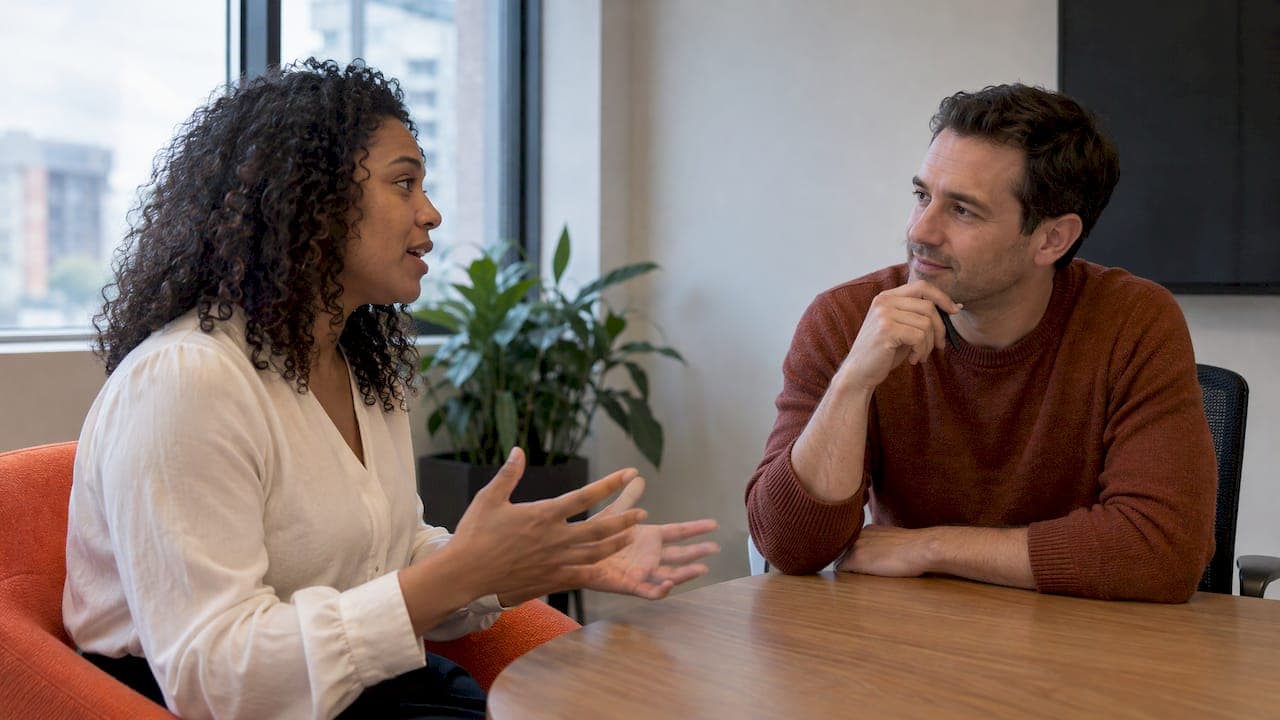
A good manager one-on-one agenda is short, shared and driven by the employee. Open with a personal check-in, review last time's action items, cover priorities and blockers, give feedback both ways, spend a few minutes on growth, and close with written next steps. Hold it weekly or biweekly for 30 to 60 minutes, and keep status updates out of the room. The full template, the questions and the follow-up routine are below.
TL;DR
- Use a six-part agenda: check-in, last actions, priorities and blockers, feedback, development, next steps.
- Let the employee build the agenda first and leave room for your topics. Baylor University HR describes the meeting as employee-driven, with the manager asking and listening.
- Meet weekly or biweekly for 30 to 60 minutes, and adjust by experience level and autonomy.
- Take notes, write down who owns what by when, and check progress before the next meeting.
- Rotate focus areas so the meeting never becomes a status report.
Table of Contents
- What a one-on-one is for
- The one-on-one agenda template
- How to prepare in ten minutes
- Questions to ask in a one-on-one meeting
- How often, and for how long
- Adapt the template to the person
- Lead the conversation, then close the loop
- Common mistakes
- Our perspective
- When one-on-ones are not enough
- FAQ
- Sources
What a one-on-one is for
A one-on-one is a recurring private conversation between a manager and one direct report. It is not a project update. Baylor University HR defines it as a regular meeting for challenges, solutions, goals, professional development, feedback, trust, engagement and follow-up.
The trust part matters most. Harvard Business School's Working Knowledge describes the one-on-one as a private forum for honest professional and personal conversation, goal clarification and expectation setting. The same piece argues that regular private conversations reduce ambiguity and mistrust and make performance reviews more forward-looking.
One trap to avoid is mismatched expectations. MIT Sloan Management Review reports that when manager and employee disagree on what the meeting is for, it can create anxiety and awkwardness. So the first agenda item, the very first time, is agreeing on purpose. Say it plainly: this is your time, we use it for what helps you do your best work, and status tracking lives somewhere else.

The one-on-one agenda template
Here is a 45-minute version. Scale the times up or down for a 30-minute or 60-minute slot.
| Segment | Time | What happens |
|---|---|---|
| 1. Check-in | 5 min | Personal, low-pressure opener. How are you really doing? |
| 2. Last actions | 5 min | Review open items from the previous meeting. Done, stuck or dropped? |
| 3. Priorities and blockers | 10 min | The employee's top priorities, what is in the way, what decisions or support they need. |
| 4. Feedback, both ways | 10 min | Recognition, one specific piece of feedback from you, and what you can do better. |
| 5. Development | 10 min | Skills, goals, responsibilities the employee wants. Rotate depth by week. |
| 6. Next steps | 5 min | Confirm actions, owners and dates. Note the topics to carry over. |
This tracks the structure most university HR guides converge on. The UC Irvine guide says agendas should balance topics important to the employee with topics important to the manager, put urgent or time-sensitive items first, and stay flexible when time runs out.
Keep it shared
Use one shared document, with a running list the employee fills in during the week. You add your items below theirs. Their topics get discussed first. If you only get through four of the six segments, that is fine, as long as the unfinished ones appear at the top of the next agenda.

Keep status out
If the meeting turns into a walk through a project tracker, you are using a scarce, private hour for something a dashboard can do. Handle routine status in your team's tracking system or a written update, and use the meeting for obstacles, judgment calls, feedback and growth.
How to prepare in ten minutes
Preparation separates a useful meeting from a pleasant chat. The steps are short:
- Ask for the agenda in advance. Baylor's manager guidance recommends having the employee prepare and send it, with time left for manager topics.
- Review the last notes and open actions. UC Irvine's guide suggests leaders look at prior conversations, open actions, recent observations and feedback they owe.
- Pick one or two of your own topics. More than that and the meeting becomes yours. Write down the specific example behind any feedback you plan to give.
- Protect the slot. Choose a private setting and avoid rescheduling. Moving a one-on-one tells the employee where they rank.
The same UC Irvine guide advises direct reports to review upcoming deliverables and recent accomplishments, so send them that nudge with the agenda link.
Questions to ask in a one-on-one meeting
You do not need all of these. Pick two or three per segment and rotate. Many of them come up across university HR and handbook guidance, so they are well tested.
Check-in
- How are you doing, outside of the work list?
- What is going on in your world this week?
- How is your workload and work-life balance feeling?
The first two are close to openers ADP's supervisor guide recommends before moving to tasks. Wellbeing and work-life balance questions appear in the UC Irvine guide.
Priorities and blockers
- What are your top two priorities until we meet again?
- What is getting in the way?
- Is there a decision you need from me, or anyone, to move forward?
- Do you want more or less direction from me on this?
The last one comes from the University of Toledo manager guide, which also suggests asking about progress on prior action items and whether agreed deadlines are realistic.
Feedback and recognition
- What went well since we last met? What did not?
- What are you most proud of?
- What is one thing I could do differently to help you?
GitLab's handbook says the direct report should set the agenda and offers these as fallback prompts when the conversation runs thin, along with asking what potential troubles the employee sees for the team or company. MIT Human Resources frames effective coaching as frequent and two-way, specific about observable behavior and its impact, and focused on things the person can change.
Development and goals
- What skills do you want to build this quarter?
- What responsibilities or projects would you like more of?
- Where do you want to be in 6 to 12 months, and what would help you get there?
Northwestern's check-in resource offers prompts along these lines, including goals for the next quarter and the next 6 to 12 months, what motivates the employee, and whether they feel supported. The University of Virginia's guide adds questions about what they like about their role and how key working relationships are going.
Closing
- What are we each taking away from this?
- What should go on the top of next time's agenda?
How often, and for how long
Weekly or biweekly, 30 to 60 minutes, is the working range. Baylor HR recommends weekly 30-to-60-minute meetings with each direct report.
Cadence should not be identical for everyone. Consider these factors:
- New hires and people in a role change: weekly, and lean toward 45 to 60 minutes.
- Remote or hybrid employees: weekly, because you lose the hallway signals that tell you something is off.
- Experienced, autonomous people: biweekly can work, as long as they know they can ask for an extra slot.
- Periods of heavy change: a reorganization, a new system or a missed quarter all justify going weekly for a while.
If you manage many people, a lightweight tracking tool for follow-ups helps a lot. A CRM and accountability setup can hold action items, owners and due dates so that nothing agreed in a one-on-one depends on memory.
For a manager with eight reports, weekly 45-minute meetings add up to six hours of calendar time. That is a real cost, and it is why the structure matters. Tight agendas let you hold the cadence without the meetings expanding.
Adapt the template to the person
A template is a starting structure, not a script. Treat it as a toolkit and do not cover every section every time. Pick the segments that matter this week, and rotate the deeper ones.
A simple rotation for a four-week cycle:
- Week 1: workload, priorities and blockers get most of the time.
- Week 2: feedback, in both directions.
- Week 3: career growth and skills.
- Week 4: team dynamics, process ideas and how the meetings themselves are going.
On that last point, every few weeks ask directly whether the meeting is useful and what to change. Adjust the timing, the questions or the format based on the answer. GitLab's handbook also stresses adapting to the individual's maturity, preferences and aspirations rather than applying one management style to everyone.
Three common adjustments:
- A quiet employee: send questions in advance and ask for written agenda items. Walking meetings can lower the pressure.
- A high performer who says everything is fine: move toward stretch assignments and development. Ask what they would change if they ran the team.
- Someone with a performance gap: keep the regular one-on-one for support and coaching, and handle the gap directly. Name the observed gap, explain its impact, confirm the role expectation, then ask for their context before agreeing on a plan.
Lead the conversation, then close the loop
The manager's job in the room is to create space. Stanford's Cardinal at Work guidance says to lead with empathy, listen actively, ask clarifying questions and give specific feedback. Aim to talk for a third of the time or less.
Some habits that help:
- Ask open questions and wait through the silence.
- Paraphrase before you respond: "What I'm hearing is..."
- Make feedback specific: the behavior, the impact, and what to do next time.
- Take handwritten or typed notes, and say you are doing it.
Then close the loop. Stanford's guidance says to document takeaways, agree on clear next steps and the manager's support, and check progress before the next formal check-in. UC Irvine adds that the meeting should end with action items due before the next conversation, and confirmation that you are aligned.
A follow-up routine that takes five minutes:
- Within an hour, send a short note: decisions made, actions with owner and date, and topics deferred.
- Do your own actions first. Nothing damages trust faster than a manager who forgets a promise.
- Midweek, send a quick check on anything with a hard deadline.
- At the next meeting, start the agenda with those items.
This is the part many teams skip, and it is where the value is. A conversation with no recorded actions is easy to enjoy and easy to forget.
Common mistakes
- Canceling when things get busy. Busy weeks are when employees most need a clear priority call.
- Using it as a status meeting. If your first question is always "where are we on X," move that to a written update.
- Doing all the talking. If you set the whole agenda, you will only hear what you already know.
- Saving feedback for the review. Small, specific, timely feedback beats an annual surprise.
- Never connecting meetings to goals. At least monthly, tie the conversation back to the team's targets and what the employee's work contributes.
If your team has the opposite problem, where people avoid raising problems upward, our guide to a skip-level meeting agenda shows how to turn that feedback into action over the next 60 days.
Our perspective
We see one-on-ones fail the same way across the operations teams we work with: the meetings happen, but nothing changes on the floor afterward.
A one-on-one is the smallest unit of execution in a company. When a leader sets a priority in the boardroom, it either reaches the front line through hundreds of these conversations or it evaporates. That is why we treat the agenda as an operating system rather than a courtesy: a consistent structure, a written record, owners and dates, and a review at the start of the next meeting.
Our approach to operations work is to make every recommendation something a floor manager can use on Monday morning. For one-on-ones that means a short agenda, a handful of questions, and a follow-up routine that survives a hectic week. If the meeting cadence is weak, our diagnostic work usually finds the same pattern in scorecards, handoffs and accountability, and we build the cadence and coaching frameworks to fix it, so the team can keep running them after we leave.
David
When one-on-ones are not enough
Sometimes the agenda is fine and the problem sits upstream: goals that never reach the team, SOPs nobody follows, managers who spend their days firefighting. Better one-on-ones will help, but they cannot fix a missing system.
That is what our 90-Day Operations Audit is for. It is a fixed-price diagnostic at $3,500 that maps your people, processes and performance systems against your goals, then delivers a prioritized action plan your managers can execute, including the scorecards, meeting cadences and coaching frameworks that keep changes in place.
If you want to see how that works before committing, our write-up on turning consulting into a 60-day action plan walks through the approach.
FAQ
How long should a manager one-on-one be?
Thirty to sixty minutes is the standard range, according to Baylor HR. Use 30 minutes for experienced, self-directed people and 45 to 60 for new hires or during periods of change. If you regularly run out of time, shorten the status portion rather than lengthening the meeting.
What should we talk about if the employee has nothing on the agenda?
Fall back on a few open questions: what went well, what did not, what they are proud of, and what you could do better. Those four open most conversations. You can also use the development segment to ask about skills and goals, which employees rarely raise unprompted.
Should the manager or the employee own the agenda?
The employee should drive it, with room left for your topics. Baylor's guidance describes the meeting as employee-driven, and UC Irvine recommends balancing both sides' topics. In practice, a shared document that both of you edit during the week works best.
Do I need a one-on-one with every direct report at the same frequency?
No. Set cadence by experience, autonomy, work arrangement and what is changing in the business. A new remote hire may need a weekly meeting, while a veteran running a stable process may be fine biweekly. Revisit the decision every few weeks.
How do I make sure action items get done?
Write each one down with an owner and a date, send it as a short note after the meeting, and open the next meeting by reviewing it. Do your own items first so the habit is visible.
Sources
- One on One Resources, Baylor University Human Resources
- Manager Best Practices: One-on-One Meetings, Baylor University
- Master the One-on-One Meeting, Harvard Business School Working Knowledge
- Five Ways to Make Your One-on-One Meetings More Effective, MIT Sloan Management Review
- One-on-One Guide, UC Irvine
- Ongoing Coaching and Feedback, MIT Human Resources
- 1-1, The GitLab Handbook
- Check-Ins, Cardinal at Work, Stanford
- Check-in questions for staff and managers, Northwestern University
- Guide to Regular Performance Conversations, University of Virginia
- Manager One-on-One Guide, University of Toledo
- Employee One-on-One Meetings, Guide for Supervisors, ADP