
Advisory services are ongoing, senior-level strategic guidance paired with hands-on execution support that help business owners turn a stated strategy into measurable results. Instead of a one-time report, you get a working relationship: a diagnostic, a prioritized plan, and someone checking whether the plan actually happened. According to Nerac's advisory services overview, the model spans finance, operations, strategy, and technology, wherever an organization needs outside judgment to solve a complex problem.
The outcomes worth expecting:
- Clearer priorities, because someone outside the business ranks what matters instead of everything feeling urgent
- Faster decisions, since you're not waiting on internal debate to resolve
- An implementation runway, not just a slide deck. An operations audit that produces a short-term action plan is a common example
Roughly three engagement shapes cover most of the market: a short paid diagnostic, a time-boxed project, or a monthly retainer. Which one fits depends on whether you need a one-time gut check or ongoing accountability.
Key Takeaways
Advisory services work when a diagnostic converts into a time-boxed plan backed by an implementation runway that survives after the advisor leaves.
| Point | Details |
|---|---|
| Advisory means ongoing support | It pairs senior-level guidance with execution help, unlike project-based consulting. |
| Match the type to the problem | Operations, finance, strategy, tech, HR, and compliance each need different deliverables. |
| The runway matters more than the diagnosis | Scorecards, meeting cadence, and coaching determine whether changes stick. |
| Vet for execution, not credentials | Ask for a past 60-day plan example and what happened after it. |
| TKD Consulting's model | The Operations Audit delivers a diagnostic plus a 60-day plan and implementation support for owner-operated and mid-market companies. |
Table of Contents
- What Advisory Services Cover: Common Types and Real Examples
- Advisory vs. Consulting vs. Compliance: What's the Real Difference?
- What Results Should You Expect From Advisory Services?
- How Do Advisory Engagements Typically Work?
- How Do You Choose the Right Advisor for Your Business?
- What Does an Advisory Engagement Look Like in Practice?
- Why Most Advisory Engagements Fail Before They Start
- Ready to Turn Strategy Into Execution?
- Sources
What Advisory Services Cover: Common Types and Real Examples
Advisory work usually clusters around six functional areas: operations, finance, strategy, technology, HR and people, and risk or compliance. Each area produces different deliverables, and the differences matter when you're deciding what to hire for.
- Operations: process maps, capacity models, and a recurring scorecard that tracks throughput or on-time delivery
- Finance: cash-flow forecasting models, margin analysis by product line, and board-ready reporting cadences
- Strategy: a prioritized roadmap that ties quarterly goals to specific owners and deadlines
- Technology: a digital transformation roadmap sequencing which systems to fix first
- HR and people: leadership development plans and accountability frameworks tied to performance reviews
- Risk and compliance: gap assessments against regulatory or industry standards
A mid-market distributor that brings in operations advisory to fix late shipments typically wants a scorecard tracking dock-to-stock time within 30 days, not a strategy memo. A SaaS company chasing margin wants a cash-forecasting model accurate enough to catch a burn problem two months out, not six. The deliverable should match the pain, and if it doesn't, that's usually a sign the wrong type of help got hired.
Advisory vs. Consulting vs. Compliance: What's the Real Difference?
The three get lumped together constantly, and the confusion costs owners money. Here's the practical breakdown:
- Consulting is typically project-based and scoped around a single deliverable. Management consulting often relies on proprietary frameworks to solve a defined problem, like a market entry analysis or a pricing study, and the engagement ends when the deliverable ships.
- Advisory is ongoing and relational. Client advisory services are built around a recurring cadence: reviewing performance, adjusting priorities, and staying accountable to the plan over months, not weeks.
- Compliance work is narrow and rules-based, aimed at meeting a specific regulatory or audit standard, with success defined by whether you passed, not whether the business improved.
If you need a single expert opinion on one decision, hire a consultant. If you need someone accountable for execution over time, hire an advisor. If you need to satisfy a regulator, that's compliance, and mixing it up with strategic advisory wastes budget on the wrong scope.
What Results Should You Expect From Advisory Services?
The benefits advisory work targets are specific enough to measure, which is what separates a good engagement from an expensive conversation. Owners typically see gains in four areas:
- Decision velocity: fewer stalled decisions waiting on data that didn't exist before
- Margin improvement: pricing and cost discipline that shows up in gross margin within a quarter or two
- Alignment: leadership and floor teams working from the same priorities instead of competing ones
- Repeatable processes: SOPs that survive turnover instead of living in one person's head
KPIs that typically move include margin percentage, throughput, forecast accuracy, and employee retention. Timelines matter here: a diagnostic surfaces the problem in weeks, but sustained improvement usually takes two to three quarters, because the hard part isn't identifying the fix. It's making it stick after the advisor stops showing up every week.
How Do Advisory Engagements Typically Work?
Most well-run advisory relationships move through three phases, and knowing them in advance helps you evaluate a proposal before you sign it.
- Discovery and diagnostic. This is where an advisor maps your people, processes, and performance systems against your stated goals. An operations-audit-style diagnostic typically produces a written assessment of where execution is breaking down, not just where strategy is unclear.
- Prioritized action plan. The diagnostic should convert into a time-boxed plan, often 60 days, with specific actions assigned to specific owners. If the plan doesn't name who does what by when, it's not a plan yet.
- Implementation runway and sustainment. This is the phase most advisory engagements skip, and it's the one that determines whether anything changes. It includes scorecards to track progress, a recurring meeting cadence to review them, and coaching to help managers actually run the new process. Some clients extend this into a monthly retainer; others handle sustainment internally once the framework is in place.
Pro Tip: Ask any advisor upfront how phase three gets handed off. If the answer is "we'll figure that out later," you're buying a diagnosis, not a cure.
How Do You Choose the Right Advisor for Your Business?
Vetting an advisor is less about credentials on a slide and more about whether they can show you their work. Run through this checklist before signing anything:
- Industry fit: have they worked with businesses your size, in your sector, facing your kind of problem?
- Execution track record: can they show a plan they wrote that got implemented, not just written?
- Measurable outcomes: do they talk in specific metrics (margin, cycle time, retention) or vague language like "improved performance"?
- Transparency on team and fees: do you know exactly who's doing the work and what it costs before you start?
Bring these questions to the first call:
- "Walk me through a 60-day plan you wrote for a client. What happened after day 60?"
- "Who on your team actually delivers the work, and what's their background?"
- "How do you measure whether this engagement succeeded?"
- "What happens after the engagement ends? Who owns the scorecards and meeting cadence?"
Watch for red flags. An advisor with no implementation runway, one who leaves you with a report and a handshake, is selling consulting dressed up as advisory. Vague success metrics ("we'll make things better") mean there's no accountability built in. And heavy reliance on buzzwords without specifics usually means the substance isn't there. A common pitfall is treating advisory as a replacement for your own management team rather than as an accelerator. The best advisors leave your internal team stronger, not more dependent.
What Does an Advisory Engagement Look Like in Practice?

TKD Consulting's flagship engagement, the Operations Audit, follows the structure outlined above almost exactly: a time-boxed diagnostic that maps people, processes, and performance systems against stated goals, then delivers a prioritized 60-day action plan built to hand to a floor manager on Monday morning.
Founder David Karpatkin built the model around a specific belief: recommendations only count if the person delivering them has actually carried a P&L, run a distribution center under pressure, and led sales teams to quota. That's the backdrop for the diagnostic questions TKD asks, and it's why the deliverables lean toward concrete mechanisms, not frameworks. Every engagement includes scorecards, a defined meeting cadence, and coaching support so the changes outlast the engagement itself, using the same management operating system approach that keeps recommendations from evaporating after the consultant leaves.
Time-boxed diagnostics that produce a prioritized 60-day plan, paired with scorecards, meeting cadences, and coaching, sustain far better than a report handed off with no implementation support.
Clients typically see a working scorecard and a revised meeting cadence within the first 30 days.
Why Most Advisory Engagements Fail Before They Start
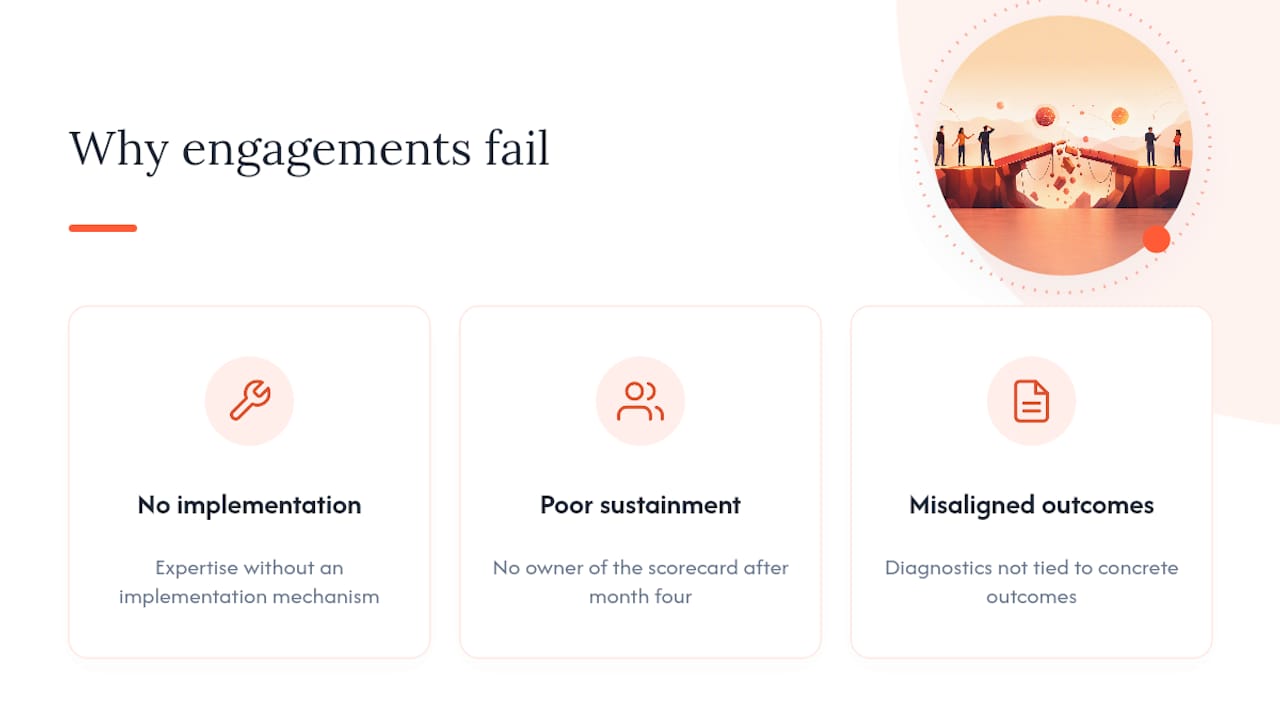
The conventional wisdom says advisory services are about access to expertise, getting a smart outside voice into the room. That's true, but it's incomplete, and it's the incomplete version that gets owners burned. Expertise without an implementation mechanism is just an expensive opinion. The IFC's own advisory model reinforces this at scale: even institutional advisory work ties diagnostics to concrete market-development outcomes, not abstract recommendations.
What gets underrated is sustainment. Owners obsess over picking the right advisor and barely think about who owns the scorecard in month four. That's backwards. The diagnostic is the easy part; a competent advisor can find your operational gaps in two weeks. The hard part is building a cadence that survives without the advisor in the room, and most engagements never plan for that transition at all.
If you take one thing from this, prioritize the handoff mechanism over the pedigree. Ask what happens after day 60 before you ask about credentials. An advisor who can't answer that question clearly isn't ready to work with your team, no matter how polished the pitch deck looks.
— David
Ready to Turn Strategy Into Execution?
If the diagnostic-to-implementation model above sounds like what your business is missing, that gap between "we have a strategy" and "we're getting results" is exactly what TKD Consulting was built to close. The Operations Audit is the entry point for most clients: a structured, time-boxed diagnostic that maps your people, processes, and performance systems, then hands your team a 60-day plan they can run without waiting on a consultant.
If your strategy exists but execution keeps stalling, the Strategy Execution Gap engagement targets that specific breakdown. For businesses that want continued execution support after the initial diagnostic, monthly retainers extend the implementation runway with ongoing scorecards and coaching. The first step for most owners is a paid discovery call to scope which engagement fits. Visit the services overview to see the full range and book a discovery call to get a diagnostic scoped for your business.
Sources
- What is Advisory Services? — Nerac glossary
- Cpa
- Management consulting — Wikipedia
- Advisory Services — International Finance Corporation (IFC)