
The order to cash process (O2C, sometimes written OTC) is the end-to-end workflow that begins the moment a customer places an order and ends when payment is received, applied, and recorded in your general ledger. Every step in between — credit review, fulfillment, invoicing, collections, cash application — either protects your revenue or quietly erodes it. For mid-sized companies, that erosion is rarely dramatic. It shows up as a DSO that creeps up quarter after quarter, invoices that sit disputed for weeks, or a cash position that looks fine on paper but never quite matches what leadership expects.
The O2C cycle is distinct from the broader quote to cash process, which starts earlier in the sales cycle and includes quoting, contract negotiation, and pricing. O2C picks up where QTC leaves off: once the deal is done, O2C owns everything through final payment. That distinction matters operationally because the teams, systems, and failure modes are different.
- O2C scope: Order capture → credit review → fulfillment → shipping → invoicing → accounts receivable → payment collection → cash application → reporting
- QTC scope: Product configuration → pricing → quoting → contracting → then hands off to O2C
Accelerating the O2C cycle directly improves liquidity, letting mid-sized companies avoid costly external financing to cover working capital gaps. When the cycle runs long, cash sits locked in receivables instead of funding operations or growth.
Table of Contents
- What are the core steps in the order to cash cycle?
- Where does revenue leakage actually happen in O2C?
- How does your business model change the O2C workflow?
- Best practices to optimize your order to cash process
- Compliance and regulatory considerations in O2C
- TKD Consulting helps you close the gap between O2C strategy and execution
- Key Takeaways
What are the core steps in the order to cash cycle?
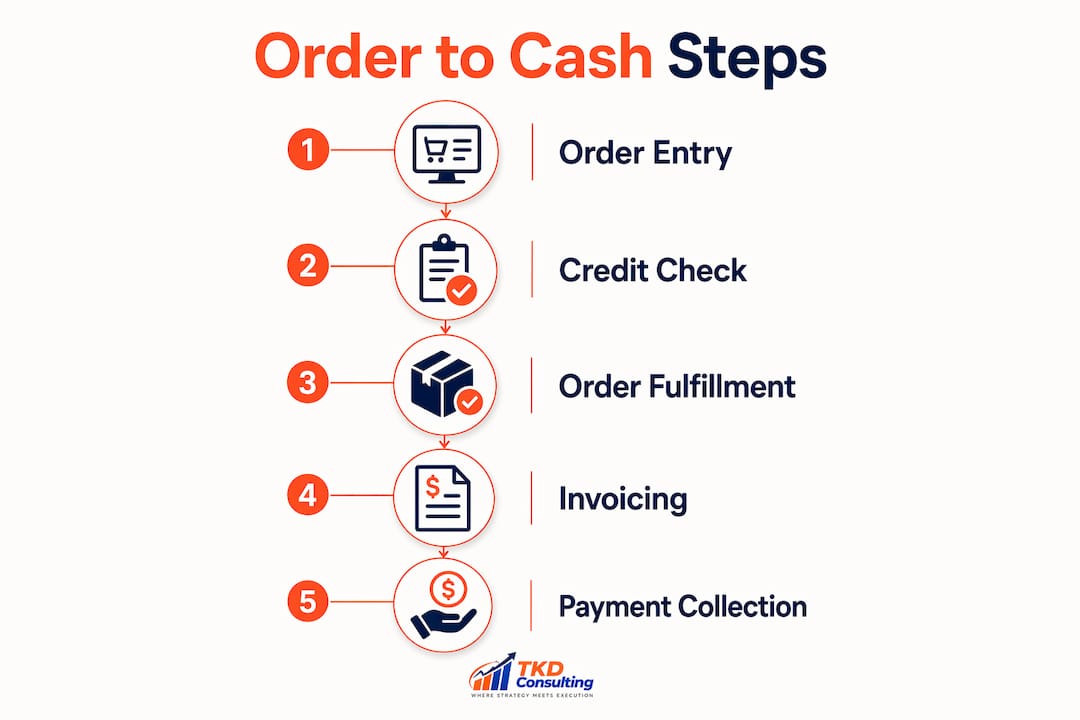
The nine standard O2C steps form a chain where each handoff either preserves or loses value.
- Order capture: The customer's order enters your system — through an e-commerce portal, a sales rep, or a procurement system. Accuracy here determines accuracy everywhere downstream.
- Credit review: Before fulfillment begins, creditworthiness is assessed. This includes credit checks for new customers, setting credit limits, and approving payment terms (net 30, net 60, etc.).
- Order fulfillment: The approved order is picked, packed, or provisioned. For physical goods, this triggers inventory updates; for services or SaaS, it means access provisioning.
- Shipping: The product ships or the service is delivered. Delivery confirmation is logged and communicated to the customer.
- Invoicing: An accurate invoice is generated and sent promptly. The faster it goes out, the faster the payment clock starts.
- Accounts receivable (AR): Your AR team tracks outstanding invoices, monitors aging, and manages payment terms. This is where overdue balances become visible.
- Payment collection: Outreach to customers with outstanding balances. The goal is assertive but relationship-preserving follow-up.
- Cash application: Received payments are matched to the correct invoices and posted to the general ledger. Slow or inaccurate matching here creates a distorted view of your actual cash position.
- Reporting: Cycle data is analyzed to identify delays, disputes, and patterns that inform process improvements.
ERP and order management systems (OMS) support this chain by keeping data synchronized across departments. Without that integration, each step operates on its own version of the truth.
Where does revenue leakage actually happen in O2C?
Most O2C breakdowns don't happen within a single department. They happen at the handoffs between them. Revenue leakage commonly occurs where sales, credit, logistics, and finance pass work to each other without shared visibility or clear ownership.
- Order entry errors: Manual data entry produces wrong quantities, wrong ship-to addresses, or misapplied pricing. Every downstream step inherits the mistake.
- Invoice discrepancies: An invoice that doesn't match the purchase order triggers a dispute. The customer holds payment; your AR team spends days resolving it instead of collecting.
- Cash application delays: When payments arrive without clear remittance information, matching them to open invoices becomes a manual puzzle. Cash application inefficiencies cause repeated collection calls on invoices that are already paid, damaging customer relationships and obscuring your real cash position.
- Siloed systems: When your CRM, ERP, and billing platform don't talk to each other, someone is manually re-entering data at every transition. That's where errors multiply and delays compound.
- Dispute management gaps: Unresolved disputes sit in a queue while no one owns resolution. Days turn into weeks; payment stalls.
Pro Tip: Before you automate anything, map your current O2C flow end-to-end and mark every handoff point. The handoffs where no one has clear ownership are where your revenue is leaking. Fix the process first; then automate the stable version of it.
How does your business model change the O2C workflow?
The O2C process adapts to how your business delivers value. Applying a product-company workflow to a subscription business creates billing chaos. Getting this right is a design decision, not a configuration detail.
- Product-based businesses: Fulfillment is physical. Inventory accuracy, warehouse throughput, and carrier performance all affect cycle time. Invoicing typically follows shipment confirmation.
- Service-based businesses: Fulfillment is the delivery of a defined scope of work. Invoicing may be milestone-based or time-and-materials, which requires tighter project tracking to trigger billing accurately.
- Subscription businesses: Recurring billing, automated renewals, and usage-based proration replace one-time order flows. Revenue recognition follows ASC 606 standards, and failed payment handling (dunning) becomes a critical process in its own right.
The SaaS model illustrates this well: order fulfillment is instant (access provisioning), invoicing is automated, and the AR function shifts toward monitoring churn risk and managing enterprise credit terms rather than chasing individual invoices. A mid-sized SaaS company running a product-company O2C workflow will consistently misfire on billing timing and revenue recognition.
TKD Consulting's diagnostic work with mid-sized companies frequently surfaces this mismatch: the process was designed for one business model and the company evolved into another without updating the workflow.
Best practices to optimize your order to cash process
Optimization starts with diagnosis, not software. Automation amplifies errors when the underlying process is broken. The sequence matters: map, fix, then automate.
Standardize workflows first. Define who owns each handoff, what the acceptance criteria are for passing work to the next step, and what happens when something is out of spec. Documented, followed SOPs cut the most common error types before any technology is involved.
Integrate your systems. CRM, ERP, and billing platform integration eliminates manual re-entry and gives every department a single version of order and payment data. This is the single highest-leverage technology investment in O2C.

Manage credit proactively. Set credit limits based on data, review them on a defined cadence, and enforce them consistently. A customer who exceeds their limit and ships anyway creates a collection problem that no AR process can fully recover.
Monitor the right KPIs. Days sales outstanding (DSO), invoice aging, and cash application speed are the three metrics that tell you where the cycle is breaking down. Track them weekly, not monthly.
| KPI | What it measures | Target direction |
|---|---|---|
| Days Sales Outstanding (DSO) | Average days to collect payment after invoicing | Lower is better |
| Invoice aging (30/60 days) | Distribution of outstanding receivables by age | Minimize 60+ day buckets |
| Cash application speed | Time from payment receipt to ledger posting | Faster reduces collection errors |
| Dispute rate | Percentage of invoices that generate a dispute | Lower indicates billing accuracy |
| Order-to-invoice time | Days from order capture to invoice sent | Shorter accelerates payment clock |
Pro Tip: TKD Consulting's Operations Audit maps your O2C workflow against your actual performance data and delivers a prioritized 60-day action plan — not a slide deck. The engagement includes the accountability mechanisms that keep improvements from reverting after the engagement ends.
A revenue audit can also surface AR and collections gaps that internal teams often miss because they're too close to the day-to-day process.
Compliance and regulatory considerations in O2C
The O2C cycle carries real compliance exposure that mid-sized companies often underestimate until an audit or a customer dispute forces the issue.
Revenue recognition is the most consequential. Under ASC 606 (the US GAAP standard for revenue from contracts with customers), revenue is recognized when performance obligations are satisfied, not when cash is received. For companies with multi-element arrangements, subscriptions, or milestone-based contracts, this means your invoicing timing and your revenue recognition timing may differ. Getting this wrong creates restatement risk.
Tax compliance compounds across jurisdictions. If you sell across state lines, economic nexus rules under South Dakota v. Wayfair may require you to collect and remit sales tax in states where you have no physical presence. Your invoicing system needs to apply the correct tax rate at the point of invoice generation, not as a manual adjustment after the fact.
Data and payment security apply throughout the collection and cash application steps. If you process card payments, PCI DSS compliance governs how payment data is stored and transmitted. A breach in your payment workflow creates liability that extends well beyond the transaction itself.
Audit trails matter for both internal controls and external audits. Every order modification, credit approval, invoice adjustment, and payment posting should carry a timestamp and a user ID. Without that trail, disputes with customers and auditors become significantly harder to resolve.
TKD Consulting helps you close the gap between O2C strategy and execution
Most mid-sized companies know their O2C cycle has problems. The harder part is knowing exactly where the leakage is, what to fix first, and how to make the fix stick when the consultant leaves.
TKD Consulting, founded by David Karpatkin, works with $5–50M industrial, B2B services, and SaaS companies that are generating revenue but not capturing all of it. The Operations Audit is a structured diagnostic that maps your people, processes, and systems against your stated goals, then delivers a prioritized 60-day action plan your team can execute on Monday morning. Every engagement includes the scorecards, meeting cadences, and accountability frameworks that keep improvements from evaporating. If your O2C cycle is leaking cash and you're not sure where to start, book a discovery call with TKD Consulting to get a clear picture of what's broken and what to fix first.
Key Takeaways
A well-run order to cash process is the difference between revenue on paper and cash in the bank — and the gap almost always lives at the handoffs between departments.
| Point | Details |
|---|---|
| O2C vs. QTC scope | O2C starts at order placement; QTC starts earlier at quoting and contracting. |
| Leakage lives at handoffs | Revenue loss most often occurs between sales, credit, logistics, and finance — not within a single team. |
| Automate last, not first | Automation amplifies broken processes; map and fix workflows before deploying technology. |
| Three KPIs to watch | DSO, invoice aging, and cash application speed reveal where the cycle is breaking down. |
| TKD Consulting's approach | The Operations Audit delivers a prioritized 60-day action plan with built-in accountability to make O2C improvements last. |