
Gong is the stronger platform for mid-market and enterprise sales teams that treat conversation intelligence as a strategic investment. Chorus is the right call for teams already paying for ZoomInfo who need solid call recording and coaching without a separate vendor relationship. That is the short version. Here is what actually drives the decision:
- Gong leads on AI deal intelligence, transcription accuracy, revenue forecasting, and pipeline visibility. Its feature set has expanded well beyond call recording into a full revenue intelligence layer.
- Chorus wins on price, especially when bundled into a ZoomInfo enterprise contract. Deployment is faster, and the native ZoomInfo data enrichment is a genuine advantage for teams already in that ecosystem.
- Feature gap: The gap has widened since ZoomInfo acquired Chorus in 2021 for $575 million. Gong has invested aggressively in AI; Chorus has slowed.
- Implementation: Gong typically requires a longer ramp for larger teams. Chorus gets teams operational faster.
- Budget reality: Neither platform offers a free tier. Both require annual contracts and enterprise budgets.
If your RevOps team needs deal-level AI, forecasting, and coaching scorecards, budget for Gong. If Chorus is already in your ZoomInfo contract, use it.
Table of Contents
- How do Gong and Chorus actually compare on features?
- What does each platform actually cost?
- How should you choose between Gong and Chorus?
- What is the difference between conversation intelligence and revenue intelligence?
- Expert perspective on picking the right platform
- How this comparison was built
- Key Takeaways
- What TKD Consulting offers sales teams evaluating these platforms
How do Gong and Chorus actually compare on features?
The two platforms share a common foundation: call recording, transcription, AI-driven analysis, and CRM sync. Where they diverge is depth, accuracy, and how far beyond the call they go.

| Feature | Gong | Chorus | Best For |
|---|---|---|---|
| AI deal intelligence | Advanced: deal boards, risk scoring, MEDDIC extraction | Basic: call-level deal tracking | Gong: revenue-focused teams |
| Revenue forecasting | Full AI-powered forecast layer | Limited pipeline insights | Gong: CROs and RevOps |
| Transcription accuracy | Best in class across accents and technical terms | Inconsistent, especially with accents | Gong: coaching-dependent teams |
| Coaching tools | Scorecards, talk patterns, initiative tracking, peer benchmarks | Coaching playlists, time-stamped feedback | Gong: structured coaching programs |
| CRM integration | Multiple integrations and automated data extraction | Salesforce native, tight ZoomInfo sync | Chorus: ZoomInfo SalesOS customers |
| ZoomInfo data enrichment | API only | Native auto-enrichment | Chorus: ZoomInfo ecosystem |
| Ease of use | Polished UI, strong search | Functional but dated interface | Gong: adoption at scale |
| Innovation pace | Rapid feature releases since 2023 | Slower post-acquisition | Gong: long-term platform bet |
| G2 rating | 4.7/5 (5,800+ reviews) | 4.5/5 (2,280+ reviews) |
Gong's core strengths
Gong's most distinctive capability is what happens after the call. Its AI extracts structured data from conversations, including MEDDIC fields, stakeholder maps, and next steps, and writes them directly to your CRM. That is not basic call logging. It means your pipeline data reflects what reps actually said, not what they typed in after the fact. Gong can also identify deal risks weeks before they surface in manual CRM forecasts, flagging signals like a decision-maker going quiet or a competitor getting mentioned twice in the same week.
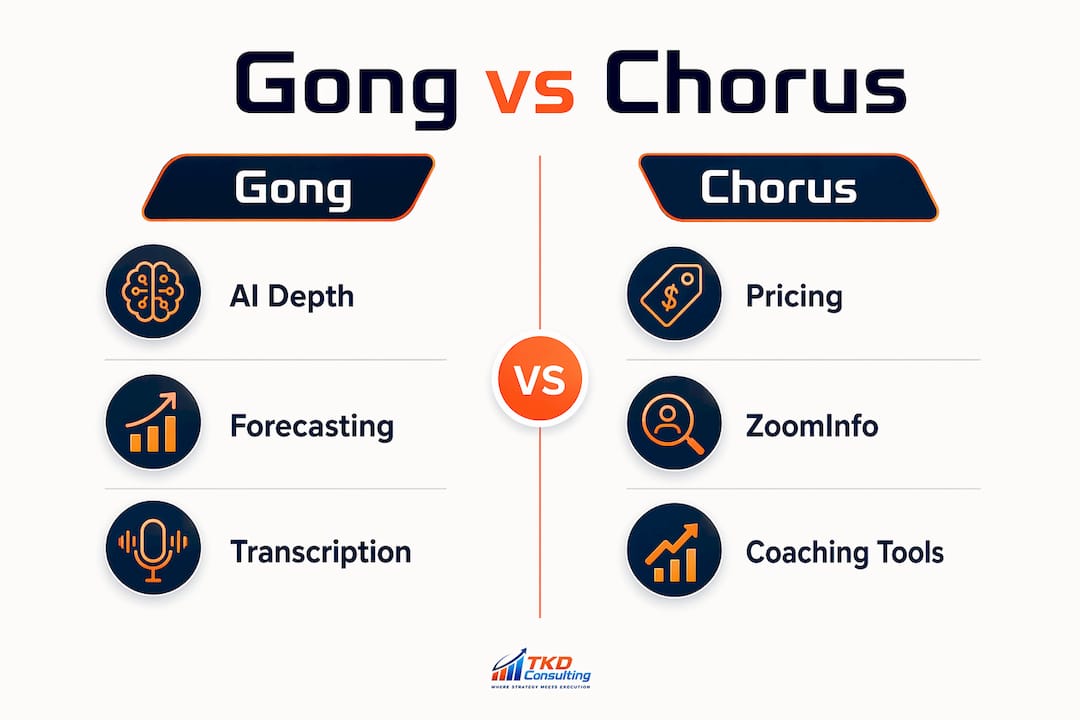
Transcription quality underpins everything else. Gong leads on accuracy across multi-speaker calls, technical terminology, and non-native English speakers. When the transcript is wrong, every AI insight built on top of it is wrong too. That is the practical reason transcription accuracy matters more than it sounds in a feature comparison.
Where Chorus holds its ground
Chorus holds 14 proprietary machine learning patents for conversation analysis, which supported genuinely differentiated coaching features before the ZoomInfo acquisition slowed development. Its structural advantage today is the native ZoomInfo integration. When Chorus records a call, it automatically matches participants against ZoomInfo's contact and company database, attaching firmographic, intent, and technographic context to the call record in real time. No standalone tool replicates that natively. For sales teams that live inside ZoomInfo SalesOS, that enrichment is built into every conversation without any manual work.

The coaching library tools are also practical. Managers can clip moments from calls, add time-stamped comments, and share them with reps quickly. It works. It just does not deliver the predictive analytics or pattern recognition that Gong's coaching layer provides.
What does each platform actually cost?
Neither Gong nor Chorus publishes pricing publicly. Both require a sales conversation before you see a number, which tells you something about the buyer they are targeting.
- Gong charges a platform fee plus a per user fee annually. Implementation fees for enterprise deployments may also apply, leading to substantial total annual cost for mid-sized sales teams.
- Chorus starts with a base annual fee for a small number of users plus additional per user fees. For mid-sized teams, standalone costs are generally less than those of Gong.
The real pricing story is the ZoomInfo bundle. If Chorus is included in your ZoomInfo enterprise contract, the marginal cost can be close to zero. That changes the math entirely.
Key cost considerations:
- Gong's platform fee is non-negotiable at the low end but can be negotiated for larger deployments. Mid-size teams should push hard on that fee before signing.
- Chorus bundled with ZoomInfo Sales Advanced or Sales Elite is dramatically cheaper than Gong as a standalone line item.
- Neither platform offers monthly billing. Both require annual contracts, so the switching cost is real.
- Teams that switch from Gong to Chorus to cut costs frequently report losing visibility into deal health. That revenue impact is harder to quantify upfront but shows up in win rates.
Pro Tip: Before signing either contract, ask specifically about platform fees, minimum user counts, implementation costs, and training fees. These are where the "hidden" costs live, and both vendors will not volunteer them unless you ask directly.
How should you choose between Gong and Chorus?
The decision comes down to one question: is conversation intelligence a core strategic asset for your revenue team, or a supporting feature bundled into your existing data platform?
If it is strategic, the answer is almost always Gong. If it is a checkbox, Chorus bundled with ZoomInfo is good enough and meaningfully cheaper.
Here is how to work through the evaluation:
- Organizational size and rep count: Gong makes the most sense for teams with 20 or more reps and a dedicated RevOps or sales enablement function that will actually use the data. Smaller teams often find the cost outweighs the benefit.
- Existing tech stack: If ZoomInfo is already in your stack and Chorus is available at a discount or included, the burden of proof shifts to Gong. You need to quantify what the additional AI depth is worth in pipeline terms.
- Forecasting needs: If your CRO relies on accurate pipeline forecasting and deal health visibility, Gong's AI forecasting layer is a material advantage. Chorus does not offer a comparable standalone forecasting capability.
- Adoption readiness: Gong's interface is more polished and tends to drive higher adoption. Chorus's dated UI leads to lower rep engagement, which undermines the coaching value. A tool nobody uses has no ROI regardless of price.
- Implementation timeline: Chorus deploys faster. If your team needs to be operational quickly, that matters. Gong's full operationalization for larger teams requires internal alignment across sales leadership, enablement, and RevOps.
Pro Tip: Run demos with both vendors and bring your RevOps lead, a frontline sales manager, and your IT or systems admin into the room. The feature that looks impressive in a vendor demo often looks different when your actual CRM admin is asking about the API. Get all three perspectives before you commit.
Adoption and change management are consistently underestimated. Buying either platform without a plan for how managers will use coaching data, how reps will be held accountable, and how the tool connects to your operational rhythms is how you end up with an expensive recording library nobody checks.
What is the difference between conversation intelligence and revenue intelligence?
Both Gong and Chorus started as conversation intelligence tools. The category distinction matters for understanding what you are actually buying.
Conversation intelligence records, transcribes, and analyzes sales calls using AI. It surfaces topics discussed, questions asked, competitor mentions, customer sentiment, talk-to-listen ratios, and coaching moments. Both platforms do this.
Revenue intelligence goes further. It connects conversation data to pipeline, deal progression, and forecasting to give revenue leaders a real-time view of deal health across the entire book of business. The core difference is that revenue intelligence answers the question "which deals are at risk and why?" not just "what happened on that call?"
Typical features by category:
- Conversation intelligence: Call recording and transcription, keyword tracking, coaching playlists, post-call summaries, CRM call logging
- Revenue intelligence: Deal health scoring, AI-powered forecasting, MEDDIC field extraction, stakeholder mapping, pipeline inspection, competitive trend analysis across thousands of calls
Gong repositioned itself as a Revenue Intelligence platform and has built aggressively toward that definition. Its deal intelligence and forecasting capabilities now operate at a level that goes well beyond what conversation intelligence tools typically offer. Chorus remains primarily a conversation intelligence tool, tightly embedded within the ZoomInfo data ecosystem, with deal tracking features that cover the basics but do not reach Gong's depth.
The practical implication: if your team needs the revenue intelligence layer, Gong is the only one of the two that actually delivers it.
Expert perspective on picking the right platform
The most useful framing from analysts who cover this space is not "which platform is better" but "what role does this tool play in your go-to-market motion?"
That framing cuts through most of the feature comparison noise. A few additional considerations that often get missed:
- The bundling trap: "Free" Chorus inside a ZoomInfo contract is not actually free if inferior deal intelligence costs you pipeline visibility. Calculate the revenue impact of better coaching and forecasting before defaulting to the bundled option.
- Vendor update cadence: Gong has released features aggressively since 2023, expanding from call analysis into pipeline forecasting and deal health analytics. Chorus development has slowed under ZoomInfo ownership as resources shifted to core data products. Buying a platform is a multi-year commitment, and roadmap pace matters.
- Support quality: Multiple user reviews note that support quality dropped after the ZoomInfo acquisition of Chorus. That is worth asking about directly in your sales process, not just reading about in G2 reviews.
- Contract negotiation: Gong's licensing structure often bundles features in ways that make lean configurations hard to purchase. Negotiating the platform fee is where mid-size teams can find the most room.
- Adoption is the real ROI driver: The measurement culture your team builds around either platform determines whether you get value from it. A coaching framework that managers actually follow beats a sophisticated AI tool that sits unused.
For teams evaluating analytics adoption best practices alongside platform selection, the organizational readiness question is as important as the feature comparison.
How this comparison was built
This comparison draws on published pricing data, G2 ratings, third-party battlecards, and RevOps analyst reporting from 2025 and 2026. Feature assessments reflect publicly documented capabilities and consistent patterns across user reviews, not vendor marketing claims. Pricing figures come from third-party estimates where vendors do not publish public pricing, and are cited to their sources. No proprietary test data or invented benchmarks were used. Where sources disagreed on a figure, the more conservative or more frequently corroborated number was used.
The goal was a comparison that a revenue operations leader could hand to a CFO or CRO and stand behind, not one that reads like a vendor's own battlecard.
Key Takeaways
Gong wins on features, AI depth, and forecasting; Chorus wins on price and ZoomInfo integration, making the right choice a function of your ecosystem and how central conversation intelligence is to your revenue motion.
| Point | Details |
|---|---|
| Gong leads on AI and depth | Deal intelligence, forecasting, and transcription accuracy are materially better than Chorus across every major comparison. |
| Chorus wins on price | Chorus standalone costs are generally less than Gong for mid-sized teams, with bundled ZoomInfo pricing widening that cost gap. |
| Ecosystem fit drives the decision | Chorus's native ZoomInfo enrichment is a structural advantage no standalone tool replicates; Gong's many integrations serve teams outside that ecosystem. |
| Adoption determines ROI | Either platform fails without internal alignment on coaching processes, manager accountability, and data-driven execution habits. |
| TKD Consulting | Helps sales and operations teams build the execution infrastructure needed to get real value from platforms like Gong or Chorus after the contract is signed. |
What TKD Consulting offers sales teams evaluating these platforms
Buying Gong or Chorus is the easy part. Getting your managers to actually coach from the data, your reps to change their behavior, and your RevOps team to connect call insights to pipeline decisions, that is where most implementations stall.
TKD Consulting works with mid-market sales and operations teams that have the tools but not yet the execution infrastructure to make them pay off. David Karpatkin has personally run sales teams to quota and built commercial infrastructure from scratch, so the advice comes from someone who has lived the execution gap, not just diagnosed it from a slide deck. The flagship Operations Audit maps your people, processes, and performance systems against your stated goals, then delivers a 60-day action plan your team can execute starting Monday. If you are about to sign a six-figure conversation intelligence contract and want to make sure your organization is actually ready to use it, that is exactly the conversation TKD Consulting is built for. Book a discovery call at tkdconsult.com.